Engines: ONS, with a working volume of 2.4 l, V6 with a working volume of 2.8 l, diesel up to 8/94, V6 with a working volume of 2.9 l without a catalytic converter
To compensate for various thermal expansions, the valve drive must have certain clearances.
If the clearances are too small, the valve timing changes, compression is poor, engine power drops, and its operation becomes uneven. In extreme cases, the valves may warp or burn out, as well as the valve seats.
If the clearances are too large, a strong mechanical noise occurs. The valve timing changes, due to the shorter valve opening time and the resulting poor filling of the cylinders, the engine power drops and its operation becomes uneven.
The clearances in the valve drive of the named engines must be checked and, if necessary, adjusted during maintenance and after repairs.
Note: For DOHC engines and all other engines manufactured since 9/94 (SCORPIO II), valve clearances are maintained constant by hydraulic compensators and do not require adjustment.
The clearances in the valve drive are checked and adjusted accordingly when the engine is cold (at an ambient temperature of +20°C).
Adjusting the clearances in the valve drive gives a positive result only if the valves are perfectly sealed on the seats, there are no too large clearances in the guides, and the ends of the valve stems are not broken.
Engine ONS
Remove the air filter, see p. 57.
Remove the spark plug caps.
Remove the cylinder head cover.
Apply the handbrake, shift the gearbox into neutral. Turn the engine crankshaft by the central belt pulley mounting bolt in the direction of its rotation so that the camshaft cam at the corresponding valve is directed upward.
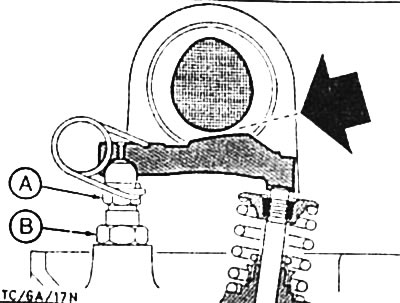
The clearance in the valve drive is measured using a feeler gauge between the cam and the pressure lever "arrow". The feeler gauge should pass into the gap, simultaneously tightly touching both parts.
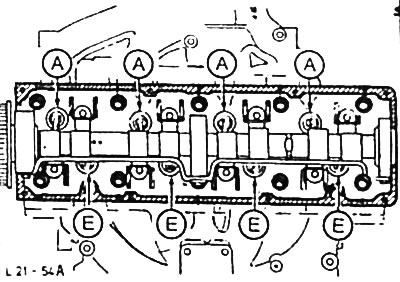
Caution: Do not confuse the inlet and outlet valves.
- Clearance for intake valves (E): 0.20±0.03 mm
- Clearance for exhaust valves (A): 0.25±0.03 mm
If the clearance is not within the specified value, it must be adjusted using the ball-head adjusting bolt "A" (Figure TC/6A/17N).
Hold the spherical head bolt "A" with a special key (HAZET 3429) and loosen the lock nut "B" with a flat key (HAZET 3429-5) (Figure TC/6A/17N). Then turn the spherical head bolt until the clearance reaches the specified value. Then, while holding the spherical head bolt, tighten the lock nut to a torque of 55 Nm.
Check the valve drive clearances again.
Install the cylinder head cover with a new sealing gasket and tighten the mounting bolts in the correct sequence to the specified torque value, see p. 15.
Engines: with a displacement of 2.4 liters, V6 with a displacement of 2.8 liters, V6 with a displacement of 2.9 liters without catalytic converter
Remove the air filter together with the suction hose, see p. 59.
Remove the spark plug caps.
Remove the cylinder head cover.
Apply the handbrake, shift the gearbox to neutral. Turn the engine crankshaft by the central bolt securing the belt pulley in the direction of its rotation so that the TDC "0" mark on the pulley coincides with the mark on the crankcase.
Apply 3 marks on the belt pulley with chalk at 120° intervals.
By turning the crankshaft slightly back and forth, check whether the valves of cylinders 1 or 5 are in the overlap phase. This means that the exhaust valve is currently closing (it moves up) and the intake valve is currently opening (it moves down).
Turn the crankshaft 120° each time and follow the sequence below to check or adjust the valve clearances accordingly.
- 5th cylinder: overlap - 1st cylinder: adjustment
- 3rd cylinder: overlap - 4th cylinder: adjustment
- 6th cylinder: overlap - 2nd cylinder: adjustment
- 1st cylinder: overlap - 5th cylinder: adjustment
- 4th cylinder: overlap - 3rd cylinder: adjustment
- 2nd cylinder: overlap - 6th cylinder: adjustment
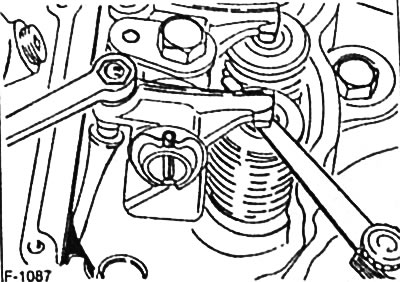
The valve drive clearance is measured using a feeler gauge between the rocker arm and the valve. The feeler gauge should fit into the gap, touching both parts tightly at the same time.
Caution: Do not confuse the inlet and outlet valves.
Location of intake and exhaust valves:
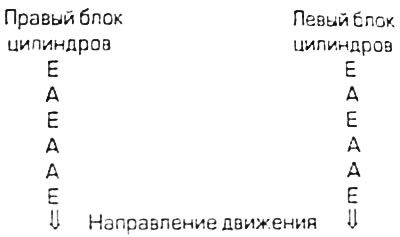
- Inlet valve clearance (E): 0.35 mm
- Clearance for exhaust valves (A): 0.40 mm
If the clearance does not correspond to the prescribed value, it is necessary to loosen the lock nut and adjust the clearance using the adjusting screw on the rocker arm.
Tighten the lock nut.
Check the valve drive clearances again.
Install the cylinder head cover with a new sealing gasket and tighten the mounting bolts.
Diesel engine up to 8/94
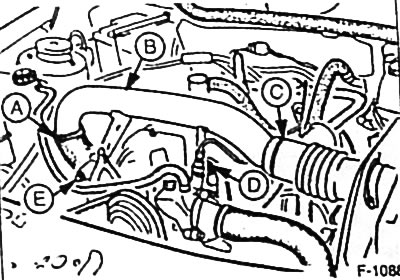
Turbocharged diesel engine Loosen the clamps and disconnect the suction hose "A" at the turbocharger and the connecting air hose "C". Unscrew the mounting nut "C" on the cylinder head, the mounting bolt "E" on the intake manifold and remove the intake manifold "B".
Diesel engine without turbocharging remove air filter.
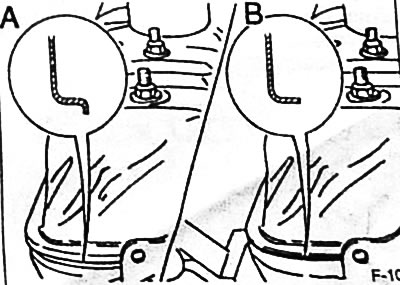
Remove the cylinder head cover.
Please note. Since 10/87, a new cylinder head cover with a reusable silicone sealing gasket has been installed. The cover is identified by the absence of a flange on the sealing surface "B". Therefore, when removing the cover, care must be taken to ensure that the silicone gasket is not damaged.
Apply the handbrake, shift the gearbox to neutral. Turn the engine crankshaft by the central bolt securing the belt pulley in the direction of its rotation so that the TDC "0" mark on the pulley coincides with the mark on the crankcase.
By turning the crankshaft slightly back and forth, check whether the valves of cylinders 1 or 4 are in the overlap phase. This means that the exhaust valve is currently closing (it moves up) and the intake valve is currently opening (it moves down).
Turning the crankshaft each time after checking the clearance and following the sequence given below, check or adjust the clearances in the valve drive of other cylinders accordingly.
- 1st cylinder: overlap - 4th cylinder: adjustment
- 3rd cylinder: overlap - 2nd cylinder: adjustment
- 4th cylinder: overlap - 1st cylinder: adjustment
- 2nd cylinder: overlap - 3rd cylinder: adjustment
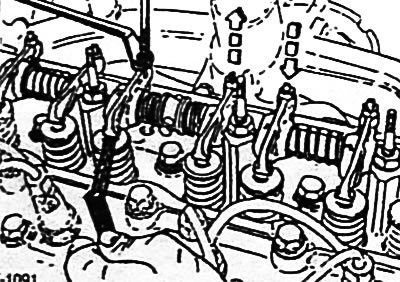
The valve drive clearance is measured using a feeler gauge between the rocker arm and the valve. The feeler gauge should fit into the gap, touching both parts tightly at the same time.
Caution: Do not confuse the inlet and outlet valves.
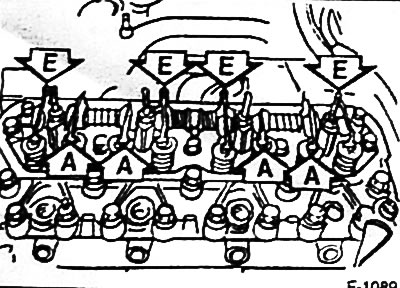
Inlet valve clearance (E):
- naturally aspirated engine: 0.30-0.35 mm
- turbocharged engine: 0.10-0.20 mm
Clearance for exhaust valves (A):
- naturally aspirated engine: 0.30-0.35 mm
- turbocharged engine: 0.20-0.30 mm
If the clearance does not correspond to the prescribed value, it is necessary to loosen the lock nut and adjust the clearance using the adjusting screw on the rocker arm.
Tighten the lock nut.
Check the valve drive clearances again.
Model up to 9/87: Install the cylinder head cover with a new gasket.
Model 10/87: Attach the cylinder head cover with the reusable sealing gasket.
Tighten the cylinder head cover mounting bolts to a torque of 3 Nm.