2. If there is no stand, you can disassemble the engine by securing it to a strong workbench or on its butt. Be extremely careful not to tip the engine over.
3. If you are going to buy a remanufactured engine, all external components must be removed first to install them on such an engine. Such components include the following:
- a) Generator and brackets (Chapter 5A)
- b) High-voltage wires and spark plugs (chapter 1 and 5B)
- c) Thermostat and its housing (Chapter 3)
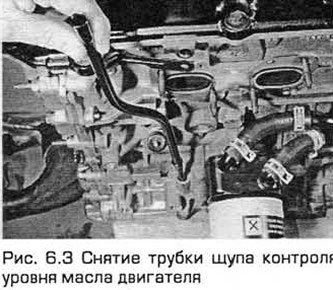
- d) Oil level control dipstick branch pipe (see Fig. 6.3).
- d) Components of the fuel injection system (Chapter 4)
- e) All electrical switches and sensors (see relevant chapter)
- g) Intake and exhaust manifolds (chapter 2A or 2B)
- c) Oil filter (chapter 1).
- i) Brackets of power unit supports (chapter 2A or 2B)
- c) Flywheel/faceplate (chapter 2A or 2B).
Note: When removing units and parts from an old engine, note everything that may be useful in the future during assembly: where and how gaskets, sealing rings, spacers, pins, washers, bolts and other important "little things" are installed.
4. If you purchased an engine assembly kit containing the cylinder block/crankcase, crankshaft and connecting rod and piston assemblies, then you will also need to remove the cylinder head, sump, oil pump and timing belt (4-cylinder engines) or chains (V-shaped 6-cylinder engines) from the old engine.
5. If you decide to repair the engine yourself, disassemble the engine and remove the external components in the following order:
- a) Intake and exhaust manifolds (chapter 2A or 2B).
- b) Toothed belt and toothed pulleys (4-cylinder engines) or chains (V-shaped 6-cylinder engines) of the valve timing mechanism (chapter 2A or 2B).
- c) Cylinder head(s) (head 2A or 2B).
- d) Flywheel/faceplate (chapter 2A or 2B).
- c) Pallet (chapter 2A or 2B).
- e) Oil pump (chapter 2A or 2B).
- g) Connecting rod and piston groups (paragraph 13)
- c) Crankshaft (paragraph 11).
6. Before starting disassembly and repair, it is necessary to purchase the appropriate equipment.