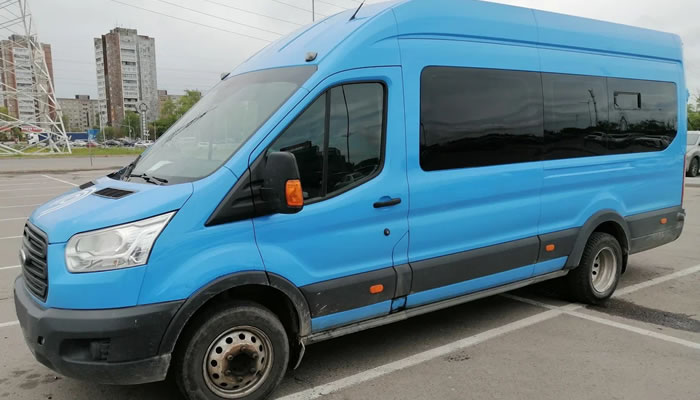
The Ford Transit is a family of light commercial vehicles produced by the American Ford Motor Company from 1965 to the present. Mostly it is a cargo van, but there are vehicles of other form factors: a minibus (since 1995 Ford Tourneo), shortened frame van chassis and pickup truck. As of 2020, more than 10 million units have been produced.
The engine has always been located in the front. At first, the drive was only on the rear wheels, which can still be selected today; in 1977, all-wheel drive appeared, and since 2000, it has been produced with front-wheel drive. The predecessors of this car were "Ford Thames 400E", produced by the European division of Ford, so the Transit was not sold in the United States, where it was until 2015 "Ford E-Series". This reflects the Transit's success in Europe, where it has been the best-selling light commercial vehicle for forty years.
The closest competitors of the Transit are cars from other manufacturers, such as BYD T3, Citroën Jumper, Chevrolet Express, Fiat Ducato, Hyundai Starex, Iveco Daily, Kia Carnival,
Mazda Bongo,
Mercedes-Benz Sprinter, Mitsubishi Delica, Nissan NV200,
Opel Vivaro, Peugeot Boxer, Renault Trafic, Toyota HiAce,
VW Transporter,
VW LT.
First generation (1965-1986)
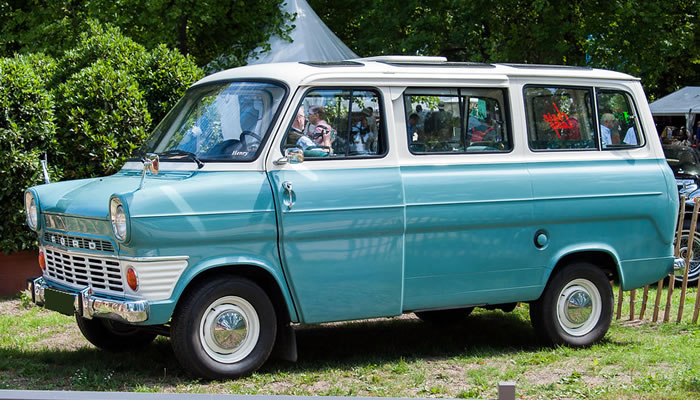
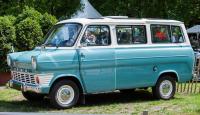 Transit 1965 of the year, minibus
The first generation was introduced in October 1965 in the United Kingdom, replacing the Thames 400E. At first, production was at Ford's Langley plant, but the production capacity of that plant was not sufficient, so it was moved to Southampton (England), where the car was produced until 2013. There was also production in Belgium, the Netherlands and Turkey. The wide track and American design gave an advantage over the European competitors of that time, and there was also a large selection of bodies — pickups, minibuses, vans with long and short wheelbases, and others.
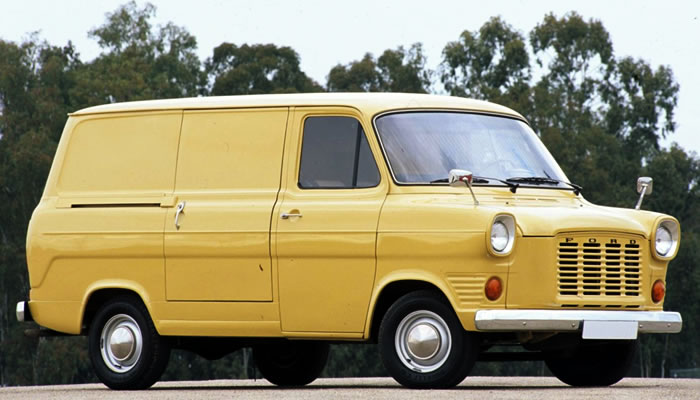
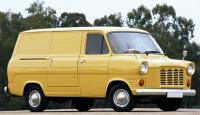 Transit 1971 of the year, van
This generation was the longest-running Transit, remaining virtually unchanged for 12 years until its 1977 update, with only one minor facelift during that period, in 1971, when only the grille was changed. Thus, production of this platform continued for over 20 years. In 1986, it was finally replaced by the new VE6 platform. The Transit was produced in two wheelbase variants: a short wheelbase with a payload capacity of 610 kg to 1,120 kg, and a long wheelbase with a payload capacity of 1,272 kg to 1,782 kg.
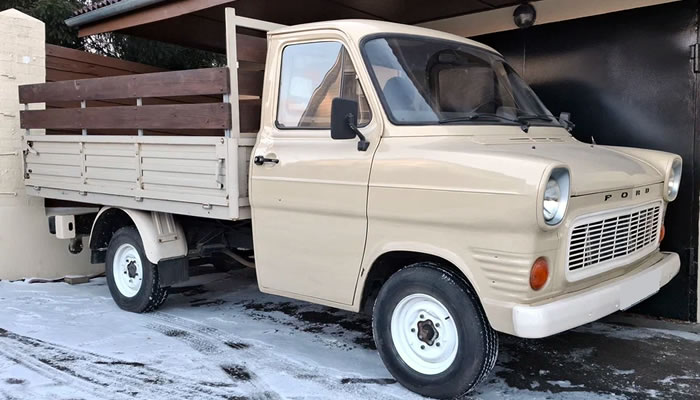
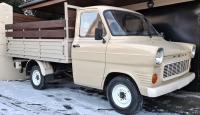 Transit 1976 of the year, pickup
The initial version of the Transit was equipped with 1.7-liter Essex V4 petrol engines producing 74 hp or 2.0-liter engines producing 86 hp, while the first diesel engine was a Perkins 4/99 producing 44 hp. A six-cylinder V6 producing 148 hp was also used for the long-wheelbase version. V-shaped engines were shorter than in-line engines, which allowed for a shorter engine compartment. The first diesel engine in 1968 was "Perkins 4/99" 1.8-liter engine with 44 hp. In 1972, Ford introduced the first small-sized diesel engine called "York" with a volume of 2.4 liters, which was available in two power variants: 55 hp for the short wheelbase and 62 hp for the long wheelbase.
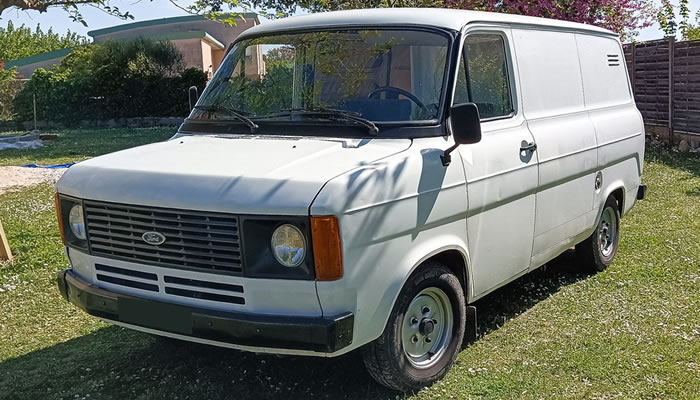
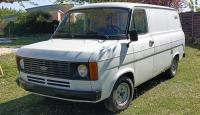 Transit 1980 of the year, restyling
In 1976, production of the model crossed the one million mark. In 1977 a major renovation was carried out. The hood has become more streamlined, the underhood space has been optimized for the installation of new overhead camshaft (OHC) engines, a new Ford C3 automatic transmission, and a more powerful heater. In 1982, a version with all-wheel drive appeared in Germany. In 1984, a 2.5-liter diesel engine with fuel injection and 68 hp was introduced. In 1985, the two-millionth Transit rolled off the assembly line.
Second generation (1986-2000)
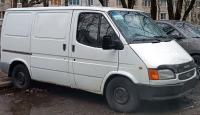 Transit 1993 of the year, вид спереди
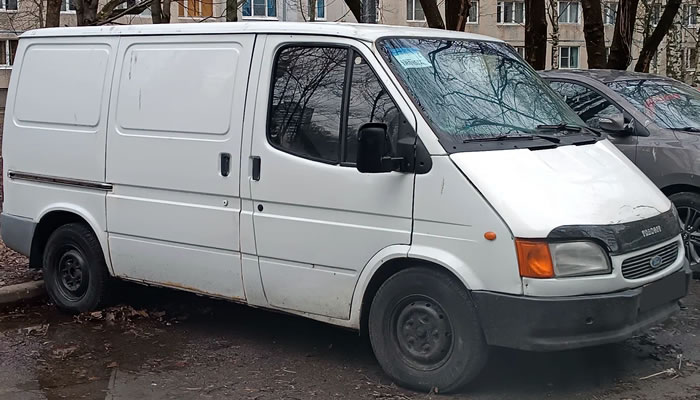
In January 1986, a completely new Transit, based on the VE6 platform, was released. Its appearance was very different from its predecessor. The windshield and hood were not positioned at an angle to each other, but formed almost a single line. Thanks to this, the drag coefficient became Cd=0.37, which was better than many competing cars of that time. This solution also improved safety in a frontal collision and made it easier to access the engine for maintenance. Usable cargo space has increased by an average of 13%. Access to cargo has also been improved thanks to wider and higher rear doors and an increased side door width for a 1-metre-wide pallet.
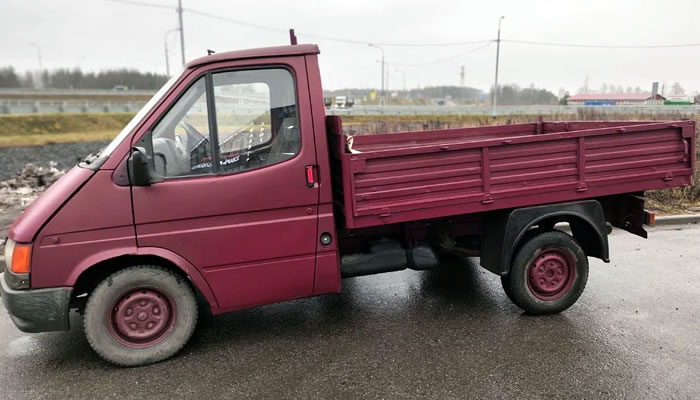
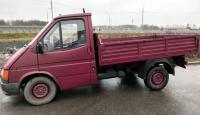 Transit 1995 of the year, pickup
Short-wheelbase models began to use MacPherson strut front suspension and rack and pinion steering. On long-wheelbase models, the dual rear wheels were removed, and 15-inch wheels became standard. The engine was located at the front with drive to the rear wheels. The engine lineup remained virtually unchanged from the previous generation after the 1977 facelift. In 1989, the 3.0-litre Essex V6 petrol engine was replaced by a 2.9-litre unit "Cologne EFI V6" due to environmental regulations. In 1991, two 2.5-liter diesel engines were added, one turbocharged with 100 hp and one naturally aspirated with 80 hp.
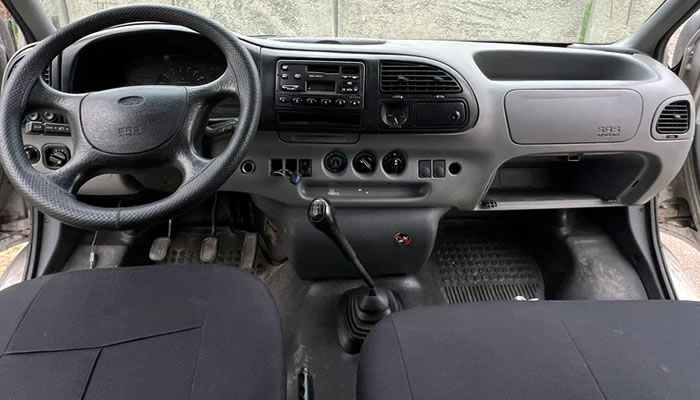
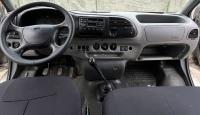 Transit 1994 of the year, интерьер
In 1994, this generation was modernized. The noise level was reduced by 5 dB, the safety level was increased on the chassis with a cabin, central locking, air conditioning, electric windows, electric mirrors, airbags were added, and the dashboard was updated. In 1995, the seat belts for rear passengers in minibuses became three-point lap and diagonal. In 1996, a 17-seat minibus with an increased level of passenger safety appeared. In 1997, production of the Transit began in Vietnam, and the first Chinese-made Transit was produced by JMC.
Third generation (2000-2014)
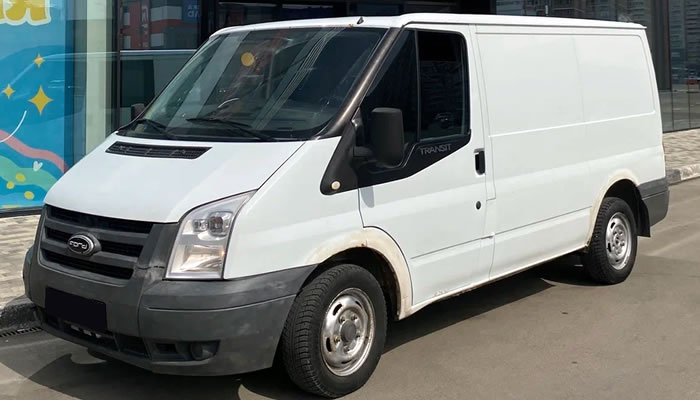
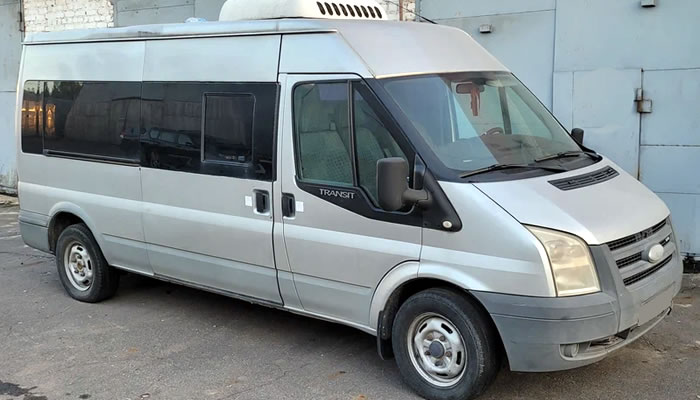
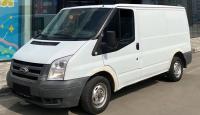 Transit 2008 of the year, van
The third generation was introduced in July 2000. The front-wheel drive model, codenamed "V185," was introduced, while the rear-wheel drive model was coded "V184." The following body styles were available: 3-door van, 2-door pickup, 4-door minibus, and 2-door cab-chassis. The vehicle was developed by Ford of America. The 4 millionth model was produced in 2000. In 2001, he received the "International Van of the Year" award and won the prestigious "Arctic Van Test". Production was carried out at the Ford assembly plant in Genk (Belgium).
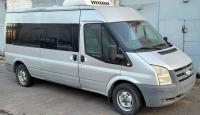 Transit 2009 of the year, minibus
Gasoline engines were initially presented in two models - 4-cylinder in-line engines with a volume of 2.0 liters (1998 cm³, 136 hp) and 2.3 liters (2295 cm³, 145 hp). The Duratorq TDCi diesel engines with the Common Rail system were 4-cylinder with a volume of 2.2 liters (2179 cm³, 86-140 hp) and 2.4 liters (2402 cm³, 101-140 hp), as well as a 5-cylinder in-line engine with a volume of 3.2 liters (3198 cm³, 200 hp). The gearbox was a 5-speed manual "Ford MT75", 6-speed manual "MT-82" (since 2004) and a 5-speed automatic "Durashift-EST".
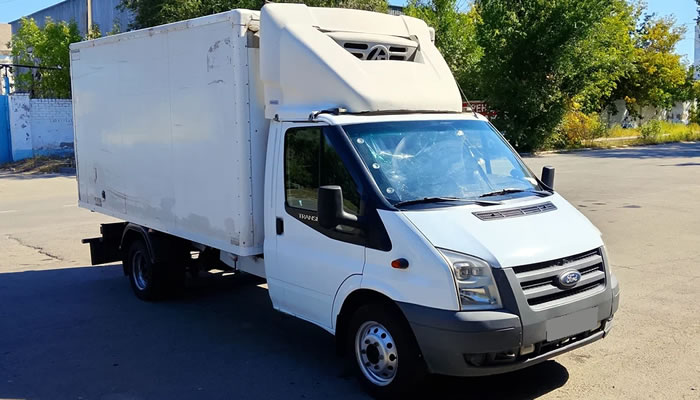
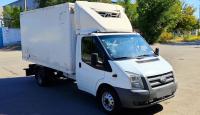 Transit 2010 of the year, truck
In 2003, a dashboard with a digital odometer appeared. In 2005, the five-millionth Transit was produced, and that same year, on the TV show "Top Gear," race car driver Sabine Schmitz lapped the Nürburgring in a short-wheelbase diesel van in 10 minutes and 8 seconds. In July 2006, the model was updated, which included new headlights and rear lights, a new front end, and an interior with a dashboard-mounted gearshift. The diesel engine's displacement increased from 2.0 to 2.2 liters for front-wheel drive models. The engines were adjusted to new emissions standards, and a CAN bus was introduced for the first time. In 2007, the Transit won the "International Van of the Year" award. Production ended in 2013, with the Southampton, England, plant being closed in favor of a plant in Izmit, Turkey.
Fourth generation (2014-present)
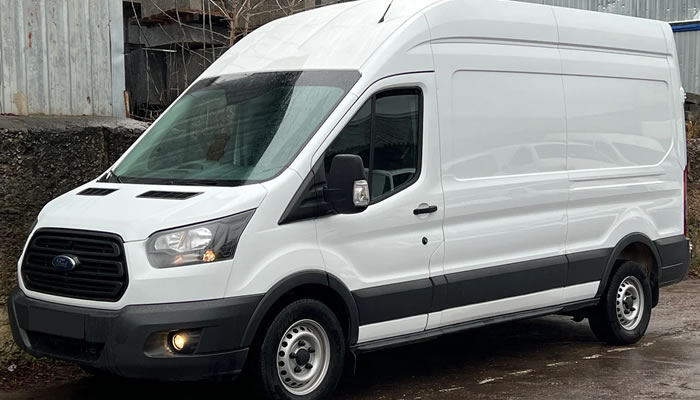
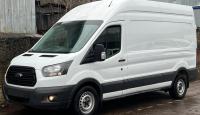 Transit 2014 of the year, van
In January 2013, the next-generation Transit, developed jointly by Ford's European and American divisions, was unveiled at the Detroit Auto Show. It was officially sold in the US and Canada for the first time. In June, production surpassed seven million vehicles. In 2014, the fourth-generation two-ton Transit went on sale. Production of the all-new Transit has begun at the Kansas City assembly plant, marking the first time it has been assembled in the United States. It will eventually displace the E-Series truck from the North American market.
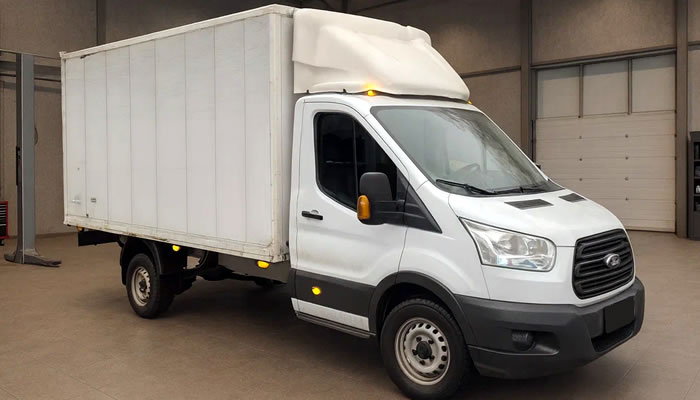
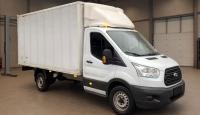 Transit 2015 of the year, truck
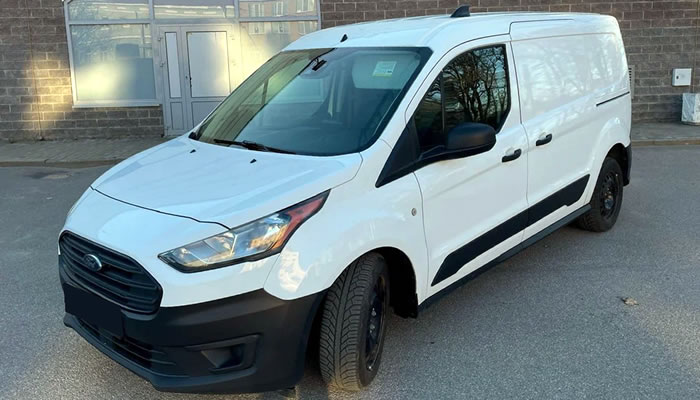
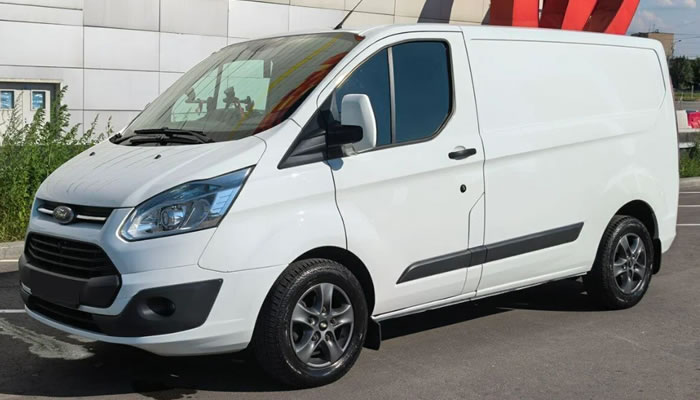
Also launched in 2013 was the all-new Transit Connect van, offering two body lengths, a payload of up to 1,000kg and innovative load space features. In 2014, it was named "International Van of the Year." Ford spun off the front-wheel-drive Transit into its own lineup, the Transit Custom (located between Transit Connect and Transit) and Transit Courier on base
Fiesta, which became the smallest model in the line.
The full-size Transit was available in the following body styles: minibus, cargo van, passenger van, chassis cab, and short cab van. The engine was located in the front, the drive was front-wheel drive, rear-wheel drive and all-wheel drive.
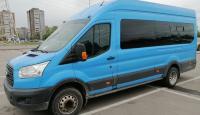 Transit 2016 of the year, minibus
The diesel engine lineup for this generation was as follows: 2.0 liter EcoBlue (1995 cm³, TDCi I4, 104/128/168 hp), 2.0 liter Duratorq (1998 cm³, TDCi I4, 113 hp), 2.2 liter Duratorq (2198 cm³, TDCi I4, 153 hp), 2.4 liter Duratorq (2402 cm³, TDCi I4, 135 hp) and 3.2 liters of Duratorq (3198 cm³, TDCi I5, 197 hp). There was a mild hybrid version with a 2.0-liter EcoBlue diesel engine and an 11.5 kW electric motor. The gasoline engines were 2.0-liter EcoBoost (1999 cm³, I4, 248 hp), 2.3 liter Duratec (2261 cm³, I4, 143 hp), 3.5 liter Ti-VCT (3496 cm³, V6, 275 hp), 3.7 liter Ti-VCT (3726 cm³, V6, 275 hp) and 3.5 liters EcoBoost (3496 cm³, V6, 310 hp).
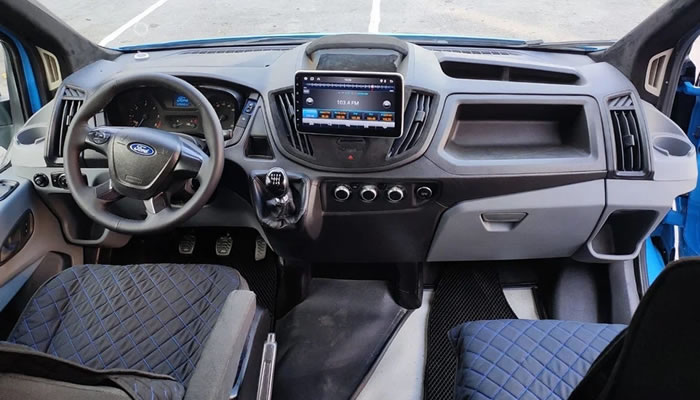
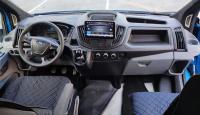 Transit 2017 of the year, интерьер
The gearbox was a 6-speed automatic "6R80", 6-speed manual "Getrag MT82-D4", 5-speed manual (only in China), 10-speed automatic "10R80." The all-electric model, dubbed the "E-Transit," had a 198 kW (266 hp) electric motor and a 48-volt, 68 kWh battery. The 3.7-liter engine could be optionally converted to run on compressed natural gas (CNG) or propane.
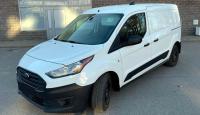 Transit Connect 2013 of the year
In 2018, at the IAA Commercial Vehicles show in Hanover, Germany, the upgraded two-ton Ford Transit with increased payload capacity and advanced driver assistance technologies, as well as the production version of the Transit Custom PHEV, were unveiled. In 2020, a new Transit version with a payload capacity of 5,000 kg was introduced, available in panel van or chassis cab body styles. Improvements to the Transit Connect include a 1,000 kg payload for the first time. In 2022, the E-Transit received a Euro NCAP Gold Award for its advanced driver assistance systems, joining the diesel Transit and Transit Custom, which also received a Gold Award. The all-electric E-Transit Custom will be unveiled in May 2022, with a range of 337 km and a payload of up to 1,000 kg.
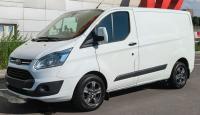 Transit Custom 2015 of the year
In April 2023, a new version of the Transit Courier was unveiled, becoming available as an all-electric E-Transit Courier. Production of the second-generation Transit Custom, featuring increased cargo capacity, improved comfort, and improved driver amenities, began. Shortly thereafter, it won the International Van of the Year award. In 2024, the new Transit Connect was introduced, featuring a plug-in hybrid for the first time, and the E-Transit Custom, with an 89 kWh battery and a range of up to 402 km.