Removal
Note 1: This procedure is difficult to perform when the engine is installed in the vehicle, as it requires preliminary disassembly and access to the components is limited. Therefore, it is recommended to perform it with the engine removed from the vehicle. Note that the oil pump relief valve can be removed from the engine installed in the vehicle (item 8).
Note 2: You will also need a new pump gasket and spare parts (see paragraph 15), as well as tools and fixtures.
1. Remove the timing belt (paragraph 10).
2. Remove the crankshaft toothed pulley and the thrust washer located behind it, taking into account which side it is installed on (paragraph 1).
3. Remove the tray (paragraph 15).
4. Remove the screws securing the suction pipe/strainer to the pump. Then remove the nut and the suction pipe/strainer. Discard the gasket.
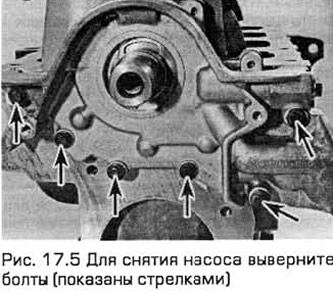
5. Remove the pump bolts from the cylinder block/crankcase (see Fig. 17.5). Remove and discard the gasket. Remove the right crankshaft oil seal. Thoroughly clean and degrease all components, especially the mating surfaces of the pump, sump and cylinder block/crankcase.
Inspection
6. Remove the slotted head screws and the pump cover. Pay attention to the position marks on the rotors and pull them out (see Fig. 17.6).
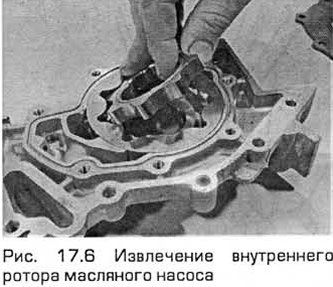
7. If any of the rotors, pump body or cover are scored or damaged, the entire pump assembly must be replaced.
8. If required, the relief valve can be removed without removing the pump. To do this, park the vehicle on a firm, level surface, apply the parking brake, raise the front end and support it on stands. To access the valve, remove the right front wheel and the accessory belt cover (chapter 1).
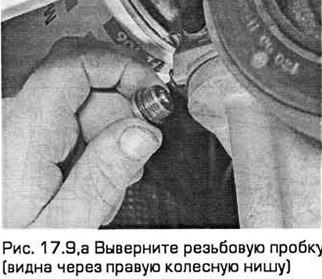
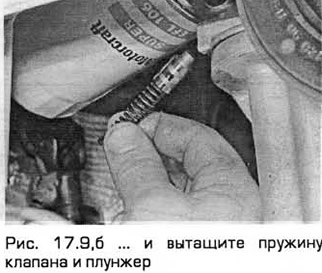
9. Unscrew the threaded plug and pull out the valve spring and plunger (see Fig. 17.9, a, b). If the O-ring is worn or damaged, it must be replaced during installation.
10. Installation - in the reverse order of removal. Install the spring and valve with the correct side and tighten the screw plug securely.
Installation
11. When installing, the oil pump must be filled with clean engine oil by turning its internal rotor several revolutions.
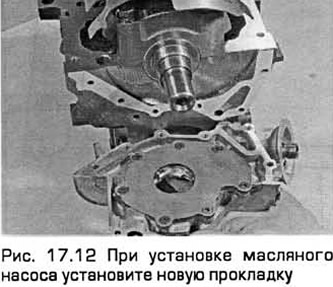
12. Using grease, adhere the new gasket to the cylinder block/crankcase. Rotate the inner rotor of the pump to align it with the flats of the crankshaft and install the pump. Insert the bolts and tighten them lightly (see Fig. 17.12).
13. Using a ruler and feeler gauges, center the pump relative to the crankshaft and install it without distortions so that its mating surface is located below the mating surface of the cylinder block/crankcase by 0.3...0.8 mm and this distance is the same on both sides of the crankshaft (see Fig. 17.13). Without moving the gasket, move the pump to the specified position and tighten its bolts to the required torque.
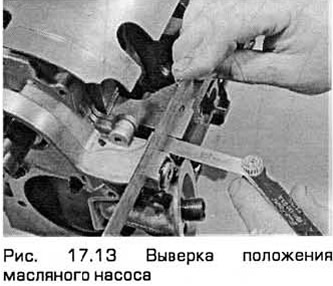
14. Make sure the pump is installed and positioned correctly. If necessary, unscrew the bolts again and repeat the entire procedure to ensure the required position.
15. Install a new right crankshaft oil seal (paragraph 20).
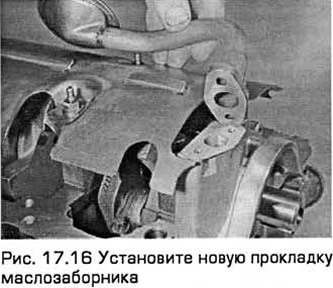
16. Using grease, stick the gasket to the pump. Install the suction pipe/strainer. Tighten the screws and nut to the specified torque (see Fig. 17.16).
17. Perform the remaining operations in the reverse order of removal.
[The original article is posted at: fordbook]