Engines up to 8/94 (except DOHC engine)
Adjustment of the ignition timing angle is required only if the ignition distributor has been removed. For adjustment, a crankshaft speed meter, a stroboscope and, for some models, a STAR tester (a special tool from FORD) are used.
Note: All DOHC engines have their ignition timing changed entirely by the engine control unit. Therefore, these engines do not require checking or adjusting the ignition timing.
Warm up the engine to operating temperature and turn it off.
Connect the crankshaft speed meter in accordance with the manufacturer's operating instructions.
Check the crankshaft speed when idling, see p. 64.
Turn off the engine and shift the gearbox to neutral. Turn the crankshaft belt pulley by the central mounting bolt with a suitable wrench so that the marks for adjusting the ignition timing are visible. Using a felt-tip pen or marker, clearly mark the correct mark for the ignition timing angle.
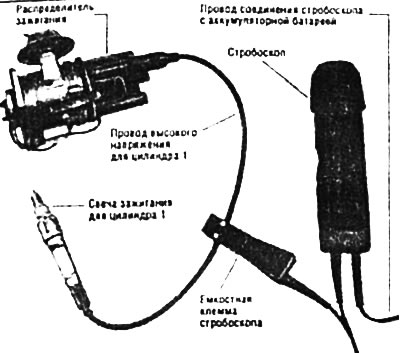
Connect the stroboscope in accordance with the manufacturer's operating instructions.
Carburetor engine: Disconnect the vacuum hose from the distributor vacuum regulator and plug it with a suitable clean screw.
Depending on the engine (see table at the end of the chapter), connect the STAR tester and enable the self-diagnosis function, code 60.
Start the engine and let it idle. The reference speed is given in the table on p. 66.
Turn off all electrical consumers (radio, rear window defroster, etc.) and the air conditioning system.
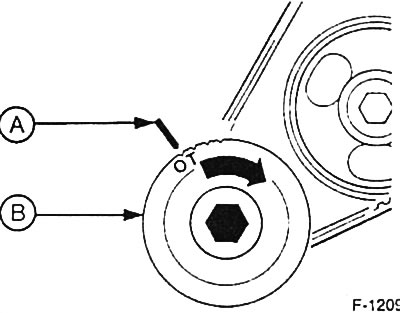
Direct the flashing light of the strobe light to the installation mark "A".
The ignition is adjusted correctly if, when the stroboscope flashes, the mark on the pulley "B" is stationary opposite the installation mark "A". The values of the ignition advance angles are given in the table at the end of the chapter.
If the ignition timing adjustment marks do not match, stop the engine.
Loosen the mounting bolt and turn the ignition distributor to set the specified ignition timing angle.
Tighten the distributor mounting bolt.
Start the engine and check the ignition timing again. If necessary, repeat the ignition timing adjustment process.
Caution: Since the engine is equipped with an electronic ignition system, do not turn the distributor by hand while the engine is running.
Finally, mark the position of the ignition distributor with paint.
Carburetor engine: remove the plug from the vacuum hose and connect it to the vacuum regulator of the ignition distributor.
With the ignition off, disconnect the measuring instruments.
At the service station, the regulating force of the centrifugal regulator weights and the vacuum regulator of the ignition distributor can be additionally checked at different crankshaft speeds. But this is only required if the ignition system is faulty.
Check and, if necessary, adjust the crankshaft idle speed, see p. 64.
Prescribed ignition timing values
| Engine | Ignition advance angle, deg, before TDC |
| ONS, carburetor, without catalytic converter | 10 |
| ONS, carburetor, with catalytic converter | 6 |
| ONS, with injection system, without catalytic converter | 12 |
| ONS, with injection system, with catalytic converter1) | 18 |
| with a working volume of 2.4-/2.9 l, without a catalytic converter1) | 12 |
| with a working volume of 2.9 l, with a catalytic converter1) | 15 |
| with a working volume of 2.8 l | 12 |
1) Connect the STAR tester and enable the self-diagnosis function, code 60.
[Information for this article was taken from the website: fordbook]