


Carburetors Pierburg 2V and Weber 2V-TLD
Since CO content and idle speed influence each other, both parameters must be checked and adjusted simultaneously.
Note: A deviation of ±0.20% in CO content and ±25 rpm in idle speed is considered normal.
Prerequisite for inspection: The exhaust system must be checked. To do this, cover the exhaust pipe with a rag while the engine is running. All pipe connections must be tight.
Caution: When performing the inspection, ensure that the workplace is sufficiently ventilated. Failure to do so may result in poisoning by exhaust gases.
Check the carburetor rods and rollers for gaps. If necessary, repair and adjust the carburetor (service station work).
Warm up the engine and turn it off. The lower coolant hose at the radiator should be warm.
Turn off all electrical consumers (radio, windshield wipers, etc.) and the air conditioning system.
Check and, if necessary, adjust the ignition timing.
The air filter element must be clean. It is best to perform the adjustment after installing a new air filter element.
In accordance with the operating instructions, connect the crankshaft speed meter and the CO content measuring device.
Warm up the engine to operating temperature, start it and let it idle.
Check the tightness of the intake tract. To do this, circle all the seals of the intake tract with a brush moistened with gasoline. If the crankshaft speed increases for a short time, there is an additional air leak in the tract. Localize the leak and eliminate the cause.
Warning: Do not inhale gasoline vapors - they are poisonous! Do not allow gasoline to splash onto hot parts and components of the ignition system. Fire hazard!
Run the engine at 3000 rpm for about half a minute, then return to normal idle speed.
Once the readings of the measuring instruments have stabilized, read the measurement results and compare them with the prescribed values, see p. 66.
Carburetor Pierburg 2V
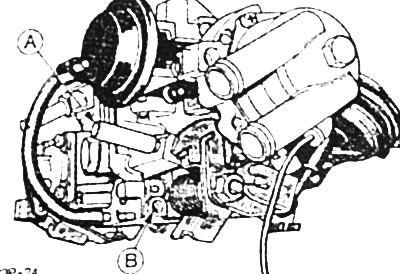
If the idle speed deviates from the specified value, turn the adjusting screw "A" until the specified value is reached.
If the CO content deviates from the prescribed value, remove the protective cap from the adjusting screw "B". To do this, drill a hole in the plastic cap in the center, screw a screw or sheet metal screw into the hole and, grasping the screw with pliers, remove it together with the protective cap. If necessary, remove and then reinstall the air filter.
Carburetor Weber 2V-TLD
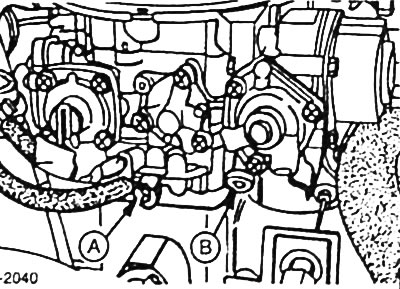
If the idle speed deviates from the specified value, turn the adjusting screw "B" until the specified value is reached.
If the CO content deviates from the prescribed value, remove the protective cap from the adjusting screw "A". To do this, drill a hole in the plastic cap in the center, screw a screw or sheet metal screw into the hole and, grasping the screw with pliers, remove it together with the protective cap. If necessary, remove the protective cap to provide access to the air filter, and then freely install it to perform the adjustment.
Caution: Do not disconnect the vacuum hoses from the filter housing.
Run the engine at 3000 rpm for about half a minute, then switch to normal idle speed. The CO content will first increase, then fall, and stabilize after about 25 seconds. Once the readings of the measuring instruments have stabilized, read the measurement results and compare them with the prescribed values.
Turn the adjusting screw to set the CO content to the prescribed value. If necessary, adjust the idle speed by turning the corresponding adjusting screw.
Note: Adjustment must be performed within 30 seconds after the readings have stabilized. Otherwise, run the engine again at a crankshaft speed of 3000 1/min.
Check the idle speed and CO content again.
Install a new protective cap on the CO content adjustment screw.
Remove measuring instruments.
Engine with Weber 2V-TLD carburetor: install air filter, see p. 57.
The material was copied from an information website fordbook.ru