Engines up to 8/94
The ignition coil is checked using an ohmmeter.
Disconnect the negative (-) battery cable.
Caution: When the battery is disconnected, the contents of electronic memory devices, such as engine fault codes or radio codes, are erased. Before disconnecting, also read the instructions in the chapter "Removal and installation the battery".
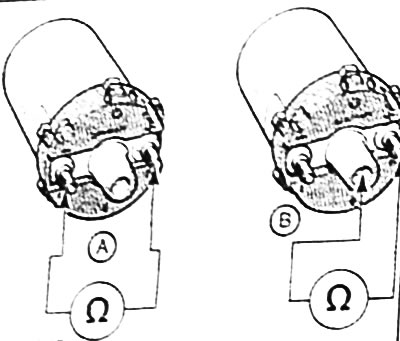
Disconnect all wires from the ignition coil. Mark the low voltage connectors - terminals 1 and 15 - with adhesive tape beforehand.
Checking the resistance of the primary winding "A"
Connect an ohmmeter between the low voltage terminals.
Measure the resistance. If the specified resistance value of 0.72 to 0.88 ohms is not achieved, the ignition coil must be replaced.
Checking the resistance of the secondary winding "B"
Connect an ohmmeter between terminals 4 (the high voltage terminal in the center) and one of the low voltage terminals.
Measure the resistance. If the specified resistance value of 4.5 to 7.0 kOhm (for a DOHC engine, 4.5 to 8.6 kOhm) is not achieved, the ignition coil must be replaced.
Connect the electrical wires to the ignition coil.
Connect the ground (-) cable to the battery.
If available, set the clock and enter the radio theft protection code.
Caution: If you need to replace the ignition coil, do not under any circumstances install a coil designed for an ignition system with a breaker, otherwise the control unit will fail.