The following wear parts need to be purchased as replacements: Fuel filter for the corresponding engine. When purchasing, please indicate the year of manufacture and the model of the vehicle.
Diesel engine
Removal water/replacing fuel filter
A suitable container is required to drain water from the filter.
Caution: Any leaking diesel fuel must be wiped off immediately, especially from rubber parts (cooling system hoses), otherwise the rubber parts will deteriorate over time.
Removal water
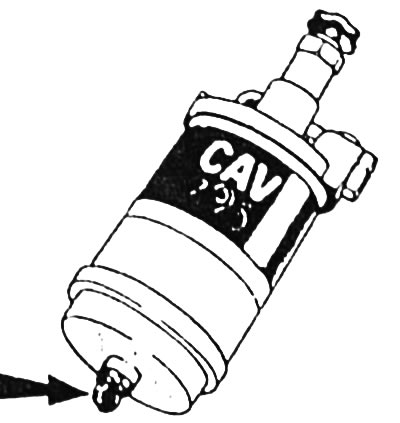
Place a suitable container under the drain plug "arrow".
Release the water drain plug and drain approximately 100 cm³ of liquid into a container. Once drained, only clean diesel fuel should flow out.
If no fluid flows out after releasing the plug, release the air bleed plug at the fuel outlet line "C", see Figure F-6277 below.
Tighten the water drain plug.
If it has been loosened, tighten the plug to remove air.
After draining the water from the filter, it is necessary to remove air from the power supply system.
Filter replacement
Place a suitable container under the fuel filter.
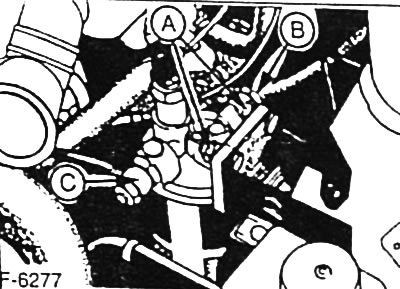
Disconnect the inlet "B" and outlet "C" fuel lines from the filter holder and secure them as high as possible to reduce fuel spillage. A - fuel filter mounting nuts.
Loosen the fuel filter fastener.
Fill the new filter to the brim with clean diesel fuel.
Insert new sealing gaskets, a new filter element and tighten the filter fastening.
Remove the container from under the fuel filter.
Remove air from the fuel system.
After a test drive, check the fuel system for leaks.
Removal air from the fuel system
Attention: From 9/94 it is necessary to remove air from the fuel system (BOSCH filter), see p. 74.
Place a suitable container under the fuel filter.
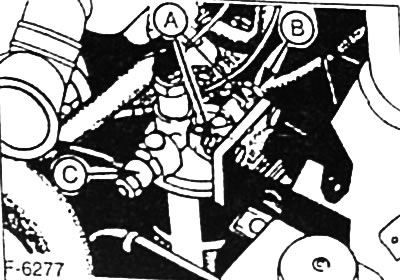
Loosen the air bleed plug at the fuel inlet line.
Loosen the fuel pump handle fastening at the filter holder.
Activate the fuel pump and pump fuel until it comes out through the bleeder plug without any air bubbles.
Tighten the air bleed plug while pressing the fuel pump handle.
Turn on the engine preheating system and then start the engine.
If the engine does not start, loosen the union nuts of the high-pressure fuel lines at the first and second cylinders. Turn the engine crankshaft with the starter until fuel begins to flow out from under the union nuts. When the engine starts, tighten the union nuts of the fuel lines to a torque of 20 Nm.
Remove the container from under the fuel filter.
Petrol engines with injection system
When removing the fuel filter, a large amount of fuel may leak out, which requires a fuel-resistant container to collect.
Removal
Warning: No open flame, fire hazard!
Disconnect the negative (-) battery cable.
Attention: Read the instructions in the chapter "Removal and installation the battery".
Raise the rear of the car onto jack stands.
Place a suitable container under the filter to collect the fuel.
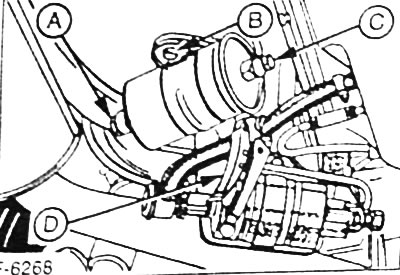
Cover the fuel line connections with rags and slowly loosen the hollow bolts of the inlet "C" and outlet "A" fuel lines to relieve the fuel pressure. After the pressure in the fuel lines drops, unscrew the hollow bolts.
Loosen the mounting bolt "B" and remove the filter.
Installation
Place the fuel filter in place and tighten the mounting bolt.
Connect the fuel inlet and outlet hoses to the filter, each with two new sealing gaskets, and tighten them.
Connect the battery ground (-) cable.
If available, set the clock and enter the radio theft protection code.
Lower the car.
After a test drive, check the tightness of the fuel system connections.