Contents: Lubricants, sealants and adhesives ↳ Clutch controls ↳ Tightening torques ↳ Elements - clutch controls ↳
Lubricants, sealants and adhesives
| Elements | Specification |
| Super DOT 4 Brake Fluid | ESD-M6C57-A |
| High temperature grease | ESDM-1C220-A |
Clutch controls
| Drive | Hydraulic |
| Adjustment | Automatic |
| Pedal travel | 133±3 mm |
Tightening torques
| Name | Nm | pound-foot | pound-inch |
| Clutch Master Cylinder Bolts | 9 | - | 80 |
| Clutch slave cylinder | 10 | - | 89 |
Elements - clutch controls
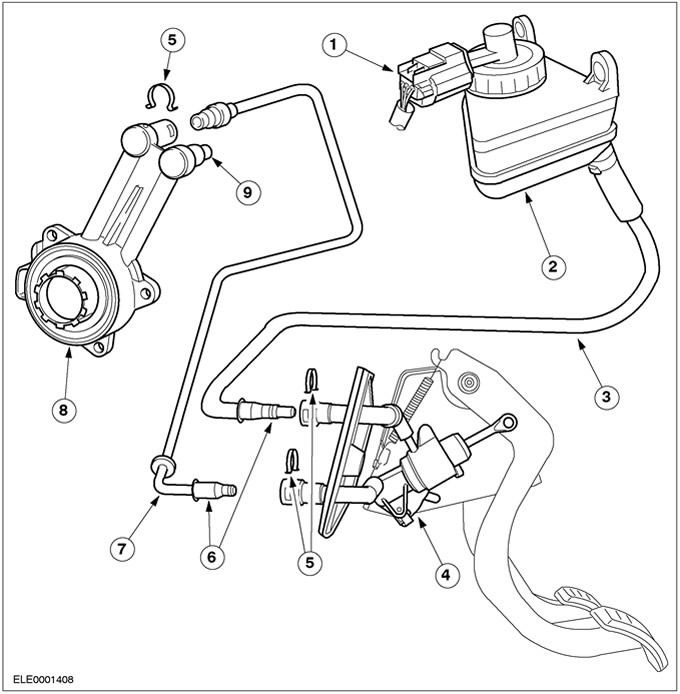
| Pos. | Spare Part No | Name |
| 1 | Brake fluid level switch | |
| 2 | Brake fluid reservoir | |
| 3 | Feed pipeline | |
| 4 | Clutch master cylinder | |
| 5 | High pressure pipeline | |
| 6 | Clutch slave cylinder with integrated clutch release bearing | |
| 7 | Air bleed nipple |
The Focus has a hydraulic clutch. The hydraulic clutch system is powered by brake fluid from a separate chamber in the brake fluid reservoir.
When you press the clutch pedal, the pressure in the clutch master cylinder increases. This pressure reaches the slave cylinder, which then acts on the clutch release bearing.
The advantages of hydraulic clutch drive are as follows:
- Automatic adjustment
- Low working force
- Minimal wear
The following hydraulic clutch components differ from those previously used in the Puma:
- Modified clutch slave cylinder; it is not possible to replace the clutch release bearing individually.
- The clutch pedal travel is not adjustable.
- Preload valve removed; the preload is created by a spring.
- New clutch slave cylinder
Working fluid reservoir
The brake fluid reservoir contains brake fluid for the clutch hydraulic drive and for the brake system.
Inside the tank is divided into two chambers - respectively for the clutch hydraulic drive and for the brake system. If there are leaks in the clutch hydraulic drive, the brake system works normally.
Clutch master cylinder
The pressure required to engage the clutch is generated by the clutch master cylinder.
When the clutch pedal is pressed, the piston rod moves the piston of the clutch master cylinder. The hydraulic fluid in the clutch master cylinder is subjected to pressure and is supplied to the clutch slave cylinder via the high-pressure line.
Clutch slave cylinder
The central clutch slave cylinder is equipped with a built-in clutch release bearing and is attached to the clutch housing with three bolts. The clutch release bearing is installed in the clutch slave cylinder by a tight fit. It cannot be replaced individually.
The hydraulic fluid squeezed out by the master cylinder piston moves the slave cylinder piston and this, in turn, leads to axial movement of the release bearing. The release bearing rests the inner ring of the bearing against the projections of the diaphragm spring. The clutch between the driven clutch disc and the flywheel created under the action of the spring is broken.
When the clutch pedal is released, the diaphragm spring directs the piston in the slave cylinder back to its original position. Under the action of the spring, the clutch between the driven clutch disc and the flywheel is restored again.