Car front and rear suspension Ford Focus Turnier 1

General information about the suspension
Outstanding handling: The Focus is praised by trade magazines for its balanced chassis setup with "zero offset" geometry of the lower wishbones and a negative steering...
Outstanding handling: The Focus is praised by trade magazines for its balanced chassis setup with "zero offset" geometry of the lower wishbones and a negative steering...

Front suspension units
Independent wheel suspension: according to the MacPherson system (patent application filed in 1949), a compact module consisting of a shock absorber, a spring and a...
Independent wheel suspension: according to the MacPherson system (patent application filed in 1949), a compact module consisting of a shock absorber, a spring and a...

Rear suspension units
SLA rear axle suspension: separate axle body made of welded steel section. Axle components such as upper wishbone, lower wishbone, shock absorbers, springs, traction...
SLA rear axle suspension: separate axle body made of welded steel section. Axle components such as upper wishbone, lower wishbone, shock absorbers, springs, traction...

Amateur work on the chassis and steering
Chassis and steering work requires experience and often special tools, as well as optical or electronic measuring instruments. If in doubt, it is better to entrust the...
Chassis and steering work requires experience and often special tools, as well as optical or electronic measuring instruments. If in doubt, it is better to entrust the...
Checking shock absorbers
Checking shock absorbers is mandatory after two sets of worn wheels. During their service life, shock absorbers mutate into air pumps: after about two sets of worn...
Checking shock absorbers is mandatory after two sets of worn wheels. During their service life, shock absorbers mutate into air pumps: after about two sets of worn...
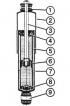
Telescopic shock absorber — design description
Your Focus is supported by what are called telescopic shock absorbers. They consist of a working cylinder in which a working piston equipped with a rod slides up and...
Your Focus is supported by what are called telescopic shock absorbers. They consist of a working cylinder in which a working piston equipped with a rod slides up and...

Checking the bearings of the wishbones of the independent suspension
Both bearings and the ball joint of the front wishbones are not subject to maintenance. The outer ball joint is located in a synthetic insert with long-term lubrication....
Both bearings and the ball joint of the front wishbones are not subject to maintenance. The outer ball joint is located in a synthetic insert with long-term lubrication....
Checking the wheel bearing clearance
The Focus' wheels rotate on double ball bearings that are maintenance-free. Modern rear axle wheel bearings are designed to last around 150,000 km. The front axle wheel...
The Focus' wheels rotate on double ball bearings that are maintenance-free. Modern rear axle wheel bearings are designed to last around 150,000 km. The front axle wheel...

Replacing the wishbone (front)
Warped wishbones should always be replaced as a complete unit. However, worn bearing bushes can be replaced, although this work is best left to your workshop (see...
Warped wishbones should always be replaced as a complete unit. However, worn bearing bushes can be replaced, although this work is best left to your workshop (see...

Replacing the shock absorber strut
Dismantling Raise the vehicle securely on a level surface and remove the front wheel. Disconnect the brake hose mount and the connecting rod to the stabilizer. Unscrew...
Dismantling Raise the vehicle securely on a level surface and remove the front wheel. Disconnect the brake hose mount and the connecting rod to the stabilizer. Unscrew...

Replacing rear shock absorbers
Dismantling in 3-, 4-, 5-door models Remove the trunk trim. Unscrew the upper nut of the shock absorber. To do this, lock the pressure rod with a key with an internal...
Dismantling in 3-, 4-, 5-door models Remove the trunk trim. Unscrew the upper nut of the shock absorber. To do this, lock the pressure rod with a key with an internal...
This section is available on russian, bulgarian, belarusian, ukrainian, serbian, croatian, romanian, polish, slovak, hungarian
See other similar sections for Ford cars:
• Chassis: Suspension Ford Mondeo 1 (1993-1996)
• Chassis: Suspension and wheels Ford Escort 4 (1986-1990)
• Chassis: Car suspension Ford Fiesta 4 (1996-1999)
• Chassis: Car suspension Ford Taurus 1 and 2 (1986-1994)
• Chassis: Suspension Ford Mondeo 1 (1993-1996)
• Chassis: Suspension and wheels Ford Escort 4 (1986-1990)
• Chassis: Car suspension Ford Fiesta 4 (1996-1999)
• Chassis: Car suspension Ford Taurus 1 and 2 (1986-1994)
Focus 2
Focus Turnier 1
Focus 1
- General information
- Vehicle device
- Owner's manual
- Faults en route
- Maintenance
- First maintenance
- Second maintenance
- Applications
- Consumables and spare parts
- Auto mechanic tips
- Power unit
- Engine repair
- Engine seal parts
- Cooling system
- Exhaust system
- Supply system
- Clutch
- Car gearbox
- Front wheel drives
- Chassis
- Front suspension
- Rear suspension
- Steering
- Brake system
- Wheels and tires
- Body and coating
- Body elements
- Side doors
- Tailgate
- Salon elements
- Safety system
- Windshield wipers and washers
- Body Care
- Electrical equipment
- Instruments and motors
- Battery and alternator
- Egnition lock
- Engine management
- Headlights and lighting
- Switches and sensors
- Schematic diagrams
Focus Turnier 1
- General information
- Introduction to guide
- Car care
- Power unit
- Engine repair
- Lubrication system
- Cooling system
- Fuel injection (gasoline)
- Fuel injection (diesel)
- Ignition system
- Power and exhaust system
- Transmission
- Clutch and drive shafts
- Mechanical gearbox
- Automatic gearbox
- Chassis
- Car suspension
- Steering
- Wheels and tires
- Brake system
- Body
- Exterior
- Interior
- Heating and ventilation
- Electrical equipment
- Equipment and devices
- Lighting and signaling
- Power devices
- Electrical circuits
Focus 1
- General information
- Using the manual
- Identification codes
- Power unit
- Engine
- Engine 1.4/1.6 Zetec-SE
- Engine 1.6/1.8/2.0 Zetec-E
- Engine Duratec ST 2.0 l
- Engine Duratec 8V 1.6 l
- Diesel engine 1.8 l
- Engine cooling
- Fuel supply
- Accessory drive
- Launch system
- Ignition system
- Air and vapor
- Engine management
- Exhaust toxicity
- Exhaust system
- Automatic gearbox
- Clutch
- Mechanical gearbox iB5
- Mechanical gearbox MTX-75
- Mechanical gearbox MT285
- Chassis
- Front suspension
- Rear suspension
- Wheels and tires
- Front axle axles
- Brake system
- Hydraulic brake
- Anti-lock braking system
- Steering
- Body and coating
- Body panels
- Body elements
- Salon elements
- Glass, frames and mechanisms
- Windshield wipers and washers
- Car sunroof
- Seat belts
- Body repairs
- Back elements
- Electrical equipment
- Climate control
- Heating and ventilation
- Instruments and control lamps
- Battery and alternator
- Audio system
- Headlights and lighting
- Power distribution
- Electronic Function Group