Shock absorber strut: consists of a coil spring and a telescopic shock absorber, which operates inside the spring coils. Internal stops in the shock absorber strut limit the downward straightening of the spring. When the spring is compressed hard, for example when hitting a pothole, the stop limiter is activated. It prevents the spring from locking and the shock absorber from being abruptly destroyed.
Shock absorber dome (in the wing): it includes a shock absorber strut. At the top it is designed in the form of a rubber support (heel pad), which, guided by a centering ring, rests on the upper and lower plate disk. The piston rod of the shock absorber strut is screwed into the thrust bearing.
Steering swivel support: holds the lower end of the shock absorber strut with two clamping bolts. Connected by a ball joint to a transverse arm made of spheroidal graphite cast iron. The transverse arm is movably located in the axle support and absorbs lateral forces.
Transverse stabilizer: is attached to the bottom of the body with the possibility of rotation. Connected to the corresponding transverse lever. It minimizes the lateral tilt of the body on turns.
Steering rack: is fixed to the axle support behind the engine. The two-section steering shaft acts directly on the toothed rack, to the ends of which the right and left transverse steering rods are screwed. The steering movements are transmitted to the steering knuckle of the steering pivot support and, consequently, to the wheels.
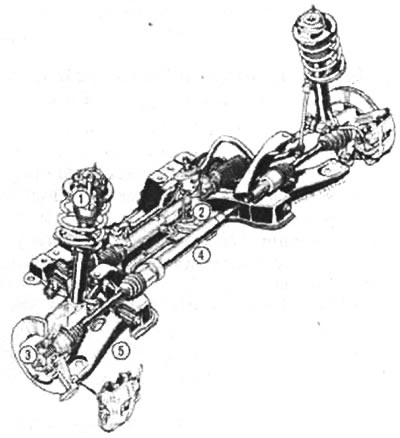
The Focus' front axle design convinces with excellent steering flexibility
Good shock absorption is provided by MacPherson shock absorber struts 1; the compact rack and pinion steering 2 responds sensitively to course changes; sufficiently sized disc brakes 3 always match the engine power; 4-bar stabilizer improves cornering performance; l-shaped transverse levers 5 control the front wheels in the longitudinal and lateral directions.
[The original post is on the web portal: Fordbook.ru]