Central and additional fuse boxes with 2/92: To remove the plastic cover, release it from the front or side clamping strips, respectively. Tilt the cover back and remove.
Additional fuse box up to 1/92: open the glove compartment and fold down the hinged holder located above it.
Before replacing a fuse, always first switch off the ignition and the corresponding consumer.
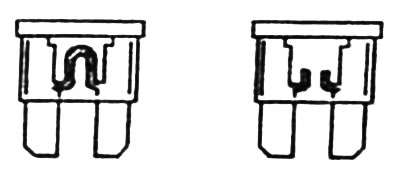
A blown fuse can be identified by a melted metal plate.
The defective fuse should be grasped with a clamp and pulled out. A plastic clamp for better grip of the fuse is located in the fuse box.
Insert a new fuse rated for the same amperage.
The fuse's nominal current value is stamped on the back of its holder. In addition, the holder has a color marking, which can also be used to determine the nominal current value.
| Nominal current value, A | Colour coding of standard fuses |
| 5 | light brown |
| 7.5 | brown |
| 10 | red |
| 15 | blue |
| 20 | yellow |
| 30 | light green |
Replace the fuse box cover.
If the new fuse also blows after a short time, the corresponding electrical circuit must be checked.
If several fuses and incandescent lamps burn out within a short period of time, the cause may be a defective generator voltage regulator and, as a result, too high a voltage in the vehicle's on-board network. It is recommended to contact a service station to check the voltage regulator.
Never replace a fuse with wire or other improvised means, as this may cause serious damage to the electrical system.
It is recommended to always have spare fuses of different amperage ratings in your vehicle.
Place the fuse box cover on and secure it in place.