V-belt - it all depends on its pre-tension
V-belts only do their job satisfactorily if they have the necessary pre-tension. They should be tight, but not too tight. It is normal for there to be 3-5 mm of slack when pressed. Over-tightened belts will eventually destroy the bearings of the alternator, water pump (depending on the engine type) and air conditioning compressor. In addition, over-tightened V-belts stretch and can then break. On the contrary, weakly tensioned V-belts slip - this is noticeable by an unpleasant squealing sound. The alternator suffers most from this, it does not provide enough charging current, which puts excessive strain on the battery, especially when driving short distances and when starting a cold engine. The V-belt itself is also damaged, its sides burn out.
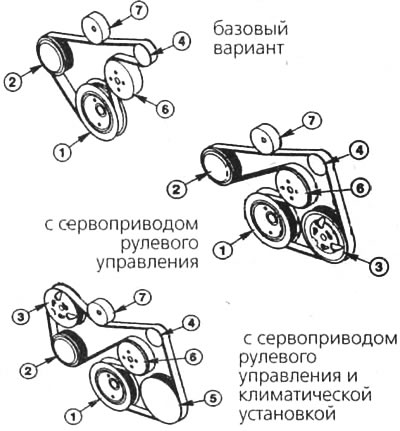
Zetec-SE engines always use 6K-Poly-V belts: they have different sizes, depending on the configuration option. A hydraulic device regulates the belt tension. 1 - crankshaft; 2 - hydraulic belt tensioner; 3 - Power steering pump; 4 - generator; 5 - air conditioning; 6 - water pump; 7 - guide roller.
The consequence: premature wear. In extreme cases, slipping V-belts can even lead to excessive engine overheating and, consequently, to costly damage (e.g., piston seizure, burnt-out cylinder head gasket). Although your Focus automatically adjusts the V-belt tension, take a targeted look at this transmission from time to time.
Stages of work
Check the surface of the belt.
Turn the engine over several times by hand. This is the only way to reliably check the V-belt. Often there is one, but deep crack in the V-belt. And if, unfortunately, during the check the crack is adjacent to the belt pulley, then, despite the check, the damage is pre-programmed.
Replace the V-belt if you find any of the following damage:
- uneven wear marks on the sides of the belt,
- porous frayed edges of the belt or its surface,
- age cracks.
(A copy of the article is available on the website: fordbook)