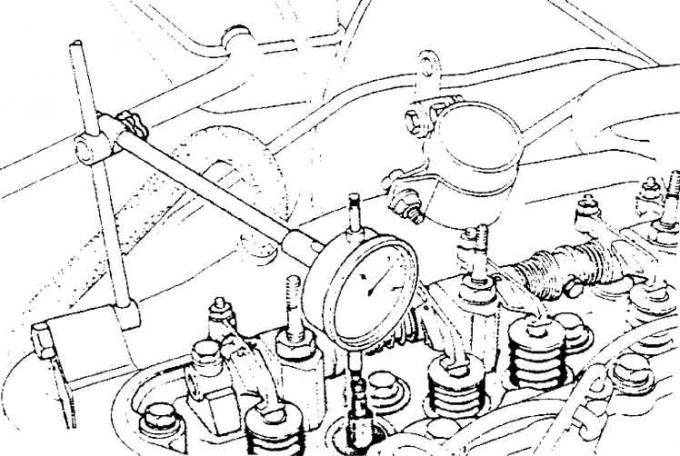
Measuring piston displacement using a dial indicator to measure the lift of the exhaust valve resting on the bottom of the piston
Air filter
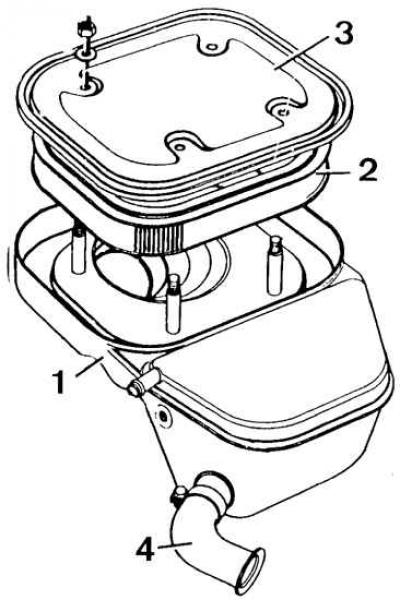
1 – filter housing with expansion chamber, 2 – filter element, 3 – filter cover, 4 – air supply pipeline
Installing an indicator with a holder on a DPC type fuel pump (in cars since 1987)
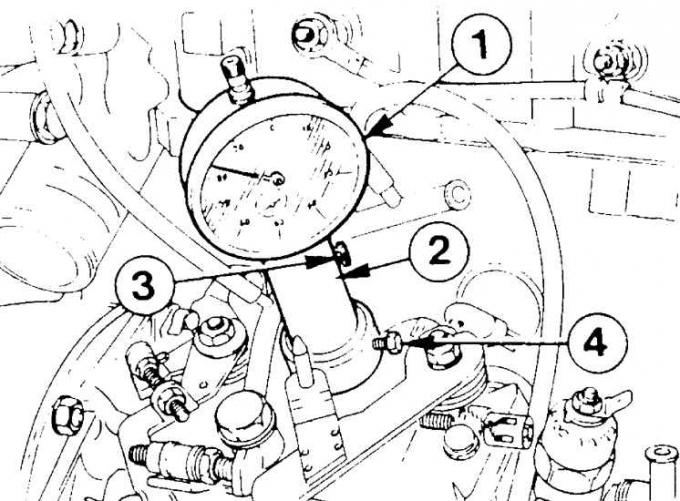
1 – dial indicator, 2 – indicator holder, 3 – indicator fixing bolt, 4 – holder fixing bolt
Engines of cars produced before 1987
Removal
1. Disconnect and remove the battery.
2. Remove the air filter.
3. Disconnect the control elements from the fuel pump, as well as the return fuel lines from the pump and from the injectors.
4. Remove the fuel supply lines to the injectors and plug their openings, disconnect the fuel supply line to the fuel pump.
5. Remove the cylinder head cover.
6. Using a valve spring puller together with auxiliary elements (No. 21.024, 21.024/04 and 21.024/03), compress the springs of the exhaust valve of the 4th cylinder, remove the push rod and turn the valve lever by 90°.
7. Remove the sheet metal cover from underneath the engine.
8. Set the piston of the 4th cylinder to TDC (both valves in the 1st cylinder are partially open), remove the crackers, support plate and valve springs from the exhaust valve of the 4th cylinder and lower the exhaust valve to the bottom of the piston.
9. Install a dial indicator on the second cylinder head cover bolt and rest its measuring tip on the head of the exhaust valve stem of the 4th cylinder.
10. Check the installation of the piston of the 4th cylinder at TDC and reset the indicator.
11. Carefully turn the crankshaft in the direction opposite to its working rotation so that the exhaust valve, resting on the bottom of the piston of the 4th cylinder, moves downwards by 7 mm.
12. Turn the crankshaft in the direction of its working rotation (eliminate gaps) by 4.15 mm so that the dial indicator shows a value of 2.85±0.05 mm (before TDC of the piston).
13. Remove the two hexagonal socket head bolts securing the fuel pump to the front engine cover and remove the fuel pump.
Installing the fuel pump and setting the injection start
1. On the side of the fuel pump, unscrew the mounting bolt and unscrew the plug that closes the inspection hole for setting the injection timing.
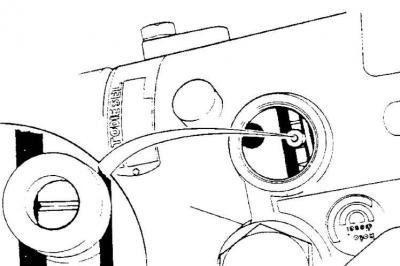
2. Turn the pump shaft so that the installation mark (groove) of the pump rotor is directed upwards (located in the middle of the inspection hole.
3. Install the fuel pump and secure it with two hexagonal socket head bolts.
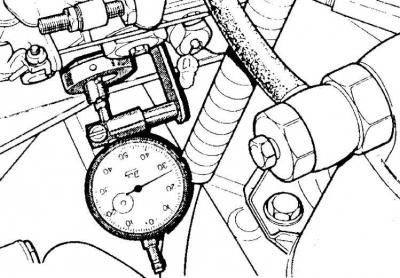
4. Check the installation of the pump rotor. Secure the holder together with the indicator to the side of the pump and rest the measuring tip of the indicator on the installation mark of the fuel pump rotor.
5. Turn the crankshaft in the direction opposite to its working rotation so that the piston of the 4th cylinder is at a distance of 7 mm before TDC. Turn the crankshaft clockwise until the indicator on the fuel pump shows the maximum value with an accuracy of 0.1–0.2 mm.
6. This value should be 2.85±0.05 mm before TDC of the piston of the 4th cylinder. If this is not the case, then it is necessary to loosen the pump mounting bolts and carefully turn it.
7. Repeat the above steps, starting from setting the piston of the 4th cylinder at a distance of 7 mm before TDC, until the required value is obtained on the dial indicator.
8. Tighten the high pressure lines starting from the rear line.
9. Set the piston of the 4th cylinder to TDC and remove the devices used to set the injection advance angle.
10. Install the 4th cylinder exhaust valve springs, support plate and crackers.
11. Turn the crankshaft in the direction opposite to its working rotation until the exhaust valve of the 1st cylinder opens.
12. Insert the push rod of the exhaust valve of the 4th cylinder, install the lever of this valve and secure the locking plug on the fuel pump.
13. Check the valve clearances and screw on the cylinder head cover.
14. Attach fuel pump controls and lines. Install air cleaner. Install engine sheet metal cover.
15. Install and connect the battery. Remove air from the fuel system.
Engines of cars produced after 1987
Installing an indicator with a holder on a DPC type fuel pump (in cars since 1987)
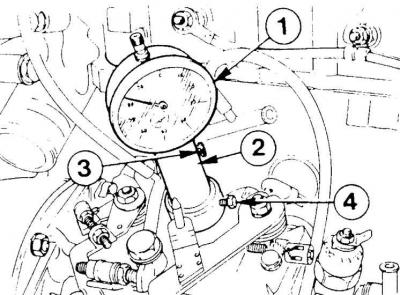
1 – dial indicator, 2 – indicator holder, 3 – indicator fixing bolt, 4 – holder fixing bolt
Removal
It is performed in the same way as described above.
Setting the fuel injection timing
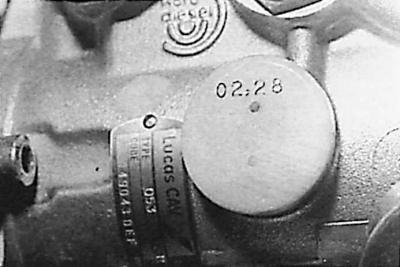
1. Each pump has a plug made of artificial material, on which the installation size in millimeters is stamped. This size is different for each pump; measured with a dial indicator with a Ford 23-0 extension.
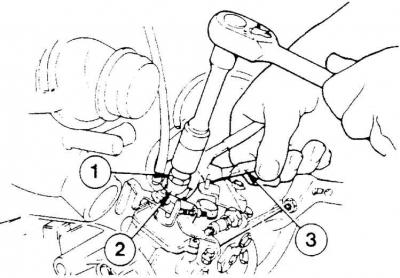
2. Remove the closing plug (1) located on the pump cover. (2 – tip, 3 – pliers).
3. Attach a dial indicator to the pump together with a Ford 23-0 extension (Fig. 1 B.19).
4. Position the indicator so that its arrow begins to move (the measuring tip lightly touches the pump rotor).
5. Set the pump indicator arrow to zero.
6. Set the piston of the 4th cylinder at a distance of 2.85±0.4 mm before TDC.
7. The pump's dial indicator should immediately show the value stamped on the pump plug.
8. If this condition is not met, then you should loosen the fuel pump mounting bolts and very carefully turn it in one direction or the other until you get the required indicator reading on the pump.
[Information for this article was taken from the website: FordBook.ru]