Power supply system diagram
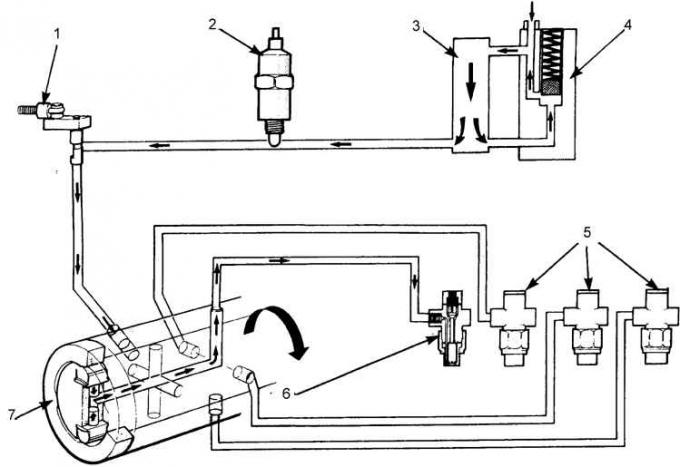
1 – dispenser; 2 – electromagnetic fuel valve; 3 – booster pump; 4 – pressure regulator; 5 – injectors; 6 – nozzle in section; 7 – rotary plunger fuel distribution unit in the high-pressure fuel pump
Two plunger pairs are installed on the pump shaft, supplying fuel to the engine cylinders under high pressure. The plungers receive translational motion due to the effect of a shaped profile located in the pump. The amount of fuel supplied to the cylinders is regulated by a dispenser controlled by a cable from the accelerator pedal. The injection advance angle changes depending on the engine speed by a mechanical centrifugal regulator built into the high-pressure fuel pump.
There is an electromagnetic valve to stop the engine. When the engine starts, 12 V is supplied to the valve winding, the valve opens and passes fuel to the pump and injectors. When the engine is turned off, the fuel valve is turned off and the fuel supply is cut off by turning the key in the ignition switch. The fuel pump under high pressure through the pipelines supplies fuel to the injectors, which are installed in the cylinder head near the combustion chambers. The injectors inject fuel into the swirl chambers, where the fuel is ignited. The injectors are a valve that opens at a strictly defined fuel pressure (110-120 bar). The sprayer, located at the lower end of the injector, forms a torch of sprayed fuel of the required shape. The fuel is cut off by a needle under the action of the injector spring. The sprayer and needle are precision units and require careful handling during repair. Excess fuel after the cut-off seeps along the needle, lubricating it, and is discharged into the tank through the return pipeline.
The serviceability and correct adjustment of the injectors are very important for the normal operation of the engine. If the injector spray does not provide the required torch shape or there is a bad cut-off, the engine begins to vibrate, strong mechanical knocks appear, and smoking increases.
Attention! Injection pressure is an adjustable parameter. During engine operation, injection pressure often drops, so the injector must be checked periodically and adjusted if necessary. It should be noted that sprayers from different engine models are externally identical, but have different characteristics, in particular, the shape of the torch, so new sprayers should be used only those designed for a given model.
To facilitate starting a cold engine, two autonomous systems are used. One of the systems maintains increased idle speed during a cold start until the engine warms up. It consists of a temperature sensor installed in the cylinder head, a cable in a sheath and a system of levers on the fuel pump. On a cold engine, the sensor tightens the cable, thereby increasing the speed. When heated, the working body of the sensor expands and releases the cable, while the normal idle mode is established on a warmed up engine.
The second system serves to improve the ignition of fuel in the cylinders at the moment of starting. Glow plugs are installed in the swirl chambers of each cylinder. Before starting the engine, voltage is supplied to them, which is indicated by the lighting of the control lamp on the instrument cluster. Within a few seconds, the plugs heat up to a high temperature and the control lamp goes out, which serves as a signal to start the engine. The hot plugs raise the temperature in the swirl chamber and facilitate the ignition of the fuel. It should be noted that the plugs do not turn off immediately after starting the engine, but after some time, allowing the engine to reach its normal operating mode.
Even a single spark plug failure results in difficult engine starting, with interruptions in operation and strong vibration. The fuel system on diesel engines is usually very reliable. The main condition for normal and long-term operation is the purity of the fuel used and the absence of water in it.
[For more information, please visit the website: FordBook]