Contents: Starting a cold engine ↳ Engines equipped with a carburetor… ↳ Engines equipped with other types of… ↳ Engines equipped with other types of… ↳ Starting a warm gasoline engine ↳ Starting a gasoline engine flooded… ↳ Starting a diesel engine ↳ Starting the engine using an… ↳
Ignition switch with steering wheel lock
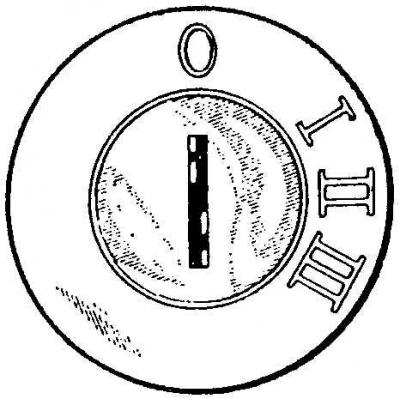
The ignition switch is connected to the steering wheel lock. It is located on the right side of the steering column.
The key in the ignition switch can occupy four designated positions:
- O – ignition off, steering wheel locked; to unlock the steering wheel, insert the key and turn it clockwise, turning the steering wheel slightly to the right and left to facilitate the release of the locking stopper;
- I – ignition off, steering wheel unlocked; in this position you can turn on the car radio;
- II – ignition on, all electrical circuits powered; when towing the vehicle, the key should be set to this position (the key should not be left in this position for a long time with the engine not running, as this may cause the ignition coil to fail);
- III – starter on; turning the key to this position requires overcoming the resistance of the return spring. The key does not remain in this position. After the turning force is weakened, it returns to position "II" (the starter is off) by itself.
Attention! The ignition switch mechanism does not allow the starter to be turned on when the engine is running (this may damage the starter and the toothed ring on the engine flywheel). To turn on the starter, first turn the key to position "I" (and therefore turn off the ignition and the engine, if it was running) and turn the key again to position "III".
Starting a cold engine
To check the engine's thermal condition, turn the ignition key to position "I" and after approximately 30 seconds, look at the coolant temperature gauge. If its arrow remains in the extreme left position, the engine is cold and should be started as described below. If the engine is warm, follow the instructions below.
When starting the engine, the handbrake must be applied and the gearshift lever must be in neutral position.
In cars with a manual transmission, before engaging the starter, press the clutch pedal all the way down and hold it in this position.
Engines equipped with a carburetor with a variable diffuser cross-section
1. Do not press the accelerator pedal. The Ford (Motorcraft) carburetor with a variable diffuser section has an automatic starting device and adjusts to engine temperature.
2. Turn on the starter. If the engine does not start within 10 seconds, turn the key to position "I", wait a few seconds and turn on the starter again.
Caution: Do not press the accelerator pedal while starting the engine.
3. If the engine still does not start, wait about 10 more seconds and then proceed according to the instructions given below.
4. After starting the engine, immediately release the force on the key, which will automatically return to position "II".
Engines equipped with other types of carburetors with automatic starting device
1. To start the automatic starting device of the carburetor, slowly press the accelerator pedal fully (to the stop) twice and release it freely.
2. Turn on the starter (key in position "III"). If the engine does not start within 10 seconds, turn the key to position "I", wait a few seconds and turn on the starter again.
Caution! Do not press the accelerator pedal while the starter is running.
3. After three unsuccessful attempts to start the engine, you must wait about 10 seconds and proceed according to the instructions below.
4. After starting the engine, immediately release the force on the key, which will automatically return to position "II".
5. If the engine stalls after it has started, repeat the steps to start the engine, first by slowly pressing and releasing the accelerator pedal.
Engines equipped with other types of carburetors with a manually controlled starting device
1. Pull the carburetor trigger lever all the way out. Slowly press and release the accelerator pedal once (do not press it later during the engine starting process).
2. Turn on the starter (key in position "III"). If the engine does not start within 10 seconds, turn the key to position "I", wait a few seconds and turn on the starter again.
Caution! Do not press the accelerator pedal while the starter is running.
3. If the engine does not start after the second attempt, wait about 10 seconds and proceed as described below.
4. After starting the engine, immediately release the force on the key, which will return to the "II" position by itself. As the engine warms up, gradually move the carburetor starting lever, ensuring smooth engine operation. Starting a warm gasoline engine.
5. Press the accelerator pedal halfway and hold it in this position.
6. Turn on the starter. After starting the engine, immediately release the force on the key and the accelerator pedal.
7. If the engine does not start after three attempts, it is most likely flooded with fuel (there is a mixture in its cylinders that is too rich in fuel).
Starting a warm gasoline engine
1. Press the accelerator pedal halfway and hold it in this position.
2. Turn on the starter. After starting the engine, immediately release the force on the key and the accelerator pedal
3. If the engine does not start after three attempts, it is most likely flooded with fuel (there is a mixture in the cylinders that is too rich in fuel). You should proceed according to the instructions below.
Starting a gasoline engine flooded with fuel
Slowly press the accelerator pedal all the way down, hold it there and engage the starter. Once the engine starts, slowly release the pressure on the accelerator pedal as the engine speed increases.
Starting a diesel engine
1. Turn the ignition key to position "II". The glow plug indicator light comes on.
2. Wait until the glow plug indicator light goes out.
3. Press the accelerator pedal all the way down.
Caution: At low ambient temperatures, to facilitate starting, before engaging the starter, press the clutch pedal to disengage the gearbox containing thickened oil.
4. Turn on the starter.
5. If the engine does not start within about 20 seconds, turn the key to position "I", wait a little and try to start the engine again.
Attention! If the engine cannot be started due to lack of fuel, after filling the tank with fuel, it is necessary to remove air from the fuel system (see subsection 2.8).
Starting the engine using an additional battery
Connecting an additional battery to start the engine
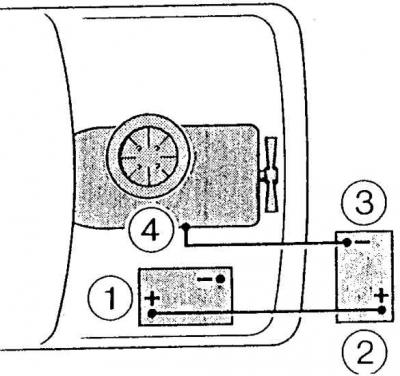
1–4 – order of connecting wires.
If the car battery is discharged, you can start the engine by connecting another, charged battery.
1. Connect the terminal () of the additional battery (B) to the terminal () of the vehicle battery using a special jumper cable (of the appropriate cross-section).
2. Connect the (-) terminals of both batteries with the second jumper cable.
Caution! First, connect the wires to the auxiliary battery to avoid sparking if the wire terminal accidentally touches the vehicle ground.
3. Do not disconnect the booster battery immediately after starting the engine when it is running at high idle speed. Wait until the engine is warm and running at normal idle speed.