Contents: Starting an engine with automatic… ↳ General provisions for starting the… ↳ Cold start system (diesel) ↳ Turning off the turbodiesel ↳ Dual-circuit braking system ↳ Disc brakes ↳ Brake fluid ↳
Individual methods are presented in table form. Note the starting methods that suit your engine.
Warning: If the engine does not start, refer to the instructions for safely starting a diesel engine.
Starting an engine with automatic transmission
The engine can only be started when the shift lever is in position N or P.
A cold engine idles at a higher speed after starting. This causes the engine to "slip" in gears R, D, 3, 2 or 1
Warning! Apply the handbrake or foot brake before engaging gear, otherwise the vehicle will start moving on its own due to slippage in the automatic transmission.
| Engine type | Engine operating conditions | |
| Cold engine | Hot engine | |
| Diesel | Turn the ignition key to position II and wait until the preheating signal goes out. | If the engine does not start within 20 seconds, wait a little and repeat the starting procedure. |
General provisions for starting the engine
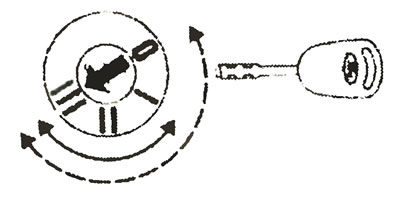
Turn the ignition key clockwise to engage the starter. Do not keep the starter on for more than 5 seconds at a time.
If the starter has to be turned on more than once, the ignition key should be returned to position I or 0
Cold start system (diesel)
If summer diesel fuel was added to the tank, replace it with winter fuel. The following procedure should be followed:
1. Disconnect the fuel supply line from the cold start heater connector and place the end of the fuel supply line in a suitable container.
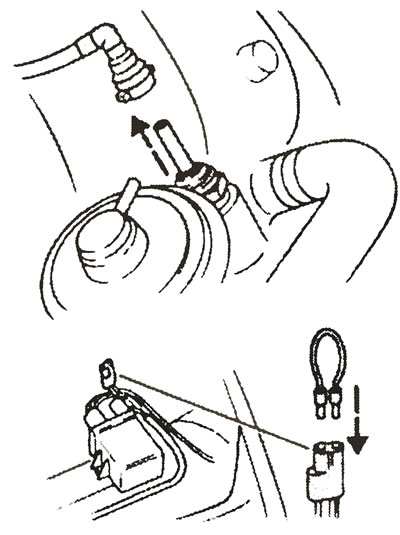
2. Disconnect the spark plug and short-circuit the test connector contacts.
3. Turn on the ignition. The pre-heating indicator lamp will light. Start the engine for 3-4 seconds until 30-40 cm³ of fuel flows out of the fuel supply line.
4. Remove the bridge connection.
5. Reconnect the fuel supply line to the glow plug.
Turning off the turbodiesel
Release the accelerator pedal. Wait until the engine idles, then turn it off.
If the engine is turned off at high RPM, the turbo will continue to operate after the engine oil pressure drops to zero. This will lead to premature wear of the turbocharger.
Dual-circuit braking system
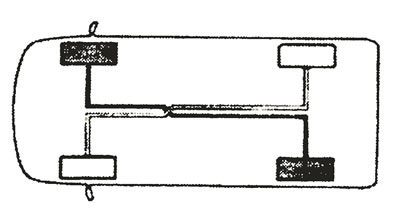
Depending on the model, your car has a dual-circuit braking system, which is divided diagonally or into front and rear systems, where the front brakes are disc brakes and the rear brakes are drum brakes. If one circuit fails, the second will continue to work.
Warning! In this case, increase the brake pedal force and take into account the increased braking distance. Have your brake system checked at a Service Center before continuing driving.
Disc brakes
After passing the car through a car wash or during heavy rain and slush, briefly press the brake pedal with light force to remove the water film from the brake discs.
Brake fluid
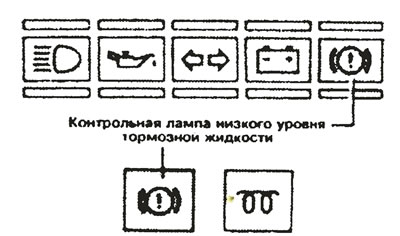
If the fluid level indicator lamp does not go out when the ignition is on, the brake fluid level is low.
Warning! Immediately add brake fluid to the "MAX" mark in the reservoir and have the brake system checked by a service center.
This article is a copy from the website FORDBOOK.RU