Frequent engine oil and filter changes are the most important part of maintenance. Old engine oil contains dissolved particles and contaminants, which leads to premature engine wear.
Before changing the oil, it is necessary to warm up the engine to operating temperature, as this significantly increases the fluidity of the oil and helps to completely remove the old oil from the engine. When draining the oil, be careful, as the leaking oil is at a high temperature.
1. Position the vehicle so that the drain plug is at its lowest point.
2. Loosen the drain plug approximately half a turn, place a container to collect the drained oil under the drain plug, then unscrew the plug completely.
3. Allow the used motor oil to drain for a while. As the oil drains, gradually move the container toward the stream of oil.
4. Clean the drain plug with a clean cloth. Remove the old O-ring from the plug and install a new one. Clean the plug installation area on the pan. Screw in the drain plug, tightening it to a torque of 25 Nm (for diesel engines 35 Nm).
5. To replace the filter, place a container under the oil filter.
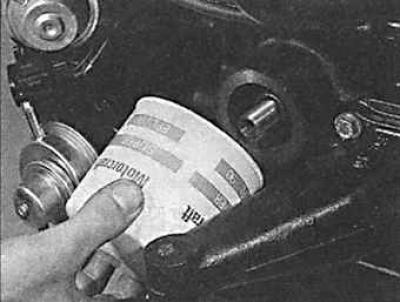
6. Use a special oil filter wrench to unscrew the used filter.
7. Clean the connection surface, lubricate the rubber gasket with fresh oil and screw in the new filter.
8. Screw the oil filter in by hand until the rubber gasket touches the engine, then screw the filter in by hand 3/4 of a turn (according to the installation instructions included with the filter).
9. Fill with fresh oil through the oil filler neck located in the cylinder head cover, maintaining the correct level.
10. Start the engine and let it run for a few minutes, then check for leaks around the oil filter and oil pan drain plug.
Caution! After starting the engine, the oil pressure indicator light will remain on for a while until the pump pumps fresh oil into the line.
11. Turn off the engine and wait a few minutes for the engine oil to drain into the pan, then re-measure the oil level and top up if necessary.
Caution: If metal shavings are present in used engine oil, this usually indicates wear of the main or connecting rod bearings of the crankshaft.
12. The volume of engine oil corresponding to the difference between the "MAX" and "MIN" marks on the oil level indicator is approximately 0.5–1.0 liters.
Attention! It is strictly forbidden to overfill the oil above the "MAX" mark. Overfilling the oil leads to failure of the crankshaft and catalytic converter seals.
Attention! When changing the oil, it is advisable to use motor oil of the same type and brand. It is advisable not to mix oils of different brands (when adding or replacing). When changing the type and brand of oil, it is necessary to flush the engine with a special agent that is added to the oil before replacing it. Oils of the same type and brand, but different viscosity can be mixed without restrictions.
Engine oil volume, dm³
| Engine | With filter replacement | Without filter replacement |
| OHC | 3,75 | 3,25 |
| DOHC | 4,5 | 4,0 |
| V6 2,9 | 4,5 | 4,25 |
| V6 2,4 | 4,5 | 3,8 |
| Diesel until September 1993. | 5,6 | 5,0 |
| Diesel after September 1993. | 6,6 | 6,0 |