- the pressure in the engine lubrication system has dropped. The cause of this malfunction is often increased wear of the camshaft journals and camshaft bearing beds in the cylinder head. If the beds and their covers are worn out, the cylinder head is replaced as an assembly, since the beds are made directly in its body;
- valve knocking with normal clearances in the valve drive mechanism. Caused by increased wear of the camshaft cams due to the use of low-quality motor oil or damage to the oil filter.
You will need: the same tools as for removing the timing belt (see "Replacing camshaft seals"), as well as a TORX E11 key, a torque wrench.
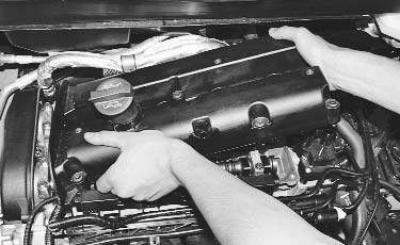
1. Remove the cylinder head cover (see "Replacing the cylinder head cover gasket").
2. Remove the timing belt (see "Replacing the timing belt").
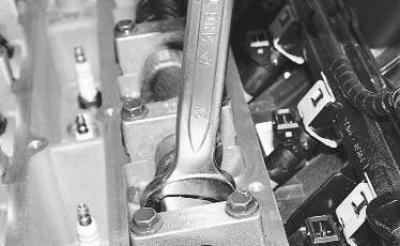
3. Having secured the camshafts from turning, unscrew the camshaft pulley mounting bolts…
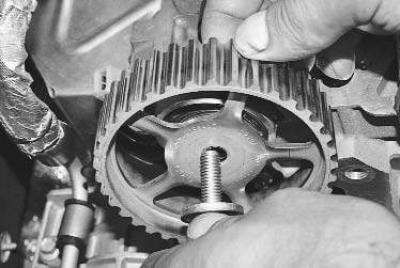
4. …and remove the pulleys from the shafts.
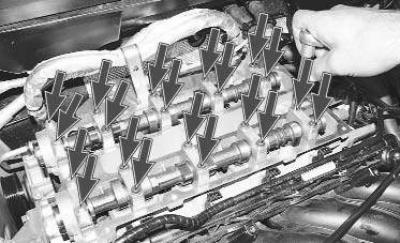
5. Unscrew the camshaft bearing cap mounting bolts in the reverse order to that shown in Fig. 5.10…
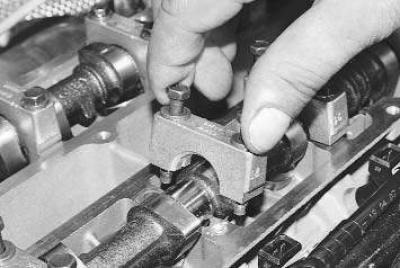
6. …remove the covers and seals from the camshaft journals…
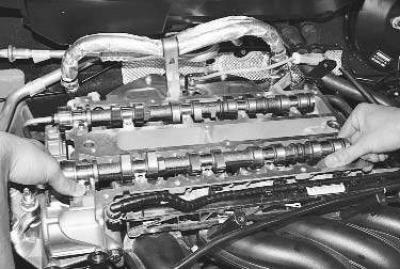
7. …and remove the camshafts.
Attention! The camshaft bearing caps have their serial numbers. Remember or write down the location of the caps to install them in their original places: the caps are processed together with the cylinder head and it is prohibited to depersonalize them.
Note: Replace the camshaft seals with new ones each time they are removed.
8. Inspect the camshafts. The surfaces of the bearing journals and cams must be well polished and without damage. No scoring, nicks, scratches, or aluminum drag from the bearing seats in the cylinder head are allowed on the working surfaces of the journals. If there are signs of seizure, overheating, deep scratches, or faceted wear on the working surfaces of the cams, replace the shafts.
Attention! Grinding of camshaft cams to eliminate step wear is prohibited, since changing the cam profile dimensions will disrupt the valve timing.
9. In workshops equipped with special tools and devices, you can check the radial runout of the camshaft journals. If the runout is more than 0.02 mm or the journals are not aligned, replace the shaft, since its straightening is not allowed.
10. Lubricate the camshaft beds with clean engine oil and place the camshafts in them in such a position that none of the cams rests with the highest part of its nose on the valve tappet adjusting washer.
11. Lubricate the front camshaft bearing caps with sealant.
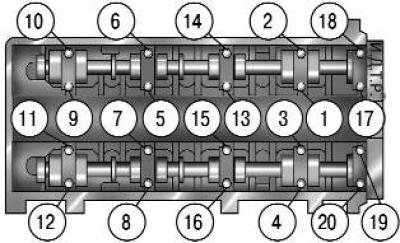
Fig. 5.10. Tightening order of camshaft bearing cap bolts
12. Install the camshaft bearing caps and tighten their mounting bolts in the order shown in Fig. 5.10, in three stages:
- Step 1 - Tighten the bolts evenly, 1/2 turn each, until the bearing caps contact the cylinder head surfaces;
- Step 2 - Tighten the camshaft bearing cap bolts to 7 Nm;
- Step 3: Tighten the camshaft bearing cap bolts by 45°.
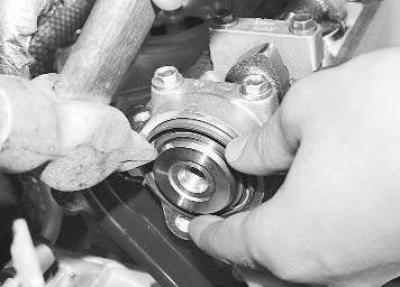
13. Press the camshaft oil seals into the seats of the front camshaft bearing caps (see "Replacing camshaft seals").
14. Install the remaining parts in the reverse order of removal.
[The original article is available on the website FordBook]