Contents: Removal ↳ Installation ↳
The cylinder head can be removed without removing the engine from the vehicle. There is no need to disconnect the exhaust and intake manifolds. The cylinder head can only be removed from a cold engine (a hot engine must stand for at least four hours until it cools down completely).
A defective cylinder head seal can be identified by various signs, see p. 1.5.
Removal
Disconnect the negative (-) cable from the battery.
Warning! This will erase data in electronic memory devices, such as the engine fault memory device or the radio code. Please read the section carefully "Removing and installing the battery", before disconnecting it.
Remove the air filter, see p. 5.6.
Loosen the retaining clamp and remove the air intake hose from the intake manifold.
Unscrew the charge air radiator "10" (arrow) and remove it.
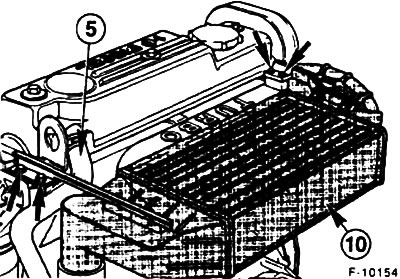
Remove the crankcase ventilation hose "5" from the cylinder head cover.
Drain the coolant, see p. 3.3.
Remove the upper radiator hose from the thermostat housing, first loosen and slide the retaining clamp.
Remove the coolant hoses going to the cylinder head:
- Connecting hoses of the expansion tank from the cylinder head and thermostat housing.
- Connecting hose from the heating system heat exchanger.
Remove the EGR vacuum hoses from the EGR valve on the exhaust manifold. Regarding the EGR system see p. 7.1.
Remove the brake booster vacuum hose and the oil return hose from the vacuum pump, perhaps unscrew them, see p. 1.11.
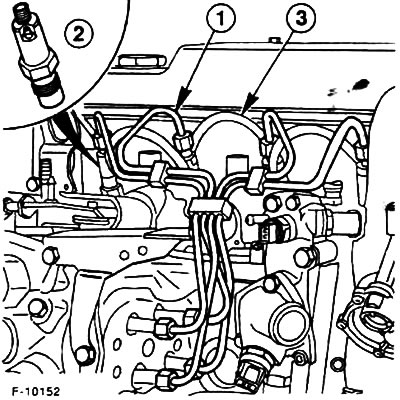
Remove the oil drain pipes "3" from the jets.
Loosen the union nuts of the high-pressure pipes "1" on the jets "2" and the high-pressure fuel pump. Remove the pipes complete with brackets.
Attention! Do not change the shape of the pipelines. Close the pipes with suitable plugs to prevent dirt from getting inside.
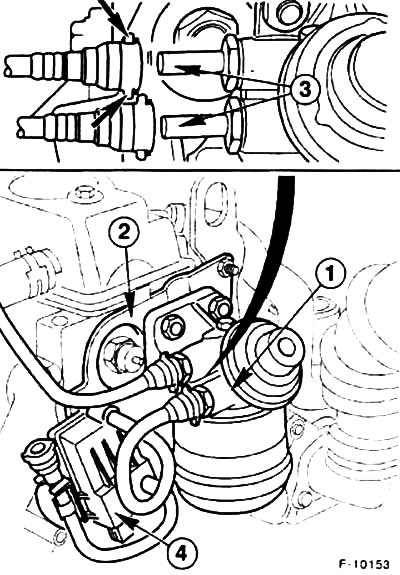
Remove the fuel supply line of the high-pressure fuel pump from the fuel filter "1". To do this, press the release buttons "arrows" and remove the quick-lock lock "3" from the pipe.
Unscrew bracket "2" and set it aside together with fuel filter "1" and fuel heater "4".
Unscrew the oil level indicator bracket with one bolt from the thermostat housing.
Disconnect the following electrical wires - from the remote thermometer sensor (near the thermostat housing), - from the engine fan thermal switch (on the thermostat housing), - glow plug wires, - from the hydraulic switch (near the fuel filter).
Remove the coolant hose from the thermostat housing.
Unscrew the thermostat housing, two bolts.
Raise the car.
Unscrew the front exhaust pipe from the turbocharger and tie it with wire so that it cannot fall, see item 8.
Remove the alternator V-belt, see paragraph 1.19.
Remove the timing belt from the camshaft sprocket, see 1.7.
Remove the camshaft sprocket bolt. Use a strong screwdriver inserted into the hole in the sprocket to prevent the shaft from turning while removing the bolt. Tap the sprocket lightly with a plastic hammer to loosen the cone joint and remove the sprocket.
Remove the timing belt sprocket under the camshaft by unscrewing the Torx bolt.
Remove both rear timing belt covers.
Remove the timing belt side covers.
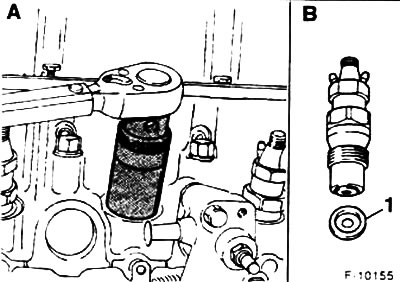
Unscrew the jets using a suitable removable socket wrench and ratchet, such as Hazet 4555.
Remove the wires from the glow plugs, unscrew the plugs, see p. 7.5.
Unscrew the cylinder head cover and the oil deflector located underneath.
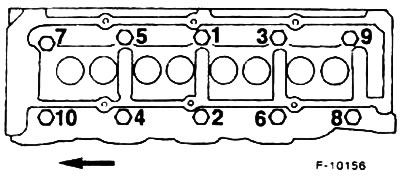
Loosen the cylinder head mounting bolts by 1/2 turn in the reverse order, i.e. from 10 to 1. Then unscrew all the bolts using the T70 Torx key.
Remove the cylinder head.
Attention! After removing the head, do not place it on the sealing surface, otherwise you can damage the fully open valves, it is best to place it on two wooden blocks.
Installation
Before installing the cylinder head, carefully clean the sealing surfaces of the cylinder head and block from seal residue using a scraper. Do not allow seal residue to enter the openings. Cover the openings with rags.
If the fuel injection system is open, try not to work with compressed air at this time, do not move the car. Close the open parts with plugs or rags if the repair is not finished.
Check the flatness of the cylinder head and cylinder block sealing surfaces using a steel ruler along the longitudinal and transverse axes. The permissible deformation due to heat exposure cannot exceed 0.06 mm along the entire length. The cylinder head must not be finished. If greater deformation is detected, replace the head.
Check the cylinder head for cracks, check the cylinder running surfaces for grooves.
Important! Thoroughly clean the cylinder head mounting bolt holes from oil and other sealant residue. Remove any oil or coolant that has accumulated in the mounting bolt holes with compressed air or a rag.
Replace the cylinder head gasket.
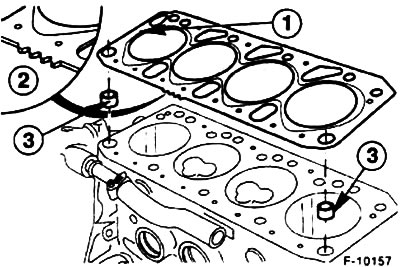
Check the tightness of the fit of both guide bushings "3" in the engine block. The guide bushings allow precise centering of the cylinder head and gasket.
Place the new gasket or sealing compound so that the holes are not covered and the inscription on the seal "TOP/OBEN" at point "1" should be on the cylinder head side.
Caution! The cylinder head gasket has "2" teeth. Only install the exact same gasket. The number of teeth serves as a measure for the thickness of the gasket, it also determines the distance the pistons can protrude from the cylinders. Seals for cylinders that meet the upper size limit are perforated.
Before installing the cylinder head, check that the camshaft is in the TDC position, see p. 1.7.
Install the cylinder head.
Install and hand tighten the new cylinder head mounting bolts.
Attention! The cylinder head mounting bolts must be replaced. These are flexible bolts that can only be used once.
Caution! Tighten the cylinder head bolts carefully. Before tightening the bolts, check the accuracy of the torque wrench. In addition, an angle washer, such as HAZET 6690, is required to tighten the bolts. If you do not have an angle washer, make a template out of paper and mark 120° and 180° on it. Install the wrench and tighten the bolt to the mark. (See Fig. E-10156).
Tighten the cylinder head bolts in stages (three steps), starting with bolt #1.
- First step: with a torque wrench, 10 Nm
- Second step: with a torque wrench, 100 Nm
After this, wait three minutes for the bolts to "settle". Perform the next step according to the tightening sequence for each bolt separately.
Third stage:
- using an open-end wrench, loosen the bolts 180°.
- tighten with a torque wrench to 70 Nm.
- tighten the bolts further with an open-end wrench to 120°.
Caution! The cylinder head mounting bolts must not be tightened further.
Install the camshaft timing belt sprocket as it was before removal and screw it in place; the adjusting pin must be installed. Tightening torques: M6 bolts: 10 Nm; Bolts M8: 30 Nm.
Screw on the two rear timing belt covers. Install the timing belt, install the timing belt covers, see p. 1.7.
Screw in the glow plugs and tighten them; tightening torque 30 Nm. Connect the electrical wires to the glow plugs.
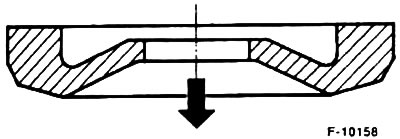
Screw in the jets with a new heat-protective seal and tighten them to a torque of 70 Nm. The recess in the seal should face upwards, the arrow points to the cylinder head.
Install the V-belt, see paragraph 1.19.
Screw on the front exhaust pipe, see item 8.
Check the valve clearances and adjust them if necessary, see paragraph 1.17.
Install the cylinder head cover with a new seal, tighten it lightly with bolts to a torque of 5 Nm.
Connect the crankcase ventilation hose to the cylinder head.
Install the bracket with the fuel filter, connect the fuel lines. The quick-locking locks should click into place, this should be clearly audible.
Screw on the thermostat housing with a new seal, see p. 3.5.
Screw the oil level indicator bracket to the thermostat housing.
Connect the high-pressure fuel lines to the jets and pump, tighten the union nuts to a torque of 20 Nm.
Connect the oil drain hoses to the jets.
Connect the electrical wires to the cylinder head, see the "Removal" section.
Connect the vacuum hose to the brake booster, connect the oil return hose to the vacuum pump.
Connect the vacuum hoses from the exhaust pipe to the EGR valve (on the intake pipe), see p. 7.1.
Connect the coolant hoses and secure them with clamps:
- connecting hoses from the expansion tank to the cylinder head and thermostat housing.
- connecting hose to the heating system heat exchanger.
Bolt the charge air radiator to the cylinder head.
Connect the air suction hose to the intake manifold and tighten the fastening clamps.
Install the air filter, see p. 5.6.
Fill with coolant, see p. 3.3.
Check the engine oil level, top up if necessary. If the cylinder head was removed because the head seal failed, it is recommended to completely change the oil, including the oil in the oil filter, since coolant may have entered the oil.
Connect the ground (-) wire to the battery. Set the clock, set the radio anti-theft code.
Attention! Before starting the engine, bleed its fuel system, see p. 7.4.
Warm up the engine, check all hose connection points for leaks, check engine oil and coolant levels.
[The original can be found on this resource: FordBook.ru]