Collapse: vertical wheel tilt. Reduces road impacts on steering components, reduces the effort required to turn the wheels, and reduces wheel friction on the road. The Focus' front wheels have positive camber - they are slightly further apart at the top of the wheel well than at the bottom near the ground.
Transverse slope: the vertical tilt of the steering axis. If you draw an imaginary line from this axis to the ground and measure the distance to the centerline through the wheel (the center of the wheel's bearing surface), you will get the steering radius. The turning radius should be as small as possible in order to reduce the forces counteracting the steering. The lateral tilt of the wheels together with the longitudinal tilt contribute to the fact that the car is slightly raised when the wheels are turned. If the steering wheel is released, the wheels themselves set to the middle position (stabilizing moment).
Longitudinal tilt: the distance (in the direction of travel) between an imaginary line extended from the steering axis to the ground and the center of the tire's bearing surface. The longitudinal tilt causes the wheels to be pulled together (rather than pushed together). The pulled wheels themselves tend to move in a straight-line position and to hold on to it steadily (the tea-tray effect).
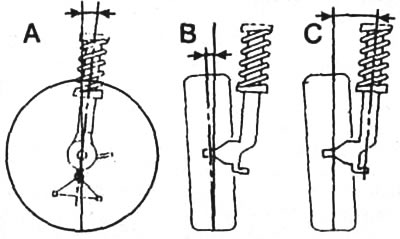
A - longitudinal slope; B - camber, C - lateral tilt
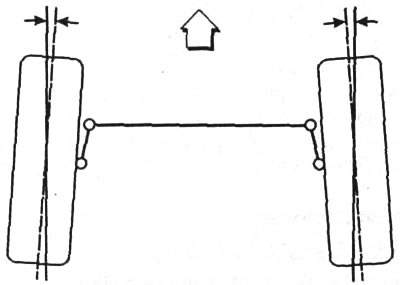
Wheel alignment diagram