Brake pads require replacement when the linings are worn out (the minimum permissible thickness of friction linings is 1.5 mm), the linings are not firmly connected to the base, the working surfaces are oily, or there are deep grooves or chips.
WARNING: Replace the front brake pads only as a set of 4 (two on each side).
WARNING: Before replacing the brake pads, check the brake fluid level in the master cylinder reservoir. If the level is close to the "MAX" mark, it is necessary to pump out some of the fluid (for example, with a medical syringe or a rubber bulb), because after replacing the worn pads with new ones, the level will rise.
You will need: a 7 mm Allen key, a lug wrench, and a large screwdriver.
1. Remove the left front wheel.
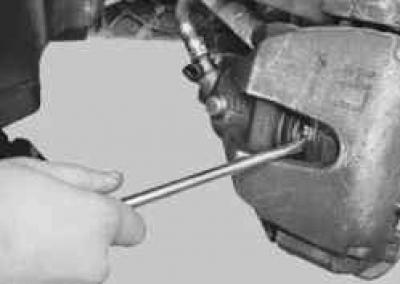
2. Insert a large screwdriver between the inner brake shoe and the slave cylinder piston and push the piston into the cylinder.
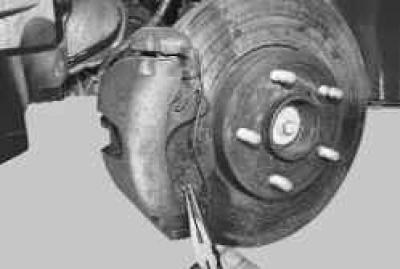
3. Using fine-nosed pliers, remove the bent ends of the outer pad spring retainer from the caliper holes…
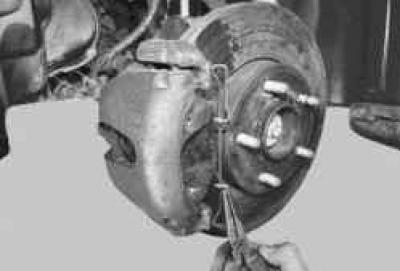
4. …and remove the retainer.
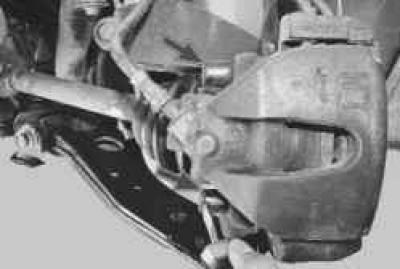
5. Using a screwdriver, pry off the covers of the protective bushings of both guide pins…
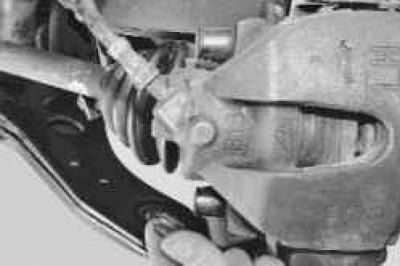
6. …remove the covers.
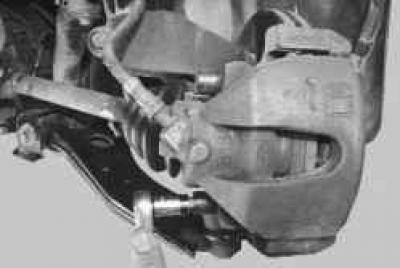
7. Turn out the lower guide pin…
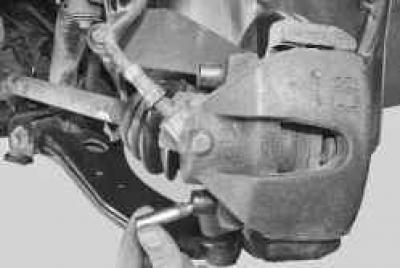
8. …and remove it from the shoe guide hole.
9. Similarly, unscrew and remove the second guide pin.
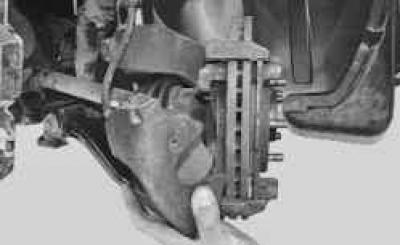
10. Remove the caliper together with the inner brake pad from the pad guide, making sure that the brake hose is not stretched or twisted…
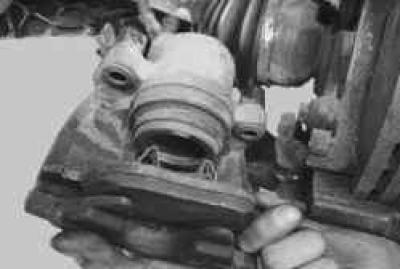
11. …and remove the inner brake shoe by extracting its spring retainer from the piston cavity.
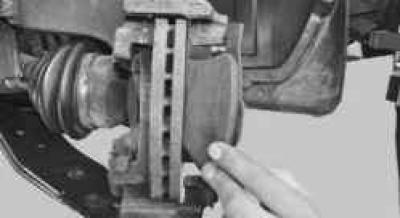
12. Remove the outer shoe by pulling it out of the guide grooves.
NOTE: Note
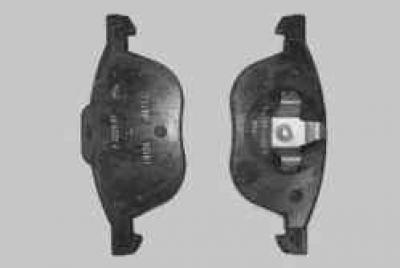
NOTE: Pay attention to the markings on the brake pads. Purchase new pads with the same markings.
13. Inspect the outer shoe spring retainer. Replace a severely deformed or corroded retainer.
USEFUL TIP: Whenever you replace the brake pads, be sure to check the condition of the protective plastic bushings of the guide pins and the movement of the caliper relative to the brake pad guide. If movement is difficult, lubricate the caliper guide pins with grease.
HELPFUL TIP: If the guide pin protective bushings are damaged or their caps do not fit into the bushing holes, replace the protective bushings.
14. Install the front brake pads in the reverse order of removal. To prevent the caliper guide pins from loosening, lubricate their threads with anaerobic thread locker before installation.
15. Press the brake pedal several times to bring the brake pads to the disc.
16. Install the wheel.
17. Similarly, replace the brake pads of the right wheel brake mechanism.
18. Check and, if necessary, restore the brake fluid level in the master cylinder reservoir.
USEFUL TIP: After replacing worn brake pads with new ones, do not rush to drive on busy highways. It is possible that during the first intensive braking you will be unpleasantly surprised by the low efficiency of the brakes, although the pads were original. Brake discs also wear out, and new pads touch them only with their edges, practically without braking. Choose a quiet street or a passage without cars and brake smoothly several times so that the pads rub in and begin to fit over the entire surface. At the same time, evaluate the efficiency of the brakes.
USEFUL TIP: Try not to brake sharply for at least the first 100 km. When unburned pads heat up strongly, the top layer of their linings burns and the brakes will not be maximally effective for a long time.