Engines 1.4 l and 1.6 l
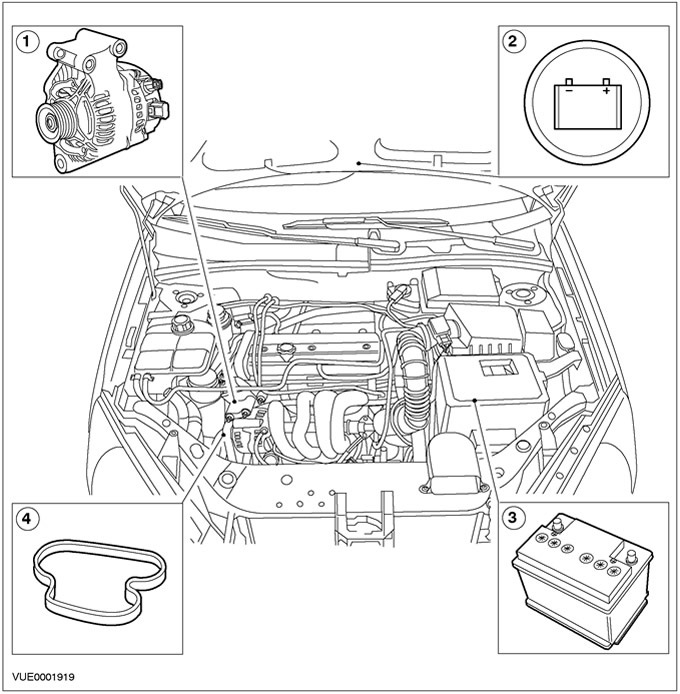
| Pos. | Spare Part No | Name |
| 1 | Generator | |
| 2 | Charging system warning lamp | |
| 3 | Battery | |
| 4 | Auxiliary drive belt |
Engines 1.8 l and 2.0 l
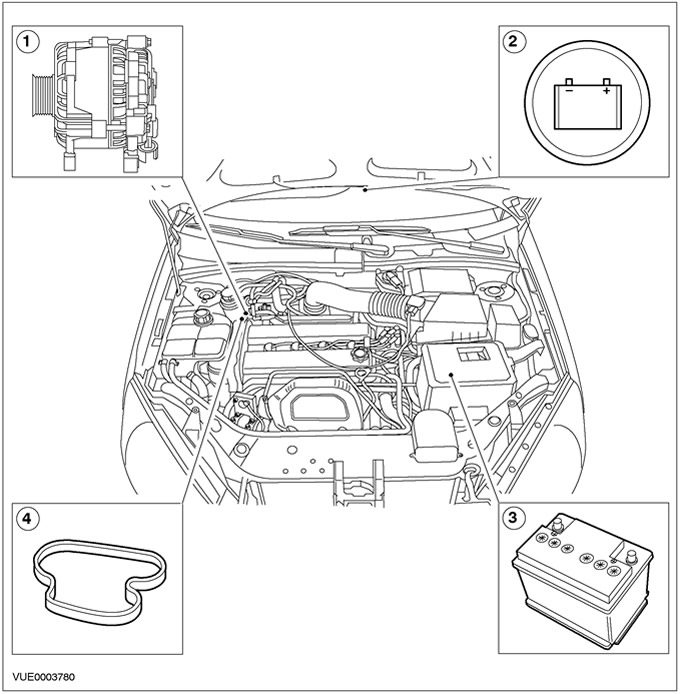
| Pos. | Spare Part No | Name |
| 1 | Generator | |
| 2 | Charging system warning lamp | |
| 3 | Battery | |
| 4 | Auxiliary drive belt |
The charging system consists of a generator that generates current to supply the vehicle's electrical system and keep the battery charged.
The generator is driven by an auxiliary drive belt. See Section 303-05 for more information. When the engine is started, the alternator starts to generate alternating current (AC), which is internally converted to direct current (DC). DC control is carried out by a voltage regulator (located at the back of the generator). Then the current is supplied to the battery.
The voltage in the charging system is controlled by the powertrain control module (PCM). The generator charges the battery and, at the same time, supplies current to all the necessary electrical circuits. The battery charges more efficiently with a higher voltage when the battery is cold and a lower voltage when the battery is hot. The PCM is capable of adjusting the charging voltage based on battery temperature using a signal from the intake air temperature sensor (IAT). This means that the PCM calculates the level of the commanded voltage and sends this value to the regulator via the communication link.
The PCM simultaneously controls and monitors the generator output. If the current draw is high or the battery is low, the system can increase the idle speed.
The PCM controls the alternator to minimize engine drag caused by friction when starting the engine. The generator does not produce output power until the engine is started. The PCM then gradually increases the generator output power.
The PCM controls the charging system warning light on the instrument panel. Therefore, it is up to the PCM to turn off the warning light after starting the engine and turn on the warning light when a malfunction occurs (if the generator does not generate the required current when the engine is running). The PCM also turns on the warning light if the engine is turned off in the run position or the engine stalls.
Units should be repaired as a single unit and should not be dismantled for repairs. See Section 414-02 for more information.
Visitor comments