


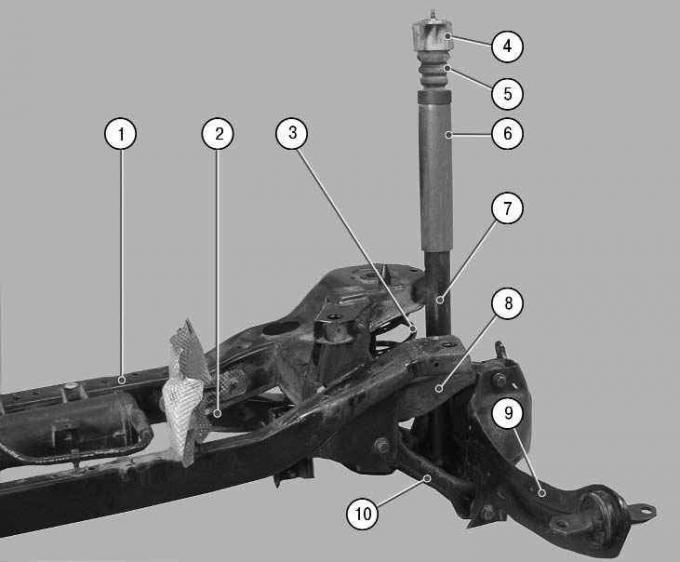
Fig. 7.2. Rear suspension of cars with sedan and hatchback bodies: 1 – rear suspension cross member; 2 – rear lower arm of the rear suspension; 3 – rear suspension spring; 4 – rear suspension shock absorber mounting bracket; 5 – compression buffer; 6 – protective cover of the rear suspension shock absorber; 7 – rear suspension shock absorber; 8 – Upper arm of the rear suspension; 9 – Rear suspension trailing arm; 10 – Front lower arm of the rear suspension
The rear suspension of Ford Focus II cars with sedan and hatchback bodies (Fig. 7.2) is independent, multi-link spring (three transverse and one longitudinal on each side), with telescopic shock absorbers and anti-roll bar.
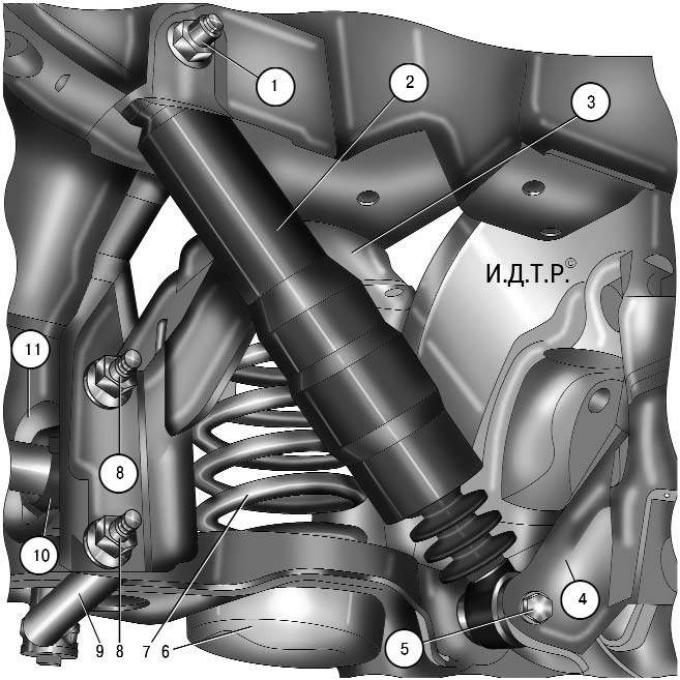
Fig. 7.3. Rear suspension of station wagons: 1 – upper shock absorber mounting bolt; 2 – shock absorber; 3 – rear suspension cross member; 4 – trailing arm of the rear suspension; 5 – lower shock absorber mounting bolt; 6 – rear lower arm of the rear suspension; 7 – spring; 8 – nuts of the bolts for fastening the anti-roll bar bracket; 9-crossbar stabilizer bar; 10 – anti-roll bar cushion; 11 – anti-roll bar bracket
The rear suspension of station wagons is similar in design to the suspension of sedan and hatchback vehicles and differs only in the shock absorber mount (Fig. 7.3).
The camber angle of the rear wheels is set by design and is not adjustable during operation. The camber angle can only be used to monitor the condition of the rear suspension (see "Checking and adjusting wheel alignment angles"). The toe-in of the rear wheels is adjusted using the rear lower arm mounting bolts, which are made in one piece with the eccentrics.
The text was obtained in its entirety from the specified website: fordbook.ru