Contents: Checking the electrolyte level ↳ Checking voltage ↳ Checking the battery under load ↳ Checking the density of the… ↳
Checking the electrolyte level
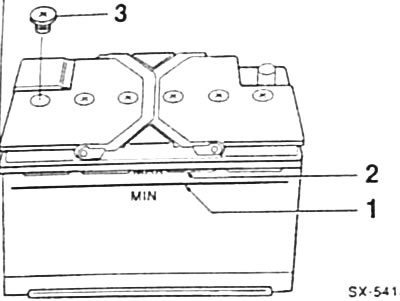
The electrolyte level in each element should be between the MIN mark "1" and the MAX mark "2". If necessary, unscrew the plugs "3" of the battery and top up the level with distilled water.
Checking voltage
The condition of the battery is checked by measuring the voltage between its terminals using a voltmeter.
Clean the outside of the battery.
Before checking, the battery must be charged for at least six hours, including after charging with the engine running.
Turn off the headlights and all other electrical consumers and wait 5 minutes.
Connect a voltmeter to the battery terminals and measure the voltage.
Conclusions based on the measurement results:
- 12.7 volts or higher - battery is in good condition;
- 12.6 volts - normal condition;
- 12.4 volts or less - the battery is in poor condition and needs to be charged or replaced.
Checking the battery under load
Connect a voltmeter to the battery terminals.
Start the engine and read the voltmeter reading.
When starting the engine, the voltage with a fully charged battery should not fall below 10 volts (at an electrolyte temperature of approximately +20°C).
If the voltage immediately drops, and in addition, different electrolyte densities were found in the battery cells, then it is necessary to conclude that the battery is defective.
Checking the density of the electrolyte
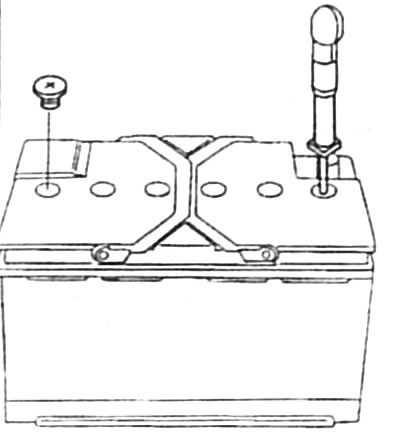
The density of the electrolyte together with the voltage measurement allows to make an unambiguous conclusion about the state of charge of the battery. For testing, a battery densimeter with a pipette is used, which is offered at an affordable price by specialized stores. The higher the density of the electrolyte sucked by the densimeter from the battery, the more the float of the densimeter floats. On the densimeter scale, you can determine the density of the electrolyte in g / ml or in degrees Baume (+° Be).
State of charge of the battery corresponding to the measured density of the electrolyte
| Charging status | +°Be | g/ml |
| discharged | 16 | 1.15 |
| half-discharged | 24 | 1.22 |
| well charged | 30 | 1.26 |
Check each battery element in sequence, all elements must have the same electrolyte density (the maximum permissible difference is 0.04 g/ml). Otherwise, a conclusion is made about the battery defect.