Lubrication system
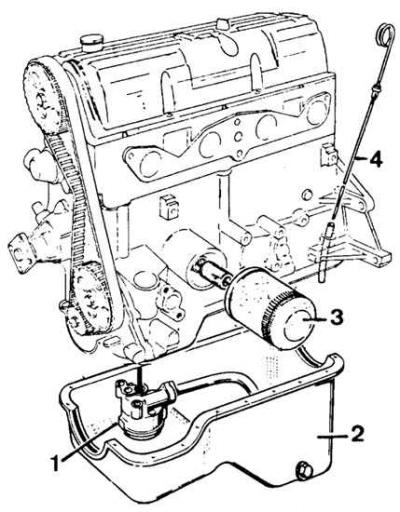
1 – oil pump, 2 – oil pan, 3 – oil filter, 4 – oil level indicator
Engine lubrication circuit
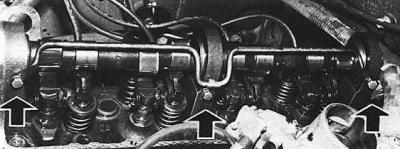
Installing the oil supply line to the camshaft bearings
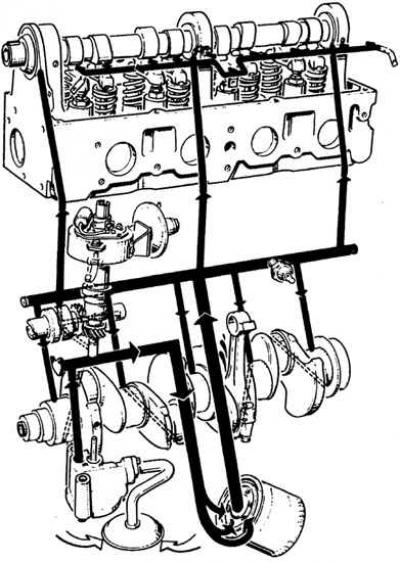
The oil pump takes engine oil from the crankcase and delivers it under pressure through a short channel to a full-flow oil filter. The safety valve located in the pump regulates the maximum pressure created by the pump. When the pressure created by the pump is exceeded, the valve opens and bypasses the oil into the crankcase. Cleaned oil enters the main oil line through the filter. If the filter is clogged, the pressure-reducing valve opens and some of the oil, without being cleaned, is directed into the main line.
From the main line, oil flows through five small channels to the main journals of the crankshaft. Through diagonal holes in the crankshaft, oil flows to the connecting rod journals and then splashes onto the cylinder walls.
From the main line, oil goes to the intermediate shaft and then to the ignition distributor. At the same time, engine oil is supplied directly to the camshaft bearings through three oil lines. From the middle bearing, oil is supplied to all cams and levers through spray oil lines.
Checking oil pressure
1. Warm up the engine to normal operating temperature.
2. Disconnect the electrical wire from the oil pressure indicator light sensor and unscrew its sensor (in vehicles equipped with an oil pressure gauge, disconnect the fitting of its pipeline).
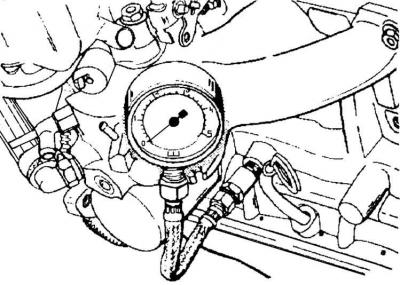
3. Screw the control pressure gauge into the hole in the cylinder block.
4. Start the engine and check the oil pressure at idle speed and above 2000 rpm. The oil pressure should be at least 100 kPa, but not more than 500 kPa.
5. Unscrew the pressure gauge and screw in the oil pressure indicator light sensor.
Replacing the oil filter
1. Unscrew the oil filter from the cylinder block.
2. Lubricate the gasket surface of the new oil filter with oil.
3. Screw the oil filter until the gasket touches the cylinder block surface. Then tighten the filter by hand another 3/4 turn.
Oil pump repair
Oil pump mount
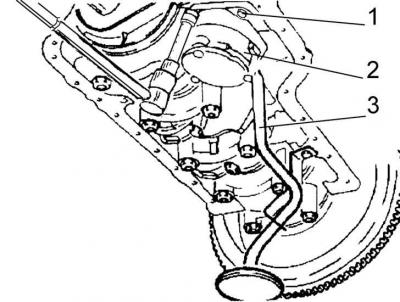
1 – pump mounting bolts, 2 – pump, 3 – oil receiver tube
Oil pump
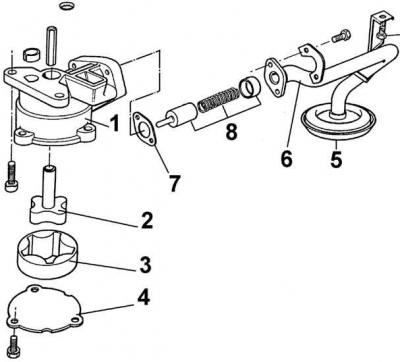
1 – housing, 2 – outer gear, 3 – inner gear, 4 – cover, 5 – oil receiver mesh, 6 – oil receiver tube, 7 – gasket, 8 – safety valve
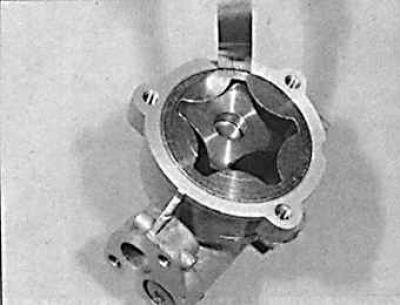
Checking the clearance between the outer rotor and the oil pump housing
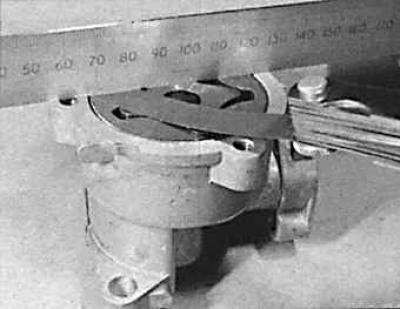
Checking the axial clearance of the oil pump rotor
Caution: The oil pump gears are matched in pairs and both gears must be replaced if necessary.
1. Apply a mark on the rear surface of the outer gear (larger) to ensure that it is installed in the same position relative to the inner gear (smaller) during assembly as it was removed from the factory packaging.
2. Remove the engine oil pan.
3. Remove the oil pump by unscrewing the three bolts securing the pump to the cylinder block.
4. Remove the oil pump cover and remove the gears, and also remove the oil supply line to the pump.
5. Punch a hole in the middle of the rubber plug of the pump bypass valve.
6. Remove the rubber plug using a bolt of the appropriate diameter.
7. Remove the bypass valve spring and piston.
8. Insert both gears into the pump body, ensuring that they are correctly aligned with each other.
9. Using a ruler and feeler gauge, measure the gap between the pump housing plane and the rear surfaces of the gears. If it exceeds the maximum permissible value, the pump housing should be replaced.
10. Using a feeler gauge, check the clearance between the outer gear and the pump body. If it exceeds the maximum permissible value, the pump body should be replaced.
11. Lubricate the bypass valve parts with engine oil and install the bypass valve.
12. Install the rubber bypass plug with the flat side facing out. It should be on the edge of the sealing surface of the oil supply line to the pump.
13. Lubricate both pump gears with engine oil.
14. Install the oil pump cover and tighten its bolts to the specified torque.
15. Insert the shaft transmitting the drive from the intermediate shaft (the end with the asymmetrical protrusion should be directed towards the ignition distributor) into the pump drive shaft and, turning it by hand, make sure that the pump gears interact without jamming.
16. Install the gasket and oil supply line to the pump.
17. Install the oil pump into the cylinder block, tightening the mounting bolts to the appropriate torque.
18. Attach the oil pan to the cylinder block.