Contents: Oil circulation ↳ Rotary oil pump ↳ Combined replacement - engine oil… ↳ Special service – oil sprayers cool… ↳ The pressure issue is oil circulation ↳ Signals only about minimum pressure… ↳
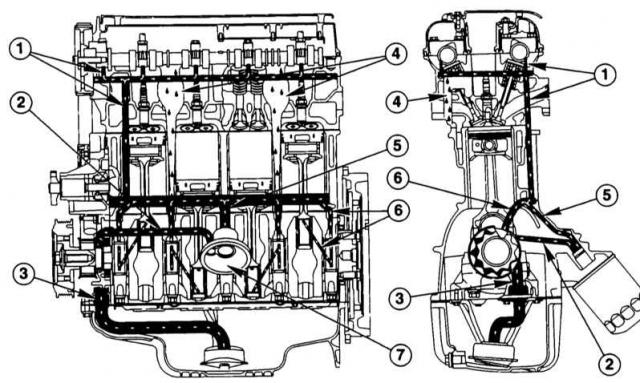
Oil circulation
 |
|
1 — Oil channel to the cylinder head and valve drives,
|
5 - Main oil channel,
|
Rotary oil pump
 |
|
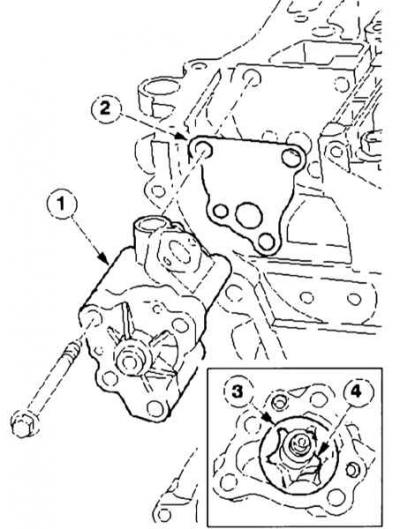
1 - Oil pump,
|
3 - Outer rotor,
|
Check at every third stop at the gas station: engine oil level. Although the Duratec and DuraTorg engines are in no hurry to follow the dubious call, namely, to become a big "oil glutton", we recommend that you check the oil level after every third stop at the gas station. As long as the oil level on the dipstick is between the "MIN" and "MAX" marks, there is no compelling reason to top up the engine oil. Depending on the engine version, the amount of oil to be topped up is between 0.5 and 2 liters. Never top up the oil above the "MAX" level - the radial seals of the crankshaft may be "wet" and the air filter may be contaminated by oil mist emerging from the engine vents.
Without sufficient lubrication, engines would stop after just a few minutes of operation. Therefore, a very thin oil film protects the engine everywhere where moving parts "consult with each other" on issues of "destructive friction": for example, pistons and piston pins, cylinder running surfaces, connecting rod and main bearings of the crankshaft or all valve drives.
In order to prevent the oil film from "breaking off", when the engine is running, the oil circulates through a filigree labyrinth of pipes, channels and holes. Such regulated oil transportation is organized by the oil pump, it directly sucks the engine oil from the oil pan and "accelerates" it inside the above-mentioned labyrinth in the direction of the required addresses. But in order for the oil to arrive there as "fresh" as possible, it first passes through the oil filter, which is located in the Mondeo shortly after the rotor oil filter directly in the main flow of the circulation system. The oil filter frees the "oil juice" from soot particles, metal abrasions and other foreign objects. Naturally, such a filter serves as long as its microscopic thin paper plates are still permeable and not contaminated.
Combined replacement - engine oil and oil filter
The oil filter should generally be replaced together with the engine oil. A dirty filter allows engine oil to circulate even through the pressure relief valve "past the oil filter", but uncleaned oil will accelerate the engine wear process - mainly the crank mechanism, the working surfaces of the pistons and cylinders and the bearing locations in the cylinder head. Usually, engine oil enters all significant lubricating places in the engine cylinder block and crankshaft through holes and channels, and in similar ways it also reaches the cylinder head with camshafts and valve drives.
Pistons and cylinders are usually quite satisfied with the usual splash lubrication provided by the rotating crankshaft: it swirls the oil flowing out of the lubrication points into the surrounding space. On its systematic "lubrication gates" through the engine, the oil maintains a good mood not only inside, it absorbs most of the excess heat that appears in the bearing areas and during each working stroke.
Special service – oil sprayers cool piston crowns
In order to relieve the hot piston crowns of the Mondeo engines even more effectively in terms of heat, they are deliberately "showered" from the engine block via oil sprayers. On the way back to the oil pan, the engine oil "flows" through relatively large drain channels into the used oil collector. Here the "lubricating juice" calms down a little, cools down in the oil pan to 75°C and then sets off on its journey again.
The pressure issue is oil circulation
In order for the oil film to withstand even high loads, the oil must be constantly supplied under pressure to the lubrication points. However, too high a pressure, for example with cold and viscous oil, can lead to engine defects. This is counteracted by a safety valve (bypass) in the connecting flange of the oil filter. It opens at approximately 4 bar and passes the oil back directly to the suction side of the oil pump. In a technically healthy Mondeo power unit, oil reaches the lubrication points at a pressure of approximately 2–3 bar at medium engine speeds (oil temperature 80–100°C, all-season oil SAE 10W-30). At idle, on the other hand, only about 0.6–1 bar is sufficient. The oil pressure gauge provides precise information on the oil pressure. The standard Mondeo does not have such a device on board, but an enthusiast can simply purchase one and retrofit it to their car.
Signals only about minimum pressure - oil pressure indicator light
The serial oil pressure indicator does not provide such precise measurement values, it only "warns" at a pressure of 0.3 – 0.5 bar. In other words, the oil pressure indicator lights up when engine defects are already approaching: sufficient oil supply is not so reliable at a pressure of 0.3 – 0.5 bar. "Trouble", for example, can occur when your Mondeo with a low oil level rushes around a bend: the centrifugal forces that arise in this case "move" the oil in the oil pan to the outside of the bend – in this situation, the oil pump only supplies "hot air" from the collection tank. The oil pressure inevitably goes "into the basement", and severe engine damage is an expensive result of such a situation.
Even if after fast driving on the motorway or mountain road the oil pressure indicator starts to flash at idle, this is a reliable sign that the required oil pressure has not been achieved. During the time when the indicator naturally goes out again when the gas is applied lightly, there is no particular reason to worry - you can dreamily continue on your way, the "healthy" engine will cool down again while driving.
Only when the indicator light is constantly on...
- stop immediately and turn off the engine.
- Check the oil level and...
- add the required amount immediately if possible. Otherwise, drive very carefully to the next petrol station and add oil there. Then check whether the control lamp has gone out.
- If it does not go out, tow the car to the nearest workshop and show it to a specialist. Depending on the circumstances, this may help you avoid serious engine malfunctions.