You will need: coolant, a clean rag, a container for draining the coolant with a capacity of at least 10 liters, a flat-blade screwdriver.
Caution! Use ethylene glycol-based coolants (antifreeze).
Caution! Replace the coolant only when the engine is cold.
Warning: Coolant is toxic, so be careful when handling it.
Caution! When starting the engine, the expansion tank cap must be closed. Screw the tank cap tightly. The cooling system is under pressure when the engine is running, so if the cap is loosely screwed, coolant may leak from under it.
1. Place the vehicle on a level, horizontal surface.
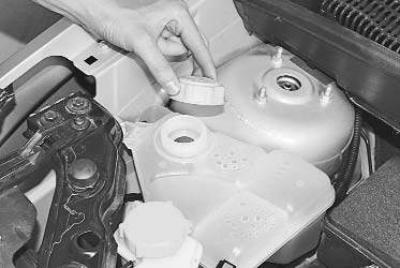
2. Unscrew the expansion tank cap.
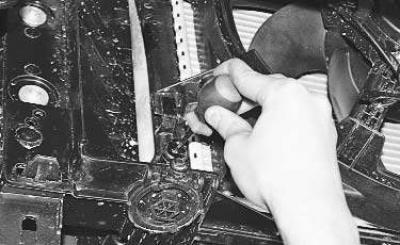
3. Place a container under the drain plug and, after unscrewing the plug..
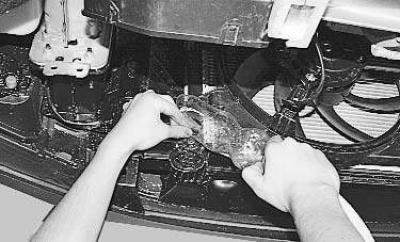
4. …drain the coolant.
Warning! Antifreeze is deadly poisonous to all living things. In order not to pollute the environment, drain it from the radiator through a funnel (for example, made from a plastic bottle for soda water).
Note: If the expansion tank is heavily soiled, remove it (see "Removal and installation the expansion tank") and rinse.
5. Flush the cooling system by tightening the drain plug and filling the system with water through the expansion tank.
6. Start the engine and let it run until the electric fan turns on.
7. Turn off the engine and drain the water.
8. Flush the cooling system until clean water starts to drain.
9. Screw in the drain plug.
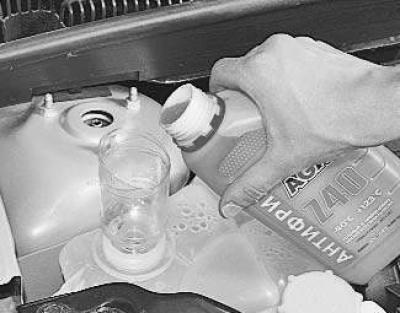
10. Fill the engine cooling system by pouring coolant into the expansion tank.
11. Start the engine and warm it up to operating temperature (until the electric fan turns on). Then stop the engine, check the coolant level and, if necessary, add it to the expansion tank up to the "MAX" mark.
Note. While the engine is running, monitor the coolant temperature on the gauge. If the needle reaches the red zone and the radiator fan does not turn on, turn on the heater and check what kind of air passes through it. If the heater supplies warm air, the fan is most likely faulty, and if it supplies cold air, then an air lock has formed in the engine cooling system. To remove it, turn off the engine, let it cool down and unscrew the expansion tank cap. Start the engine, let it run for 3-5 minutes and tighten the tank cap.
Note: To ensure the system is filled without air locks, periodically squeeze the radiator hoses with your hand.
Note: After a few days of vehicle operation after replacing the coolant, check its level. Replenish the level if necessary.
Note. If after a very short time the color of the fresh liquid turns brown, it means that you have poured in a fake, to which the manufacturer "forgot" to add corrosion inhibitors. In addition, one of the signs of a fake is a sharp complete discoloration of the liquid. The dye of a quality coolant is very stable and only darkens over time. The liquid tinted with linen blue discolors. Such "antifreeze" must be replaced quickly.
[The original article can be viewed on the portal: FORDBOOK]