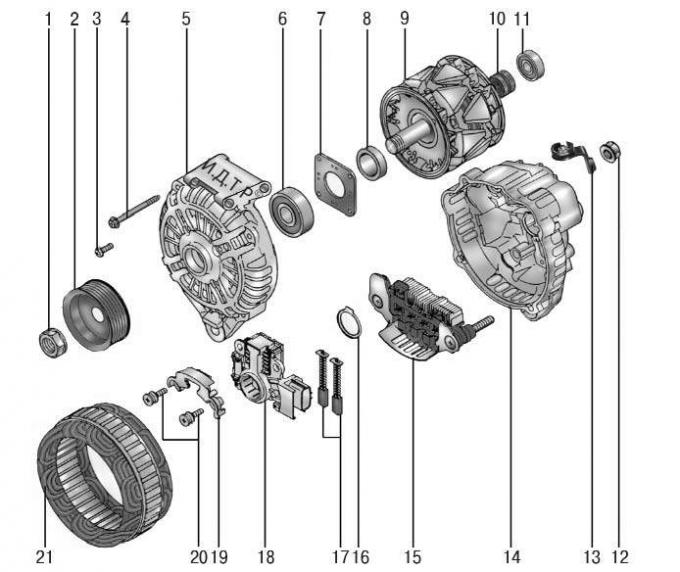
Fig. 10.2. Generator parts: 1 – pulley mounting nut; 2 – pulley; 3 – front bearing pressure plate fastening screw; 4 – generator cover tightening bolt; 5 – drive side cover; 6 – front rotor bearing; 7 – bearing pressure plate; 8 – distance ring; 9 – rotor; 10 – slip rings; 11 – rear rotor bearing; 12 – contact bolt nut; 13 – contact bolt terminal; 14 – cover from the contact ring side; 15 – rectifier block; 16 – sealing gasket; 17 – brushes; 18 – brush holder with voltage regulator; 19 – overlay; 20 – brush holder mounting screws; 21 – stator
Covers 5 (Fig. 10.2), 14 and stator 21 are pulled together by four bolts 4. Rotor shaft 9 rotates in closed-type ball bearings 6 and 11.
The generator stator is equipped with a three-phase winding, made according to the "triangle" scheme (phase windings have three attachment points).
The excitation winding is located on the rotor 9. The terminals of the excitation winding are soldered to two copper contact rings 10 installed on the shaft of the rotor 9. Power is supplied to the excitation winding through two contact brushes 17 and contact rings 10.
The contact brushes are located in the brush holder 18, combined in one housing with the voltage regulator.
The generator connections are shown in the electrical diagrams.
Depending on the engine model, generators of different power, but similar in design, can be installed on the vehicle.
Note: Codes of the occurring faults of the power supply system are stored in the memory of the electronic engine control unit. They can be read using a scanner at the service.
Note. Recently, many companies have appeared that specialize in repairing imported starters and generators. There, you can diagnose a faulty unit, purchase spare parts for any generator (starter) model, and get qualified advice. If you are not sure that you can repair a generator (starter) yourself, it makes sense to contact a company that will repair these units quickly, efficiently, and, as a rule, at an affordable price. However, on cars with high mileage, it is often more profitable to replace the unit as a whole with a new one than to replace the failed parts.
The original text is provided on an online resource FordBook