The operations for replacing oil seals are the same for all engines.
If it is possible to use a source of compressed air under a pressure of 0.7–1.0 MPa (7–10 kgf/cm²), then the oil seals can be replaced without removing the cylinder head from the engine. If there is no source of compressed air, the cylinder head will have to be removed, since on the engines in question, fixing the valves with mechanical devices inserted into the spark plug hole is impossible.
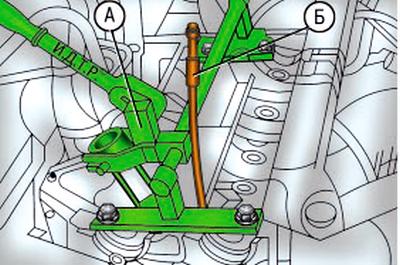
Fig. 5.31. Devices for removing valve springs: A – device for compressing springs; B – a device for supplying air to the spark plug hole.
You will need: all the tools needed to remove the cylinder head cover (see Replacing the cylinder head cover gasket), belt (see Checking and replacing the timing belt of the 1.6L Duratec Ti-VCT engine) or chains (see Replacing the timing chain of the 2.0 and 2.3 L Duratec-HE engines) of the timing gear, camshafts (see Replacing camshafts), as well as tweezers (or a magnetized screwdriver) for removing crackers from the valve spring plates, device A (Fig. 5.31) for compressing the valve springs, device B for feeding air into the spark plug hole (can be made from a faulty spark plug)…
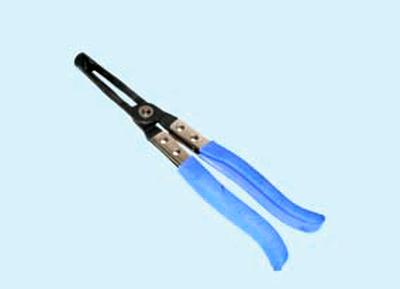
…tick-borne…
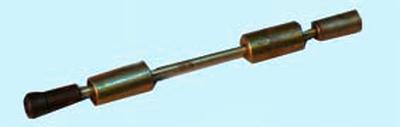
…or an inertial valve stem seal puller.
The puller shown has a mandrel on the other end for pressing the caps on. If you don't have such a puller, you'll need pliers to remove the caps and a mandrel of the appropriate diameter to press them onto the valve guides.
1. Disconnect the wire from the negative terminal of the battery.
2. Remove all spark plugs (see Replacing and servicing spark plugs).
3. Set the piston of the 1st cylinder to TDC (see Setting the piston of the first cylinder to the TDC position of the compression stroke).
This position corresponds to the BDC of pistons of the 2nd and 3rd cylinders.
NOTE: If the piston of the cylinder whose valve stem seals are being replaced is not at BDC, when compressed air is supplied to the cylinder, the engine crankshaft will turn and the vehicle may move (with gear engaged).
4. Remove the cylinder head cover (see Replacing the cylinder head cover gasket).
5. Remove the camshafts (see Replacing camshafts).
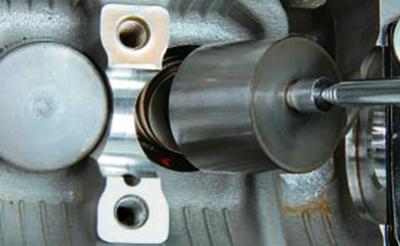
6. Remove the valve lifters of the cylinder whose oil seals you are replacing.
7. Install the valve spring removal tools on the 2nd engine cylinder as shown in Fig. 5.31.
8. Supply compressed air at a pressure of 0.7–1.0 MPa (7–10 kgf/cm²) to the spark plug hole of the 2nd cylinder.
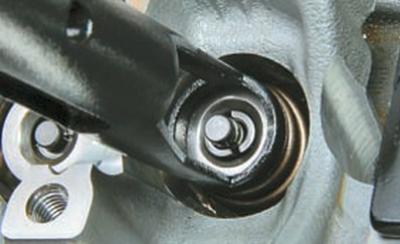
9. Compress the spring of one of the valves with the device…
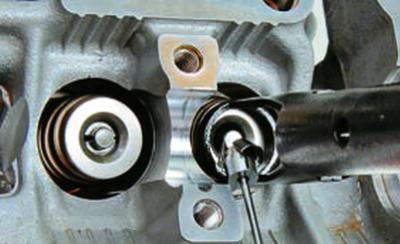
10….and using tweezers or a magnetized screwdriver, remove two crackers from the spring plate. Then remove the device.
WARNING: Once the crackers are removed, the valve is held in the up position only by air pressure. Do not release the pressure until the valve stem seal has been replaced and all parts have been installed, otherwise the valve will fall into the cylinder and the cylinder head will need to be removed to remove it.
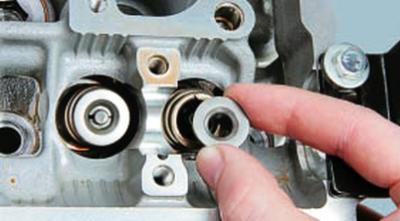
11. Remove the spring plate…
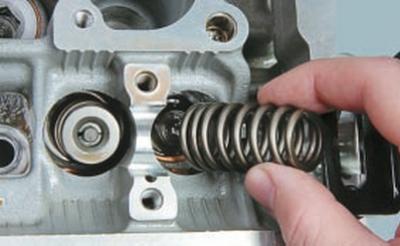
12….and a spring.
NOTE: If you are removing retainers and springs from multiple valves at the same time, the removed parts should be installed on the valves from which they were removed.
13. Press the valve stem seal off the valve guide sleeve. To do this, install the collet of the inertial valve stem seal puller on the seal and sharply hit the collet sleeve with the striker. Then, just as sharply hit the handle of the tool with the striker, thereby pressing the seal off the sleeve.
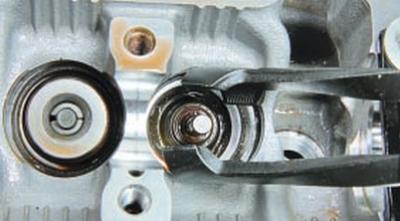
14. If there is no inertial puller, remove the cap with a special pliers-type puller or pliers, applying force strictly upwards and without turning the cap, so as not to damage the valve guide sleeve.
WARNING: Do not remove the cap by prying it from both sides with screwdrivers. The guide sleeve on which the cap is placed is made of metal ceramics and its edge easily chips off.
15. Before installing new valve stem seals, we recommend removing the springs from them, otherwise the caps can be damaged when they pass through the grooves for the crackers on the valves. If the new caps come with a plastic installation sleeve, you can leave the springs in place. In this case, put the sleeve on the valve stem.
NOTE: The original intake valve stem seals are painted green, and the exhaust valve stem seals are painted brown.
16. Lubricate the inside surface of the valve stem seal with engine oil and slide the seal along the valve stem to the guide sleeve.
17. Install the mandrel for pressing the cap. Press the cap in with light blows of the striker on the mandrel until it stops. If you do not have a special device, you can select a cylindrical mandrel of a suitable diameter and press the cap through it with light blows of a hammer on the mandrel.
HELPFUL TIP: You can use the long head from the tool kit as a mandrel.
You need to select a head with 12 faces and a chamfer inside the hole so that the head contacts the cap along a continuous circle.
18. Remove the guide bushing from the valve stem or place the spring on the cap if it was removed.
19. Install the spring and valve plate in the reverse order of removal. Install the crackers using the tool so that they fit into the grooves of the valve stem. After installing the crackers, hit the end of the valve with a hammer through a metal rod so that the crackers sit in place.
WARNING: If the cross-installed valve keepers are not secured, the loose valve will fall into the cylinder when the engine is started, causing serious engine failure.
20. Similarly, replace the oil seals of the remaining three valves of the 2nd cylinder and four valves of the 3rd cylinder.
21. Turn the crankshaft half a turn so that the pistons of the 1st and 4th cylinders are at BDC, and replace the oil seals of the remaining valves.
22. Install the removed parts in the reverse order of removal. After installing the camshafts and timing belt, check and, if necessary, adjust the valve clearances (see Adjusting valve clearances)
The article was taken in its entirety from the specified website: www.fordbook.ru