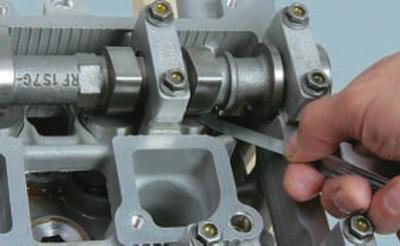
The clearance is measured with a feeler gauge on a cold engine (at a temperature of +20°C) between the camshaft cam (the cam should be directed upwards from the tappet) and the valve tappet. The nominal clearance for the intake valve is 0.17–0.23 mm, for the exhaust valve – 0.31–0.37 mm.
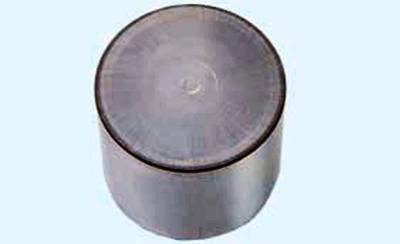
The clearances are adjusted by selecting the thickness of the tappets. Spare parts come in sets of tappets of different thicknesses.
In relation to the timing drive, the valves located on the right are exhaust valves, and those on the left are intake valves.
The work on adjusting the valve clearances is the same for all engines.
You will need: all the tools necessary to remove the camshafts, as well as a set of flat feeler gauges.
1. Set the piston of the 1st cylinder to the TDC position of the compression stroke (see Setting the piston of the first cylinder to the TDC position of the compression stroke).
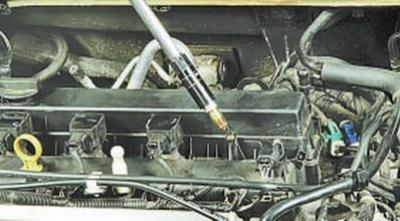
2. Remove all spark plugs.
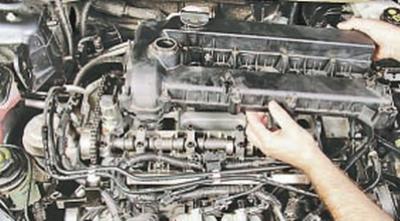
3. Remove the cylinder head cover (see Replacing the cylinder head cover gasket).
4. Use a feeler gauge to measure the clearances between the cams of both camshafts and the valve tappets of cylinder 1. Record the measured clearances.
5. Rotate the crankshaft by the bolt securing its pulley by 180° each time, measure and record the valve clearances of the remaining cylinders. The order of cylinder operation is: 1–3–4–2. It is necessary to replace the tappets of those valves whose drive clearances differ from the nominal values. After measuring all the clearances, set the piston of the 1st cylinder to the TDC position of the compression stroke.
6. Remove the camshafts (see Replacing camshafts).
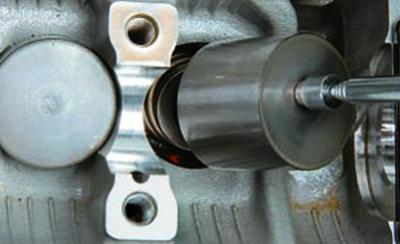
7. Remove the valve tappet that requires clearance adjustment from the cylinder head socket and record its thickness (it is indicated on the inner surface of the tappet).
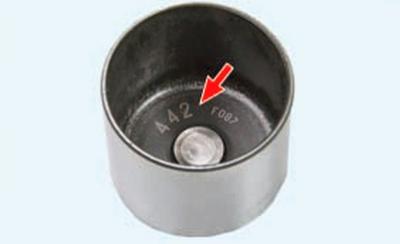
NOTE: The number stamped on the inside surface of the valve tappet is the tappet thickness. However, only three digits after the decimal point are stamped (e.g., the number "650" means the tappet thickness is 3.650 mm).
8. Calculate the thickness of the new tappet using the formula (all values in mm) H = B + A – C, where A is the value of the measured gap; B – thickness of the old pusher; C – nominal clearance; H – thickness of the new pusher.
9. Install the new pusher into place.
10. Similarly, replace the tappets of all valves that require clearance adjustment.
11. Install the camshafts, but do not install the timing drive yet.
CAUTION: Turn the crankshaft 90° counterclockwise until all pistons are in the center position.
12. Turn the camshafts by the hexagons made on them and measure the resulting clearances with feeler gauges. If the clearances differ from the nominal values, repeat the adjustment (see paragraphs 6–8).
13. If all clearances correspond to the nominal values, install the timing drive and all removed parts in the reverse order of removal.
The full article is on the online resource [fordbook.ru]