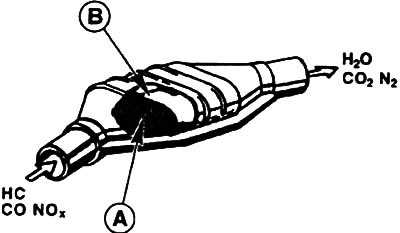
The catalyst consists of a ceramic honeycomb body "A" covered with a carrier. This carrier contains salts of noble metals, which ensure the conversion process. The insulating support layer "B" elastically holds the ceramic honeycomb body in the catalyst body. This support layer is made of extremely heat-resistant ceramic non-woven material.
Petrol engines
The injection system and the oxygen sensor precisely dose the amount of fuel burned so that the catalytic converter can reduce the content of harmful substances. The oxygen sensor is located in the front exhaust pipe, past which the exhaust gas flow passes. As for the oxygen sensor, we are talking about an electric sensor that shows the residual oxygen content in the exhaust gases based on voltage fluctuations and allows conclusions to be made about the chemical composition of the fuel-air mixture. The oxygen sensor can send the corresponding signals to the injection system control device in a split second, as a result of which the ratio between the amount of fuel and the amount of air constantly changes. Firstly, this is necessary because the operating conditions are constantly changing (idle, full throttle), and secondly, optimal neutralization in the catalytic converter occurs if the exhaust gases of the engine still contain a sufficient amount of gasoline.
In order for neutralization to occur in the catalyst at temperatures of 300-800°C, the fuel-air mixture must contain more fuel than is necessary for simple combustion.
As for the catalyst, we are talking about a so-called three-way catalyst. This means that in this catalyst, based on regulation by means of an oxygen sensor, the oxidation of carbon monoxide (CO), hydrocarbons (HC) and the reduction of nitrogen oxides (NO2) are simultaneously carried out.
Catalytic converter in a diesel engine
Diesel engines use serial catalysts. Here it is not possible to regulate the composition of the fuel-air mixture as it is done with the help of an oxygen sensor in petrol engines. The catalyst reduces the content of toxic carbon monoxides and hydrocarbons to the level that is achieved with the help of an adjustable catalyst in petrol engines. In addition, the hall, typical for diesel engines, is reduced. The higher content of nitrogen oxides, inherent in diesel engines, is reduced by an additional exhaust gas recirculation system, see item 7.
In vehicles with catalytic converters, certain operating rules must be strictly observed.