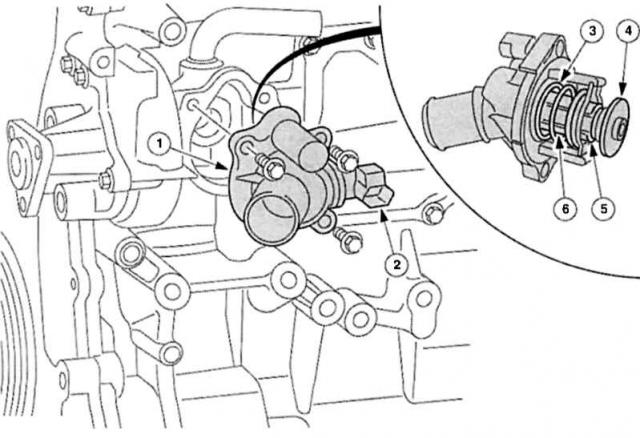
An experienced car enthusiast is quite capable of carrying out such work. When you are ready to begin, you can first relieve the operating pressure in the cooling system and prepare the necessary spare parts. You will need a thermostat (for Duretec engines, completely with the housing), a cover gasket for the thermostat housing, and an elastic and heat-resistant sealant. If necessary, collect the drained coolant in a clean container; it can be used, without hesitation, after the repair.
However, if you want to check the functioning of the old thermostat, heat water in a special pan and check the water temperature with a household thermometer. Read the regulation temperature on the thermostat body and compare it with the actual water temperature. Naturally, we do not advise you to completely rely on an "unkempt" thermostat. Electrically heated Mondeo thermostats can also be checked with a multimeter: measure the resistance between the two contacts - a well-functioning regulator has a resistance of 15 ohms.


| ORDER OF EXECUTION | ||
|
If the engine is "cooked", the cooling system fan is to blame
Your Mondeo's cooling system copes with smooth, long idling runs as well as with strenuous mountain crossings. However, if the temperature rises to the boiling point, it may not be the fault of the "striking" fan. So don't tow the car straight away: let the engine cool down and then drive quickly to the nearest workshop. Idling and slow driving in high gears are, of course, best avoided if possible. Your supposed caution is unnecessary, as it will lead to the engine heating up, since the radiator is no longer "facing" the oncoming wind.
Note: when the engine is stopped and heated while driving, the fan may operate even when the ignition is off.Therefore, never work near a fan! |
[The text was obtained in its entirety from the specified website FORDBOOK.ru]