Contents: When the engine is cold - small… ↳ When the engine is warm - a large… ↳ Constantly under pressure - the… ↳ Continuous monitoring of engine… ↳
Clearly visible: the coolant level in the transparent expansion tank next to the right shock absorber strut.
If you frequently add small amounts of water, check the system for leaks and add antifreeze closer to autumn.
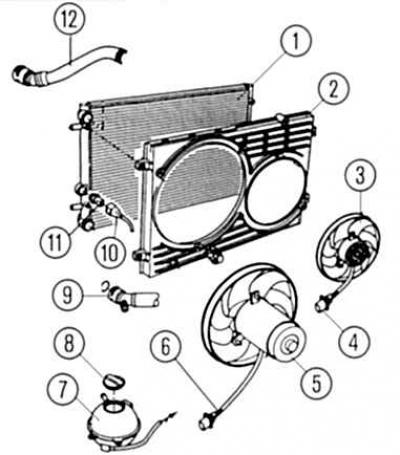
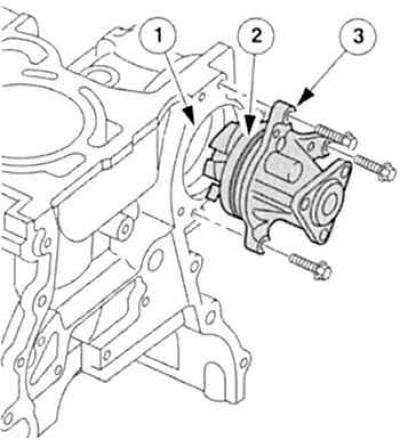
Under normal operating conditions, the cooling system of the Mondeo is always in a "healthy" temperature range. "Cooling" is a union of several units: the heat exchanger (radiator), water pump, cooling fan, thermostat, expansion tank, coolant pipes and hoses are just "extras" for the coolant, which does its job in the cylinder block and cylinder head "under constant pressure" in a filigree network of strictly proportional water channels, the so-called "water jacket". The excess heat energy from combustion stored in the water jacket is released into the atmosphere by the heat exchanger. The secret paths through which the coolant circulates in the Mondeo depend, of course, on the engine temperature and the current conditions of use.
When the engine is cold - small circle of coolant circulation
After each cold engine start, the coolant initially pulsates in a small circle, limited by the "water jacket" and the heater radiator. At this stage, the new Mondeo's electrically powered thermostat delays the flow to the radiator until the engine reaches its operating temperature.
This is an important reason. Since the circulating volume of liquid in the small circulation circuit is smaller, the engine thus reaches the required temperature earlier and emits less exhaust gas. As soon as the coolant has reached its operating temperature, the thermostat opens and the heated coolant passes in a measured manner from top to bottom through the heat exchanger. On this way through the radiator, it is "blown" by the oncoming wind, passing by the radiator segments, and takes away excess thermal energy.
The thermostat-coordinated interaction of the air and water elements protects the engine from both cold shock and hot collapse.
When the engine is warm - a large circle of coolant circulation
At normal operating temperature, the coolant in the Mondeo flows from the right radiator tank (relative to the direction of travel) to the water pump. From there it enters the cylinder block and the engine cylinder head: through the open thermostat, the bulk of the liquid flows back into the left radiator tank, the rest makes a "bypass" through the heat exchanger. The liquid flowing down from the bottom of the radiator automatically creates a place at the top for the heated liquid flowing in – the liquid circuit is closed. If the coolant temperature drops below the set operating temperature while driving, the thermostat closes until it warms up again.
"Circulation system economy": components of the engine cooling system in hydraulic "contact"
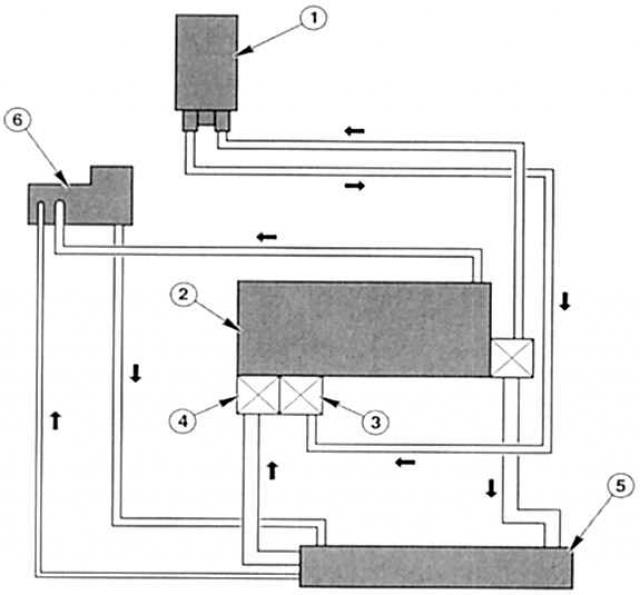 1 — Heat exchanger – heating,
|
Constantly under pressure - the cooling system
When the engine is running, the cooling system is constantly under a certain excess pressure. This increases the boiling point of the coolant from 100°C to approximately 120°C. High engine temperatures reduce fuel consumption and exhaust emissions. If the pressure in the cooling system exceeds 0.85 to 1.2 bar when the engine is hot – depending on the engine version – the pressure reducing valve on the shut-off cap of the expansion tank closes and the excess pressure in the cooling system escapes into the atmosphere. The vacuum that occurs in the system immediately balances the valve in the shut-off cap. As soon as it opens, outside air enters the tank and the pressure is equalised. In particular, when driving in the city or in stop-and-go mode, there is often no headwind, and the engine must be sufficiently cooled and protected from defects caused by overheating. For this special case, all Mondeos have an electrically driven fan located directly behind the radiator. This small wind power unit activates a thermal switch at a temperature of about 120°C. The fan automatically switches off again when the normal operating temperature is reached.
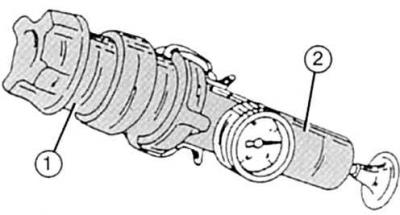 Reduce pressure: The cooling system is tested using a mechanical pump. 2 To do this, the pressure in the radiator or receiver is set to about 1.6 bar lower for about 5 minutes. The system pressure should drop by about 0.2 bar, otherwise the leak must be found and fixed. 1 Seal cap of the expansion tank. |
Continuous monitoring of engine temperature
If the engine temperature is constantly exceeded under maximum load, such as when towing a trailer, or due to other faults, the Mondeo engine will be protected from major engine damage by an overheating program installed in the drive control unit (PCM). At stage 1, the program only instructs the temperature indicator pointer to settle in the red range of the scale.
If you ignore this signal and the temperature continues to rise, the "drive failure" indicator light comes on on the instrument panel. In this case, be sure to let the engine rest for a while, it must cool down, and then you need to go to a Ford station. During this interim period, the control unit does not work, but it has recorded a fault code that can be read at the station by the diagnostic program. If you ignore both the indicator reading and the indicator light or accidentally miss it, the 2nd stage of the program comes into effect: the PCM deactivates two cylinders and limits the engine speed. At the same time, the indicator on the instrument panel will now warn before further engine damage.
To free up the engine during this critical phase, both "dead" cylinders suck in clean air at this time. To lower the temperature level as evenly as possible, the cylinders "rest" alternately. If you ignored stage 2, then stage 3 leaves you with exactly 30 seconds of time to stop your "hot" Mondeo on the side of the road. And to avoid major engine troubles, the PCM then simply switches off the engine.
| TECHNICAL DICTIONARY | |||
|