Every 16,000 km or 12 months.
1. This check should be performed when the engine is cool (at least 3 hours after the end of the trip). Check the entire exhaust system, from the engine to the tailpipe. It is best to raise the car on a lift for free access to the system, and if there is no lift, then raise and place the car on supports.
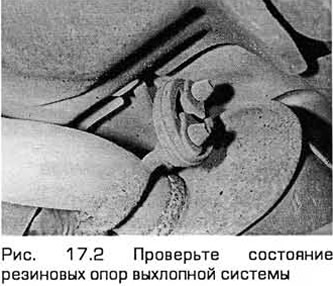
2. Make sure all brackets and rubber struts are in good condition and securely tightened (see Fig. 17.2). If any of the supports need to be replaced, use components of the specified type. Exhaust system struts are colored to indicate their heat resistance.
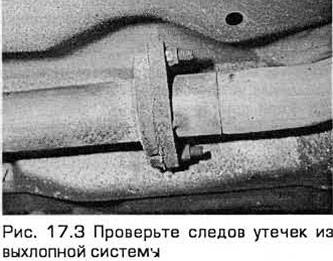
3. Check pipes and connections for leaks, significant corrosion or damage. Leaks through joints or other parts of the system will usually show up as a black deposit in the area of the leak (see Fig. 17.3). Note: Do not use exhaust system sealants in areas upstream of the catalytic converter (in the direction of the exhaust), even if such sealant does not contain additives harmful to the converter, since its particles can damage or clog the converter channel, causing local overheating.
4. At the same time, inspect the underbody for holes, corrosion, cracked seams, etc., as exhaust gases can penetrate into the interior through these defects. Seal all holes in the body with putty.
5. The exhaust system can often be the source of grinding and other noises because it can bounce on rubber struts. Try wiggling the system, muffler(s), and catalytic converter. If any of the components are touching the body or suspension components, the exhaust system will need to be installed on new struts.
6. Check the engine's working condition by inspecting the inside of the tail pipe. Deposits in this area indicate that the engine is not in perfect condition. The inside of the tail pipe should be dry, and its surface color should be between dark gray and light gray/brown. If it is black and covered with soot or white deposits, then the fuel system needs to be thoroughly checked.
(The original source of this article can be found at: FORDBOOK.RU)