


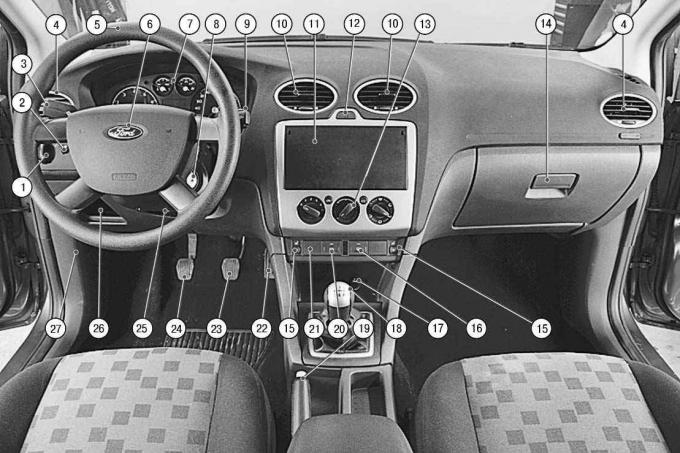
Fig. 1.7. Instrument panel and controls
The following controls and instrumentation are located on the instrument panel (see Fig. 1.7).
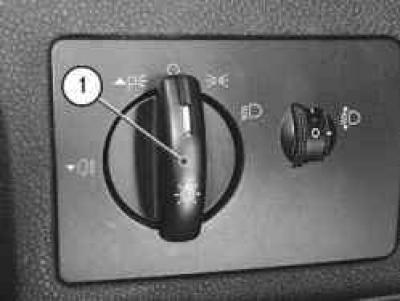
1 – Outdoor lighting switch. Turn the handle to select one of the following positions:
0 – external lighting off;
 – side lights are on;
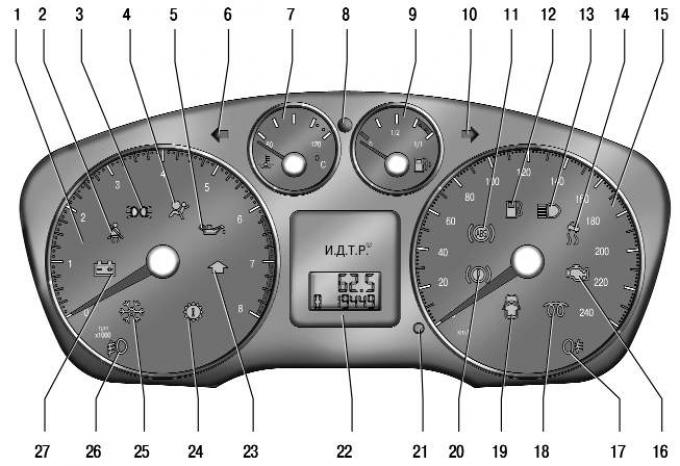
Fig. 1.8. Instrument cluster
NOTE: When the side lights are switched on, indicator lamp 3 lights up in the instrument cluster (see Fig. 1.8).
– low/high beam headlights are on;
NOTE: When the high beam headlights are switched on, indicator lamp 13 lights up in the instrument cluster (see Fig. 1.8).
AUTO — automatic mode for switching on low beam headlights depending on the illumination (on vehicles equipped with an automatic low beam switching system);
NOTE: For the automatic low beam mode to operate, the ignition must be on (the key in the ignition switch must be in position "II").
NOTE: In AUTO mode, the high beam headlights can only be turned on if the system has turned on the low beam headlights.
NOTE: In AUTO mode, the fog lights and headlights are not turned on. To turn them on, turn the switch knob to the position

 – parking lights are on. To turn on this mode, press the switch handle and turn it counterclockwise.
To turn on the rear fog light, turn the switch handle to the position
 and pull it out one position.
NOTE: When the rear fog light is switched on, indicator lamp 17 lights up in the instrument cluster (see Fig. 1.8).
To turn on the fog lights, turn the switch handle to the position
 and pull it out two positions.
NOTE: When the fog lights are switched on, indicator lamp 26 lights up in the instrument cluster (see Fig. 1.8).
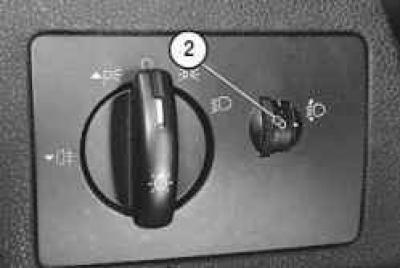
2 – headlight beam corrector regulator. By rotating the regulator handle, depending on the vehicle load, the angle of the headlight beam is changed in such a way as to prevent blinding oncoming drivers. Combining the mark on the regulator handle and the number on the scale ensures the appropriate adjustment of the headlight position for the following vehicle load options:
0 – one driver or driver and front seat passenger;
1 - all seats are occupied;
2 – one driver and cargo in the trunk;
3 – all seats are occupied and cargo is in the trunk;
4 – all seats are occupied, cargo is in the trunk, the vehicle is used with a trailer.
NOTE: When operating the vehicle with a trailer, it may be necessary to move the electric corrector regulator to one position higher (for example, instead of position 2, set position 3).
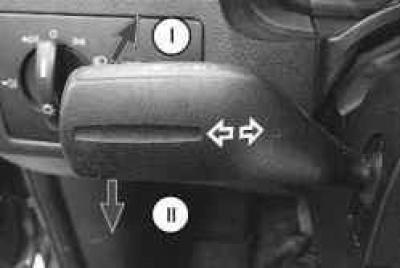
3 – lever for external lighting and direction indicators. The switch lever can occupy the following positions:
I — right turn signals are on (fixed position);
II — left turn signals are on (fixed position).
When the lever is moved to position "I" or "II", the control lamp 10 or 6 in the instrument cluster flashes (see Fig. 1.8). When the steering wheel is returned to the straight-ahead position, the lever is automatically reset to its original position. When changing lanes, to turn on the turn signal, simply press the lever in the direction of position "I" or "II" until you feel a noticeable resistance, without fixing the lever, and then release it. In this case, the turn signals will flash three times.
To switch between high and low beam headlights (the handle of the external lighting switch 1, shown in Fig. 1.7, must be in the position), move the switch lever towards the steering wheel by two positions and release it.
NOTE: When the high beam is switched on, indicator lamp 13 lights up in the instrument cluster (see Fig. 1.8).
To signal with high beam headlights, move the switch lever one position towards the steering wheel (the handle of switch 1 for external lighting, shown in Fig. 1.7, must be in the position) and release.
NOTE: When the high beam is switched on, indicator lamp 13 lights up in the instrument cluster (see Fig. 1.8).
If you move the switch lever one position toward the steering wheel and release it when the ignition is off, the headlight delay function is activated: the low beam headlights will turn on and turn off 30 minutes after the last door is closed. To turn off the headlights, move the switch lever one position toward the steering wheel and release it again.
NOTE: If the ignition switch is in the "0" or "I" position and the exterior lights are on, a buzzer will sound when the driver"s door is opened to remind you to turn off the lights.
Depending on the configuration, the lever may also have a SET/RESET button and a MENU switch. By turning the MENU switch, the required on-board computer menu windows or settings are selected, and the SET/RESET button is used to enter the submenu or adjust the settings.
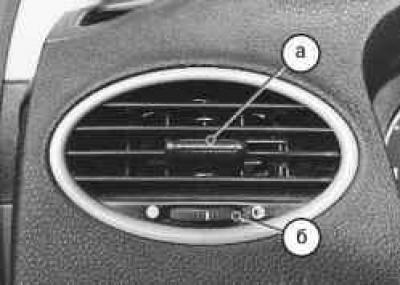
4 – side nozzles of the ventilation and heating system of the passenger compartment. They are designed to direct the air flow from the heater, air conditioner or ventilation system. The air flow direction is changed by moving the handle a, installed in the center of the nozzle, to the right and left or by turning it up and down. Under the grille, there is a handle b for adjusting the amount of air supplied through the nozzle. When the handle is turned all the way to the left, the damper is completely closed, blocking the air flow. When the handle is turned all the way to the right, the damper is completely open (maximum air flow).
5 – steering wheel.
6 – sound signal on/off key. To sound the signal, press the power button.
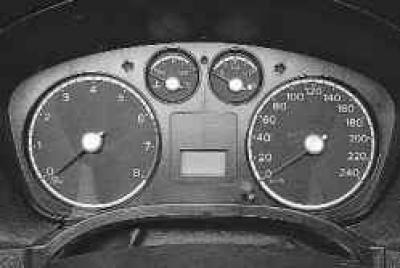
7 – instrument cluster (see "Instrument cluster").
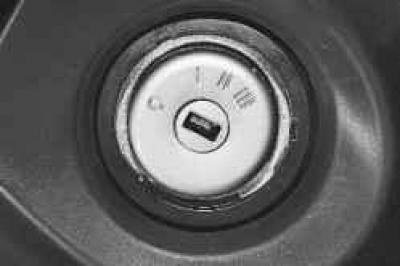
8 – ignition switch (lock), combined with an anti-theft device, is located on the right side of the steering column. The key in the lock can occupy one of four positions:
– 0 (lock) – ignition is off, anti-theft device is on when key is removed.
To ensure that the steering shaft is locked, turn the steering wheel to the right or left until it clicks.
To turn off the anti-theft device, insert the key into the ignition switch and, turning the steering wheel slightly to the right and left, turn the key to position "I";
WARNING: Do not switch off the ignition or remove the key while driving: the steering will be locked and the vehicle will become uncontrollable.
– I (additional equipment) – ignition off, key cannot be removed, steering is unlocked. Power circuits for horn, exterior lighting, high beam headlights, radio equipment, cigarette lighter, etc. are on.;
– II (on) – ignition on, key cannot be removed, steering is unlocked. Ignition, instruments and all electrical circuits are on;
– III (starter) – ignition and starter are on, the key cannot be removed, the steering is unlocked. This position of the key is not fixed, when released, the key returns to position "II" under the force of the spring.
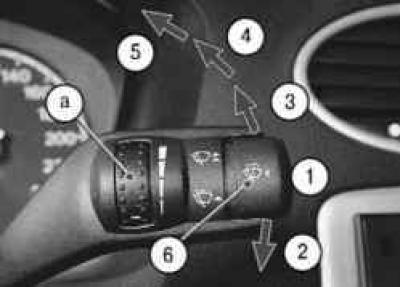
9 – Windshield and tailgate glass wiper and washer switch lever (on station wagon and hatchback vehicles) turns on electrical circuits when the ignition is on.
The lever can be moved to the following positions:
1 – windshield wiper off;
2 – the wiper blades will complete one cycle;
3 – intermittent windshield wiper mode is on. The delay time between cycles is adjusted by rotary switch a: extreme lower position – minimum interval between cycles, extreme upper position – maximum;
NOTE: Depending on the configuration, an automatic wiper may be installed instead of an intermittent wiper. In this case, setting the switch lever to position 2 activates the automatic mode. In this case, handle a adjusts the sensitivity of the rain sensor: the lowest position is high sensitivity (the wipers will turn on when there is a small amount of water on the windshield), the highest position is low sensitivity (the wipers will turn on when a large amount of water is detected on the windshield).
NOTE: Vehicles may be equipped with a windshield wiper that has a speed-dependent delay between wipes in intermittent mode. When the vehicle slows down or comes to a stop, the delay time between wipes increases by one notch. When vehicle speed increases, the delay time returns to the driver setting. Moving the lever while the wipers are operating will turn them off. If vehicle speed drops significantly or the vehicle comes to a stop, the system will reactivate.
4 – the first (low) windshield wiper speed is on;
5 – the second (high) speed of the windshield wiper is on;
6 – Washer button. When you press the button, the windshield wiper will automatically turn on along with the washer, and its brushes will perform several working cycles after you release the button.
NOTE: If the vehicle is equipped with headlight washers, pressing the button with the headlights on will also turn on the headlight washers.
When the lever is moved towards the steering wheel one position, the rear window wiper is turned on.
NOTE: The tailgate window wiper is activated automatically (depending on equipment) when reverse gear is engaged and the wiper lever is in position 2, 3, 4 or 5.
When the lever is moved towards the steering wheel by two positions, the rear window washer is turned on.
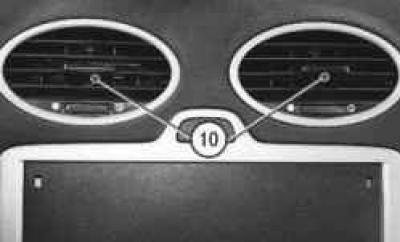
10 – central heater nozzles.
11 – place for installing a radio.
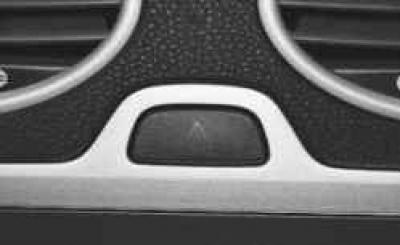
12 – hazard warning switch.
NOTE: The hazard warning lights operate in any position of the key in the ignition switch.
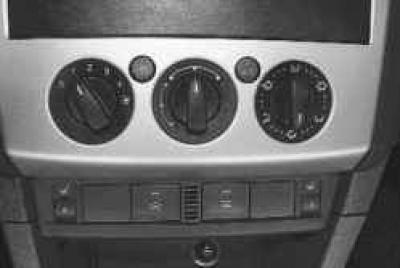
13 – control unit for the heating (air conditioning) and ventilation system of the passenger compartment, see "Heating (air conditioning) and ventilation of the passenger compartment".
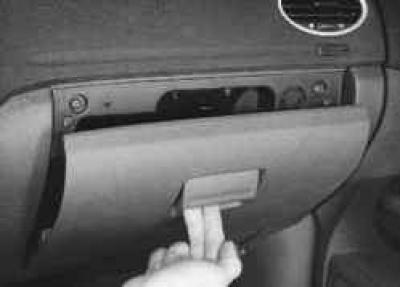
14 – storage box. It is used to store small items and opens by pressing the lock handle upwards.
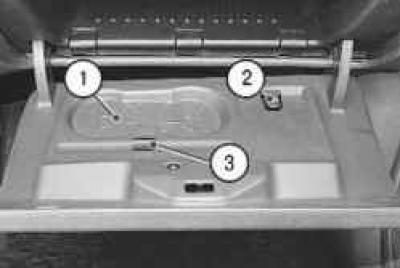
On the inside of the lid there are cup holders 1, a paper clip 2 and a pen clip 3.
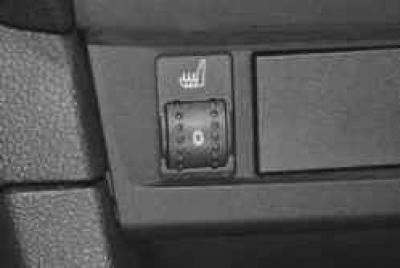
15 – Front seat heating controls (on the left - driver's, on the right - passenger's). Seat heating can only be turned on when the ignition is on (position "II"). When the regulator is set to position "0", the electric heating is off. In position "3" the maximum heating is turned on for quick heating of the seats in the cold season. Intermediate positions determine different heating intensities.
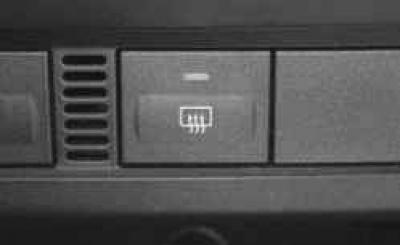
16 – Rear window heating switch.
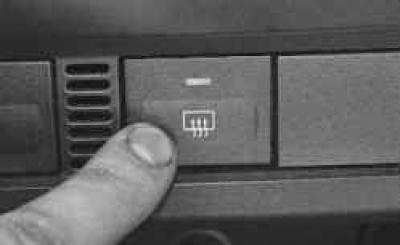
When you press the button (the key in the ignition switch must be in the "II" position), the rear window heating is turned on, and the indicator lamp in the button lights up at the same time. When you press the button again, the heating is turned off.
WARNING: The heating element consumes a very high current. Therefore, to avoid excessive battery discharge, turn on the electric heating with the engine running and only for the time required to eliminate fogging of the rear window.
WARNING: To avoid damaging the heater wires, do not use scrapers or other sharp objects, or cleaning agents containing abrasives, to clean the inside of the rear window.
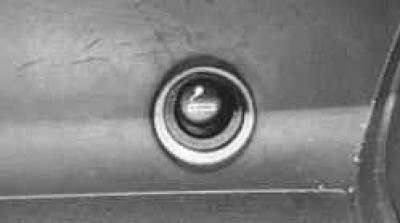
17 – cigarette lighter.
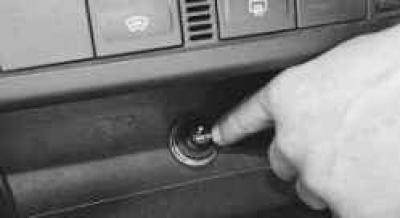
To use the cigarette lighter, press the button on its moving part (the key in the ignition switch is in position "I" or "II"). After the coil has heated for 10-20 seconds, the moving part will automatically return to its original position with a click.
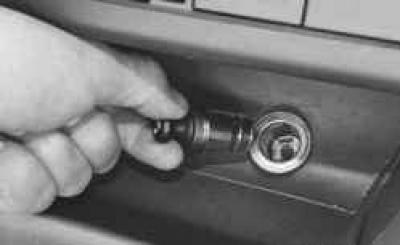
After this, remove the cigarette lighter for use.
WARNING: The cigarette lighter cannot be turned on again until 20 seconds have passed.
WARNING: Do not force the cigarette lighter to remain in the depressed position.
WARNING: Do not use the cigarette lighter socket to connect powerful electrical appliances (electric coffee maker, etc.) - this may damage the vehicle's electrical equipment.
WARNING: If the cigarette lighter button does not return to its original position within 30 seconds after switching on, remove the cigarette lighter from the socket to prevent the coil from burning out.
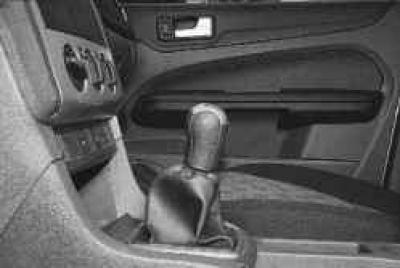
18 – gearbox control lever (see "Gearbox Control").
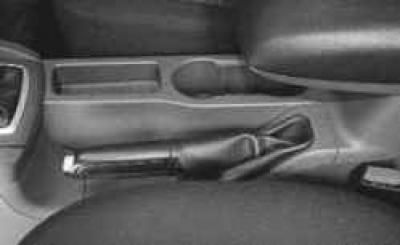
19 – parking brake lever.
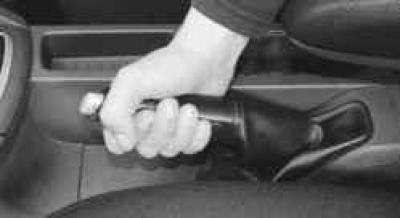
To apply the parking brake, lift the lever all the way up - the indicator light in the instrument cluster will light up red.
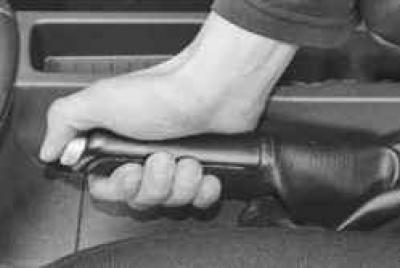
To release the brakes, pull the lever up slightly, press the button at the end of the lever handle and lower the lever all the way down - the indicator light should go out.
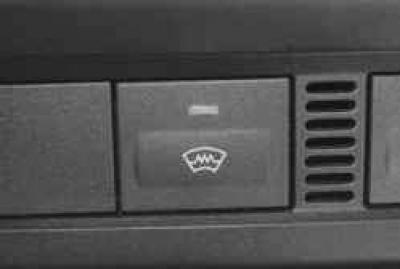
20 – Windshield heating switch. When you press the button (the engine must be running), the windshield and washer jets are heated, and the control lamp in the button lights up at the same time. When you press the button again, the heating is turned off. The electric heating also turns off automatically after a short period of time.
21 – ESP dynamic stabilization system switch(if any).
22 – accelerator pedal.
23 – brake pedal.
24 – clutch pedal.
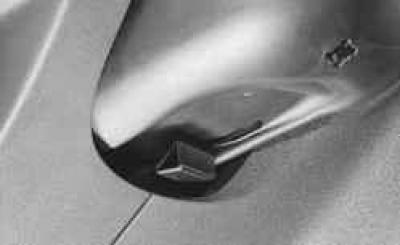
25 – steering column position lock lever (see "Adjusting the steering wheel position").
26 – shelf for small items.
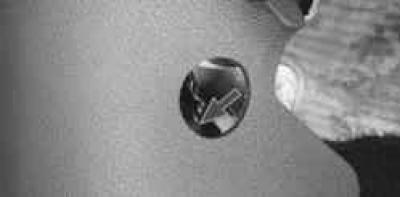
27 – emergency fuel shut-off button (on cars with gasoline engines).
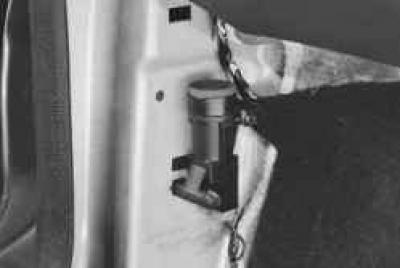
NOTE: This is what the emergency fuel shut-off button looks like (the side panel has been removed for clarity).