


Without sufficient lubrication, engines would seize up within minutes. That's why a very thin film of oil protects against destructive friction wherever moving parts in the engine come into contact with each other: for example, on pistons and piston pins, on cylinder running surfaces, connecting rod bearings and crankshaft main bearings, or in the entire valve train.
In order for the lubricant film not to "break", the oil circulates through a filigree labyrinth of tubes, channels and holes when the engine is running. The regulated circulation is provided by the oil pump, it sucks the engine oil directly from the crankcase and accelerates it inside the described labyrinth in the direction of the desired address. And in order for the oil to arrive there as "fresh" as possible, it first passes through an oil filter, which in the Focus is located almost immediately behind the oil pump right in the main flow of circulating oil. The oil filter separates soot particles, metal abrasion products and other foreign particles from the lubricant. It cleans as long as its microscopically thin paper plates retain permeability and are not contaminated.
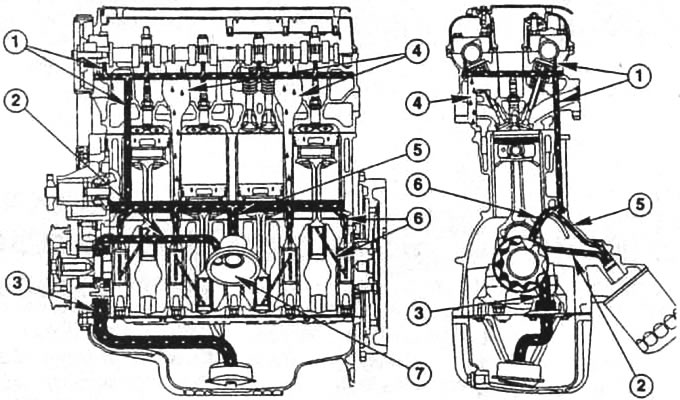
Lubricant circulation in Zetec-SE: 1 - lubrication channel to the cylinder head and to the valve mechanism; 2 - lubrication channel from the oil pump to the oil filter; 3 - oil suction pipe; 4 - oil recirculation channels to the oil pan; 5 - main lubrication channel; 6 - lubrication channel to the crankshaft bearings; 7 - oil filter connecting unit.
[The full article is on the online resource: FORDBOOK.RU]