ABS in combination with EBD is always standard on the Focus brake system. EBD uses the ABS sensors to detect the wheel speed. During braking, the rear wheels, which are monitored by EBD, are only given the brake pressure that always brakes with maximum deceleration force just before the locking limit. The system automatically takes into account each load condition, thereby shortening the braking distance, including the ABS control range. With up to 12 control intervals per second, ABS in the Focus corresponds to the latest state of the art. It ensures maximum deceleration without limiting controllability and forms the basis for the operation of ASR and ESP.
ASR brakes only individual wheels in the lower speed range. Above 50 km/h it additionally assists engine management by reducing torque through selective fuel diet of the cylinders and/or modified ignition timing until uniform traction conditions again prevail at the drive wheels.
Since 1999, Ford has been increasing the safety reserves of the Focus chassis with the optional ESP. ESP is an interactive system that reduces engine power and specifically brakes individual wheels using a progressive identifier. ESP's intervention provokes a yaw moment, which automatically stabilises the vehicle. The system works completely autonomously with the active brake force booster.
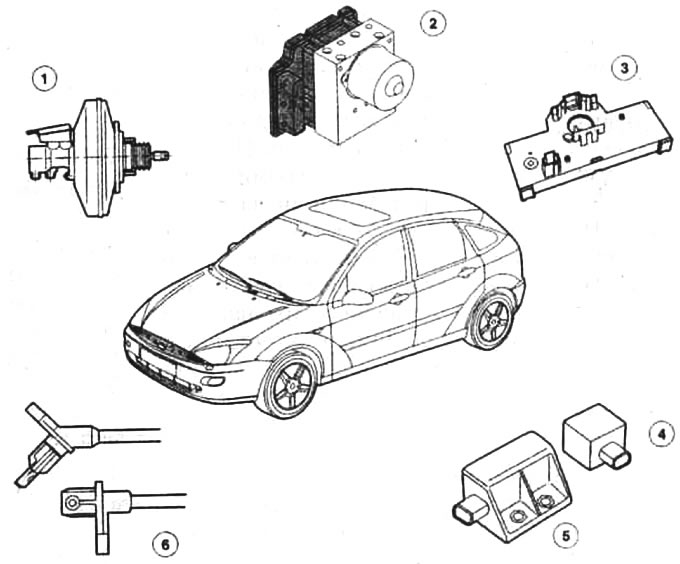
In the service of active safety: at an extra cost, invisible sensors keep the Focus reliably on its course with the help of the Electronic Stability Program (ESP). But if the driver ignores the limits of driving physics, even ESP will not help to avoid a run-off or a collision. 1 - Active Brake Booster with pressure sensors on the brake master cylinder; 2 - ESP module with electronic control unit and integrated ABS and TCS; 3 - steering wheel position sensor; 4 - Lateral acceleration sensor; 5 - yaw rate sensor; 6 - wheel speed sensors.
At this point we are quite deliberately repeating ourselves: ESP is powerless against "brainless" drivers: if the limits of the physics of movement are really exceeded, flying off the road is inevitable.
[The original article is posted at: fordbook.ru]