Contents: Front axle ↳ Rear axle ↳
Dual-circuit braking system: a braking system divided diagonally. Each brake circuit connects one front wheel to one opposite rear wheel.
Master brake cylinder (MBC): converts the brake pedal travel into hydraulic force. When the brake pedal is released, the pressure in the system immediately disappears.
Brake booster (servo brake): is located in the engine compartment in front of the brake master cylinder. Each time the brakes are applied, it increases the mechanical force of the pedal by approximately 60%. In vehicles with ESP, an active brake booster is installed. As soon as the electronic stability program is triggered in the Focus, the electromagnetic valve in the brake booster is activated. Due to this, a pressure of approximately 10 bar is created on the back of the membrane, without the brake pedal being pressed. The brake boosters draw their energy via a hose directly from the intake manifold or a separate vacuum pump (diesel engine). During the braking process, the membrane, connected to the piston rod of the brake master cylinder, reacts to the pressure difference between atmospheric pressure and the reduced pressure in the intake manifold.
Wheel brake cylinder (WBC): the brake fluid pressure in the KTC can reach 120 bar. The KTC pistons transmit the pressure through a system of pipelines to the pistons with free travel in the brake collets (disc brake) or to the wheel brake cylinders (drum brake). The piston stroke is transmitted in disc brakes to the brake linings or brake shoes in drum brakes.
Front axle
Brake disc: rotates synchronously with the axle hub. Removes friction heat into the atmosphere.
Brake caliper seat: the brake caliper seat grips the Focus brake disc like a fist. On its inner side is the brake piston.
The brake pedal is pressed: the system pressure created by the brake master cylinder acts on the piston in the brake caliper seat and presses the inner brake pad against the brake disc. Due to this, the brake caliper collet, mounted on the sliding bearings, moves inward and presses the outer brake pad against the brake disc in the same way.
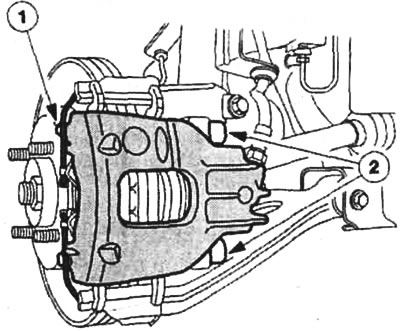
Disc brake with cam caliper: 1 - cam support; 2 - sliding pins.
The brake pedal is released: the hydraulic pressure suddenly disappears, the piston gasket pulls the piston together with the brake caliper seat away from the brake discs. A small gap appears between the brake pads and the disc - the brake disc rotates freely again.
Rear axle
Brake disc: rotates synchronously with the axle hub. Removes friction heat into the atmosphere.
Brake caliper seat: the brake caliper seat grips the Focus brake disc like a fist. On its inner side is the brake piston.