All disc wheels are made in the form of so-called deep rims with a hump. A hump is a projection pressed onto the rim shelf, which prevents the tubeless tire from coming off the rim even during extremely sharp turns of the car.
If tires and/or rims are installed that are not specified in the vehicle documents, a corresponding entry must be made in the documents. As a rule, permission from the vehicle manufacturer is required for this.
Note: The law requires that the permissible aspect ratio of the tyre pattern when worn be at least 1.6 mm. However, for safety reasons, it is recommended to replace summer tyres at an aspect ratio of 2 mm and winter tyres at an aspect ratio of 4 mm.
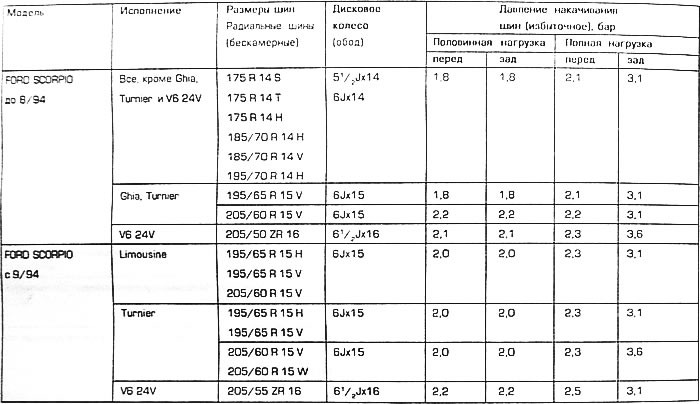
The tire inflation pressure is also given in the vehicle's operating manual.
Note: Technical improvement of vehicles continues. It may turn out that other inflation pressures and, accordingly, other combinations of tires and rims are allowed. In this regard, it is recommended to inquire about the current parameters of the wheels at the service station.
The inflation pressure for the spare tire should correspond to the highest inflation pressure when fully loaded for the rear axle.
When operating a vehicle with a sight, the tire pressure must be increased to the inflation pressure at full load.
For sporty driving, it is recommended to increase the excess pressure in the front and rear tires by 0.2 bar. When increasing, it is necessary to proceed from the basic value of excess pressure, standardized for different loads.
All inflation pressure data apply to cold tyres. Increased pressures resulting from a long journey, for example from 0.2 to 0.4 bar, do not need to be reduced. Winter tyres are generally operated at an inflation pressure of 0.2 bar higher; the inflation pressure recommended by the winter tyre manufacturer must be observed. Since winter tyres have a maximum speed limit, the instructions on the permissible speed in the driver's field of vision must be followed (§36. paragraph 1 of the Technical Requirements for the Operation of Non-Railway Transport - StVZO)
Caution: If the vehicle is driven at speeds above 160 km/h for a long time or continuously, it is necessary to increase the tire pressure in accordance with the recommendations in the table below. If the speed is exceeded for a short time, then it is not necessary to increase the tire pressure.
Increase tire pressure for long, high-speed travel
| Spiky execution/letter designation of speed | Long-term movement at a speed of km/h | Additional pressure increase for every 10 km/h, bar |
| H.V.W.ZR | from 160 to 190 | 0.1 |
| H.V.W.ZR | from 190 to 210 | 0.2 |
Wheel and tire sizes / tire inflation pressure
(The text is available on the specified website info portal: FORDBOOK.RU)