Note: If the vehicle pulls to one side or makes strange noise when braking, check the condition of the brake pads.
1. Place the vehicle on a lift or jack (stands).
2. Remove the front wheel.
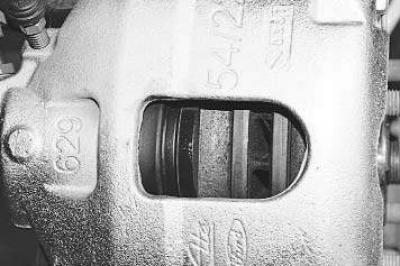
3. Check the condition of the brake pads through the hole in the brake caliper housing. If the thickness of the friction linings is less than the permissible value (Table 4.4), replace the brake pads (see "Replacing the brake pads of the front wheel brake mechanism").
Table 4.4. Dimensions of brake pads, discs and drums, mm
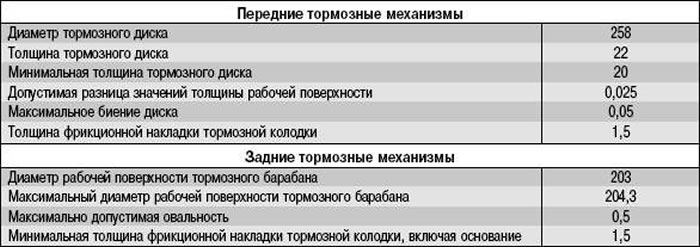
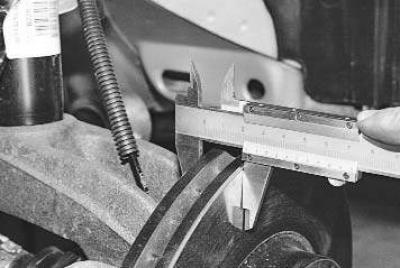
4. Measure the thickness of the brake disc. If its thickness is less than the permissible value (see Table 4.4), replace the brake disc (see "Replacing the brake disc").
Note: On vehicles with rear disc brakes, check the brake pads and rear brake disc for wear in the same manner.
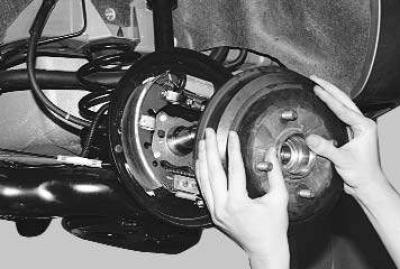
5. To check the degree of wear of the rear brake pads, remove the rear wheel and brake drum (see "Removal and installation the brake drum").
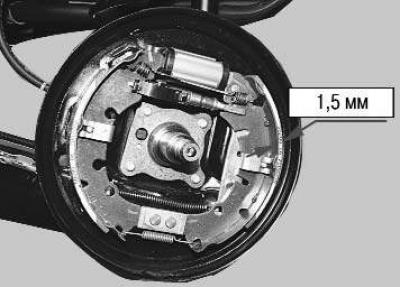
6. Measure the thickness of the friction lining together with the base. If the thickness is less than the permissible value (see Table 4.4), replace the pads (see Table 4.4). "Replacing the rear brake pads").
Note: Replace the pads in the following cases:
- the thickness of the friction linings is less than 1.5 mm;
- the surface of the linings is oily;
- the pads are not firmly connected to the base.
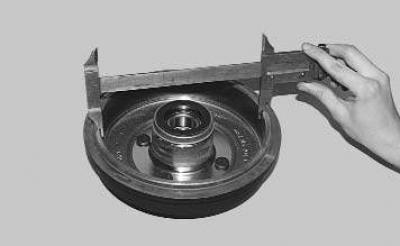
7. Measure the diameter of the working surface of the brake drum. If it is larger than the permissible value (see Table 4.4), replace the drum (see "Replacing the brake drum").
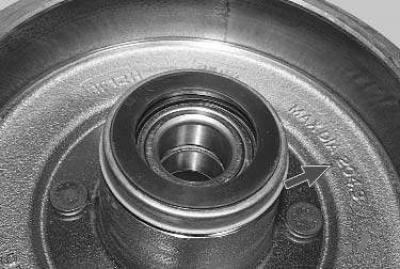
Note: The maximum allowable working diameter of the brake drum is stamped on its inner side.