In Mondeo models with a manual transmission, the engine is separated from the gearbox by means of a single-plate dry clutch at every gear change – a proven solution for decades. For those who work on their own, the single-disk dry clutch has, of course, the disadvantage that worn parts, such as the driven disk or the clutch release bearing, are not found in the event of a repair «in sight». In the Mondeo, this requires separating the gearbox from the engine and dismantling it: a job that requires serious knowledge and special tools. Our advice: better hand over the job of replacing the clutch to a specialist workshop.
Teamwork
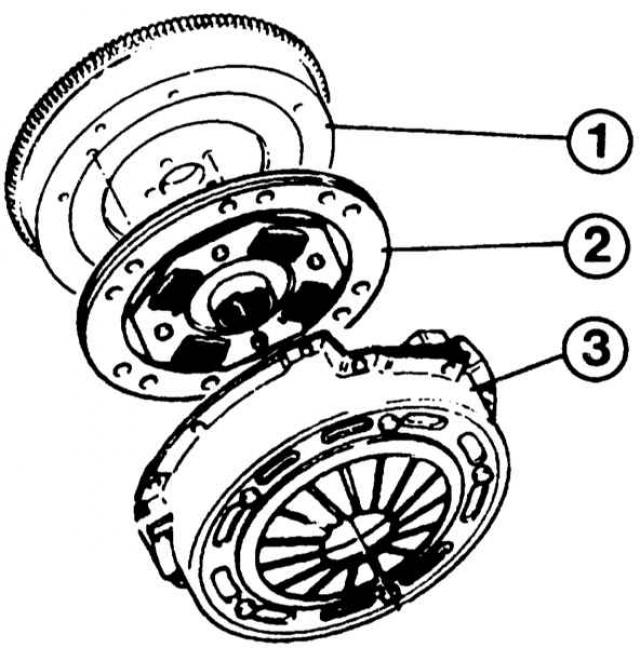
clutch consists of flywheel 1, clutch disc (slave drive) 2 and clutch pressure plate (automatic clutch drive) 3. In all Mondeos with a manual transmission, the clutch pressure plate has a diaphragm spring. |
Clutch in detail
Engine Flywheel: rotates with the crankshaft and is firmly connected to it.
Clutch disc (driven disk): is located on the input shaft of the gearbox and rotates with it, can move longitudinally. On both sides «steel disk» riveted friction pads. The outer diameter of the clutch disc in Mondeo, depending on the engine used, is different: 1.8 l / 2.0 l Duratec-HE = 228 mm; 2.5 L Duratec-VE/DuraTorg-DI = 240 mm.
Clutch pressure plate (hydraulic clutch drive): firmly screwed to the engine flywheel. Presses the floating clutch disc against the flywheel with a Belleville spring.
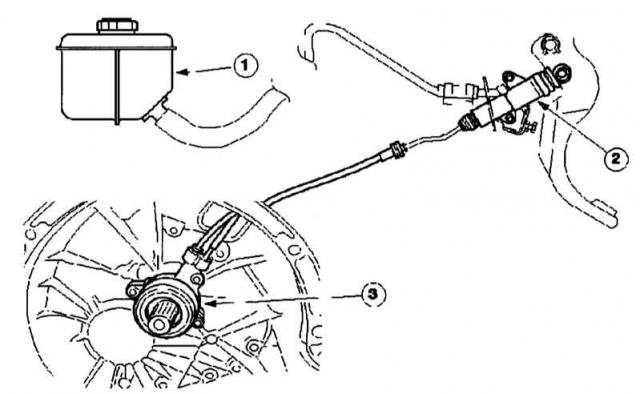
Clutch Release Bearing: (in all Mondeo models built directly into the clutch slave cylinder). It is located axially and moves on the shutdown shaft. Transfers the downforce generated by the clutch pedal to the clutch pressure plate belleville spring. Due to this, the clutch pressure plate is released - the driven disc loses downforce on the engine flywheel.
Adjusting machine: in all Mondeo models, the hydraulically operated clutch automatically adjusts the prescribed clutch pedal play. Therefore, cumbersome adjustment work is not necessary. As soon as the clutch in your Mondeo is slipping, assume that it is due to be replaced or possibly stuck «only» primary pressure valve.
Closed-loop hydraulic system: Mondeo clutch operation
|
TECHNICAL DICTIONARY |
How does the clutch work?
Clutch clearance: with an unloaded clutch pedal, the clutch release bearing maintains the distance from the clutch pressure plate. Similar to the wear of the clutch disc, the clutch gap, with increasing mileage, always becomes smaller: the disc spring of the pressure plate approaches the clutch release bearing. Once the bearing is «without gap» against the cup spring, the pressure plate is released. The clamping force of the driven disk to the adjacent surfaces of the flywheel and the pressure disk is automatically reduced as a result. If the gap can no longer be corrected, then the clutch can no longer transmit engine torque without slipping into the gearbox - the engine flywheel does not touch the driven plate.
Disconnection: If you press the clutch pedal, then with the help of the clutch release bearing, the elasticity of the pressure plate is weakened. It is released and - when the clutch is fully released - is removed: the driven disc rotates freely between the pressure plate and the flywheel.
Clutch engagement: when the clutch is engaged, the clutch control practically leaks «reverse movement» separation process. The released disc spring of the pressure plate gradually presses the driven plate against the flywheel. At this stage, the friction pads briefly slide over the flywheel and clutch pressure plate. With the clutch pedal disengaged, the downforce of the hydraulic actuator is finally so great that the flywheel even stops and the connection between the flywheel and the pressure plate becomes a reality. Now the power of the engine is fully transferred to the gearbox. |
|
|
PRACTICAL ADVICE |
«Murderer» clutch
Doubtful glory «the killers» clutch hurries ahead of any motorist who quite calmly enrages his wagon «howling engine» and a slippery clutch: Clutch killers regularly stage their «heavy» pressing the clutch pedal «hot» drama between the clutch disc friction pads, pressure plate and flywheel, as temperatures build up around the slipping clutch, which quickly finish the clutch disc and pressure plate.
A driver who, while driving, constantly «parks» your foot on the clutch pedal, thereby paying for your comfort in equal measure by increased wear.
Another bad habit «the killers» clutch: instead of idling and applying the handbrake (parking brake), he keeps his car on slopes or in front of a red traffic light in the set first gear, while the clutch and gas pedals are «Aweigh». For this his «will thank» not only the clutch, but over time also the clutch release bearing, as well as the crankshaft adjusting bearing.
If you don't sympathize «killer» clutch, then before a red traffic light, it is better to disengage the clutch and set the first gear only when the traffic light switches to yellow light. And while driving, put your sole - between gear changes - next to, and not on the clutch pedal. |
|
Visitor comments