The gearbox, designated CD4E, is an electronic 4-speed automatic transmission for front-wheel drive vehicles. The CD4E automatic transmission works together with a clutch to lock up the torque converter and a push-button accelerator. Two rows of planetary gears, connected one after the other, implement the corresponding gear ratios - three multi-plate clutches, one multi-plate brake, one brake band and a roller freewheel mechanism reproduce the drive and braking functions. The drive torque passes through a cascade of intermediate gears before it reaches the final drive.
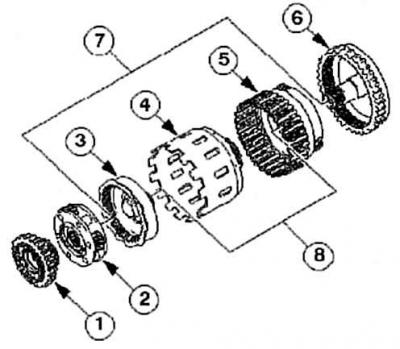
Shifting without interruption of traction force: planetary gear
 |
|
1 - Sun gear, 1-/2-gear,
|
5 — Planetary gear carrier, reverse/4th gear,
|
Mondeo automatic gearbox – this is how the gearbox shifts
The Mondeo automatic gearbox changes gear ratios under load – like all automatic gearboxes – without interrupting traction. As a "clutch", the automatic operates a four-component torque converter with a locking clutch. The converter brings the following components "into play":
- planetary gear set,
- chain drive,
- planetary gear (main gear),
- bevel and side wheel differential.
It receives its instructions from an electronically controlled hydraulic mechanism.
The gear lever can be used to control six functions: P, R, N, D, 2, 1. In addition, the gearbox control switch gives you the option of "damping" the accelerator. In second and third gear, the driver of a Mondeo with this gearbox can also use the engine brake.
Position (P): In this position, no power is transmitted to the gearbox. The gearshift control shaft lever, which is connected to the camshafts, presses the parking cam on the parking wheel against the driven sprocket. This locks the final drive and the drive wheels are "blocked". For safety reasons, always apply the parking brake when the Mondeo is parked.
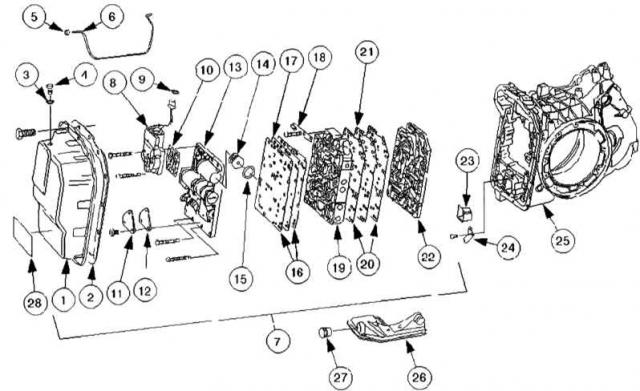
Central director's point: steering gear housing of the CD4E automatic transmission
 |
|
1 — Steering gear housing cover,
|
16 — Servo housing gaskets (intermediate plate, 2 pieces),
|
Position (R): In this position you are moving with a reduced gear ratio in reverse. The engine brake still operates in position R, however.
Position (N): as in position P, no force is transmitted to the gearbox. However, the final drive is not blocked by the parking cam - thus the wheels can rotate. You can also start your Mondeo in position N.
Position (D): in the D (DRIVE) position, during normal operation, all shifting processes (from first to fourth gear) and programs (clutch engagement and disengagement, locking clutch, fuel consumption optimization) occur automatically. Fourth gear (Overdrive) uses the engine brake and can be blocked on the gearshift lever by the transmission control switch. When Overdrive is off (TCIL indicator is on), the automatic system uses the engine brake of second and third gear.
Position (2): Position 2 'locks' 2nd gear after an automatic or manual downshift or upshift. Once you have pre-selected 2nd gear when stopped, your Mondeo starts off in 2nd gear – an advantage on slippery roads or in the presence of ice or snow. In position 2, engine brake action is given to 2nd gear.
Position (1): Position 1 represents the first stage. To protect the transmission from high speeds, the PCM ignores position 1 above 48 km/h. Of course, position 1 also provides the effect of the engine braking torque - these brakes help protect the car when driving in mountainous areas.
Shifting into high gear: To control shifting processes, shift pressure and locking clutch, the PCM processes various signals from a variety of sensors and personal driver commands.
Shifting to a lower gear: Under certain conditions, the transmission automatically downshifts to low range (without using the gearshift lever). There are three categories for automatic downshifts: forced idle, torque demand, and forced downshifts.
Forced idle mode: Shifting to low gears in the forced idle mode occurs when the vehicle manually applies the brakes in this mode.
Torque requirement: Downshifting to meet torque requirements is carried out automatically during acceleration under partial load; as soon as the torque requirement at this gear ratio exceeds the engine's capabilities, the engaged locking cylinder is deactivated to provide additional acceleration on occasion.
Enabling downshift (Kickdown): Downshifting for maximum acceleration can be achieved by fully depressing the accelerator pedal – at speeds below 88 km/h in second gear and below 40 km/h Kickdown causes a downshift to first gear.
Operating principle of the gearbox control switch and indicator: The accelerator can be switched off using the transmission control switch. The system automatically switches the accelerator back on as soon as the engine is restarted or the transmission control switch is switched on. This is visually indicated by the light on the instrument panel.
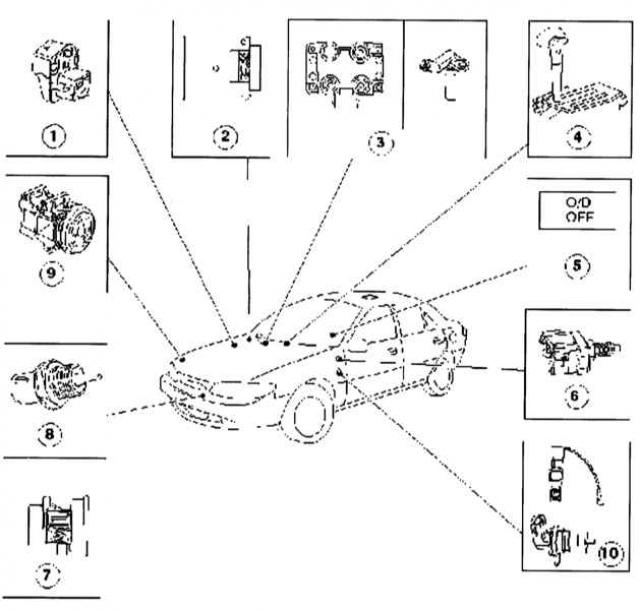
Assistants in the background: RSM reacts to them
 |
|
1 — Throttle position sensor (TP),
|
6 — Brake light switch,
|
Automatic transmission repair - no job for amateurs
Modern automatic transmissions are ahead of the call for increased reliability. And this can be said with good reason: since, as practice has shown, their failure, with proper operation, can hardly be caused by excessive wear. In other words: the appearance of an automatic transmission on the machines in Ford workshops is a very rare occurrence. Naturally, there are exceptions to this rule: when such units are "poorly maintained". As a result, they have to be returned to the factory for inspection.
This article was borrowed from the website www.FordBook.ru