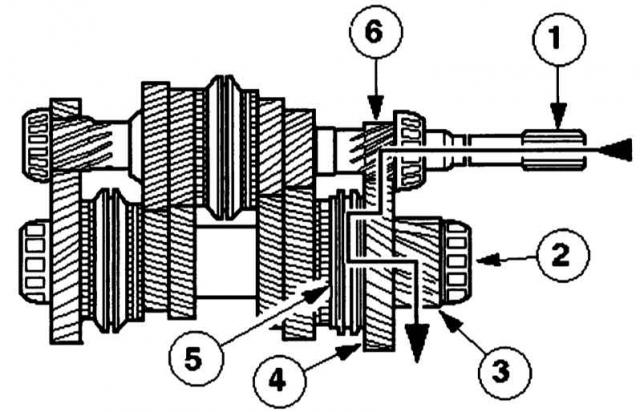
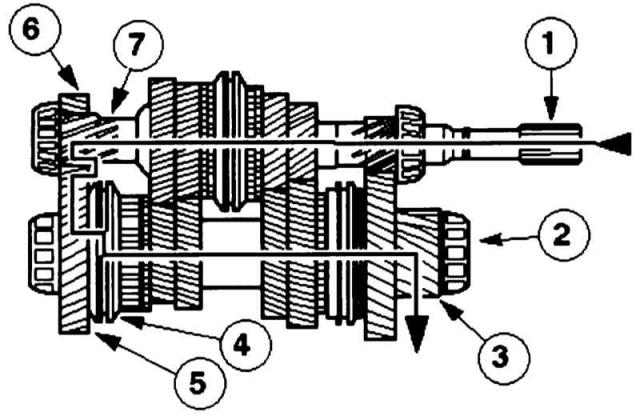
As standard, the Mondeo transmits its engine power to the drive wheels via a manually shifted five-speed gearbox (MTX-75). The MTX-75 gearbox is an old friend from the Ford unit stock: for example, it is also used by powerful Focus variants. The 2001 Mondeo "shifts and controls", of course, a thoroughly modified version of the MTX-75. For example, it has.
- new external gear shift levers,
- output shaft of a different design - the small gear here is a strong component of the shaft,
- gearbox housing matched to the new engine.
As before, the MTX-75 gearbox operates as a two-shaft design: the letter M stands for "manual", T for gearbox, X for front-wheel drive, and the number 75 characterizes the distance in millimeters between the drive and driven shafts.
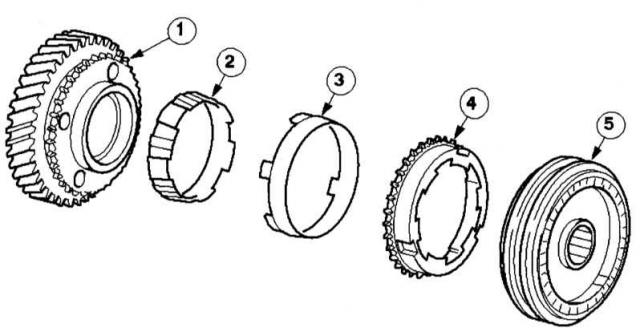
In neutral, none of the drive wheels are in contact with the drive or driven shaft: no torque is transmitted to the differential. Only one tapered roller bearing positions the drive and driven shafts on the clutch and gearbox sides at the corresponding halves of the gearbox housing. The small pinion of the driven shaft is in constant engagement with the cylindrical gear of the differential - this is a part of the driven shaft. The transfer gears - 1/3 gear and the synchronizer clutch - 1/3 gear are located on the drive shaft. The engagement for gears 1, 2 and reverse are parts of the driven shaft. The transfer gears 1/2/5 and reverse are located on the driven shaft. The engagement for gears 3 and 4, as well as the small pinion of the drive shaft, are parts of the driven shaft. Gears 1-3 have double synchronization. It consists of an internal synchronizing ring, a conical ring, an external synchronizing ring and a synchronizer body. The transmission wheel does not have a conical surface: synchronization is performed by means of synchronizing rings and a conical ring connected by a kinematic closure to the transmission wheel. In addition, the reverse stroke is also synchronized.
Dual synchronization standard for first three gears
 |
|
1 - Transfer gear,
|
4 - Outer synchronizing ring,
|
Gearbox repair – when in doubt, an option for a workshop
Depending on the engine options, Mondeo gearboxes operate with different gear ratios. According to practice, the automobile life of MTX-75 gearboxes is quite long. If you think that you have an exception to this rule, then it is better to go to a specialized workshop, since they use a special tool and at the same time require the appropriate competence and experience. If not, then there is no reason for false shame: many workshops send gearboxes subject to repair, as a rule, to their manufacturers for revision on stands or immediately replace them with exchange units.
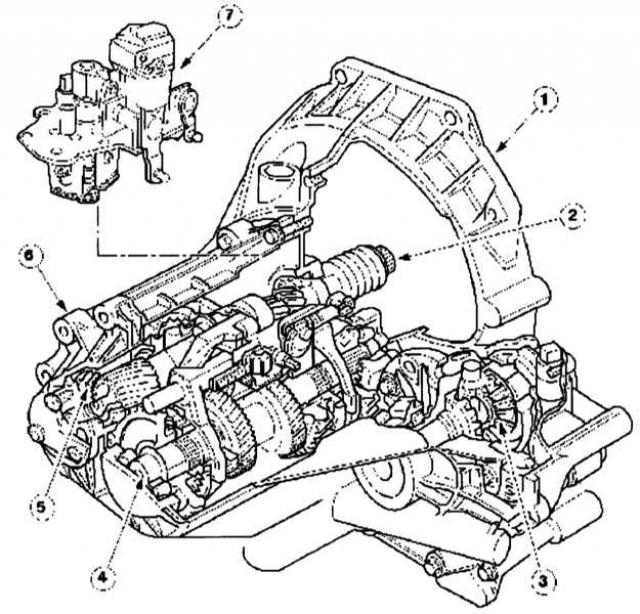
Modern gearbox design: mechanical gearbox MTX-75
 |
|
1 — Clutch housing,
|
5 - Intermediate reverse gear,
|
| TECHNICAL DICTIONARY | |||
|