Engine power distribution to the drive wheels: main gear
 |
|
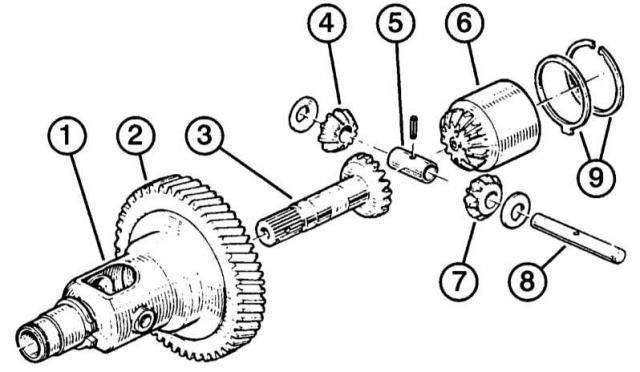
1 — Differential housing,
|
6 - Planetary wheel,
|
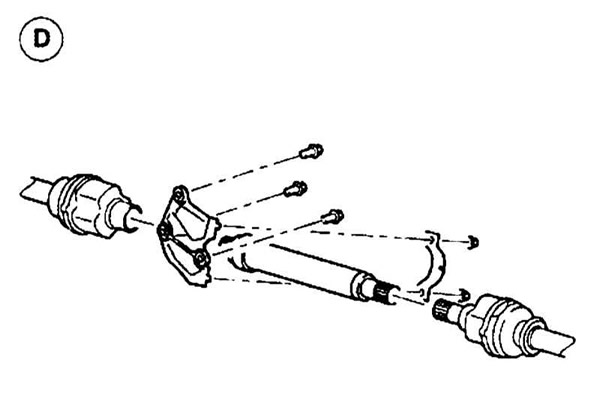
Differences in detail: drive shafts in the Mondeo
    |
|
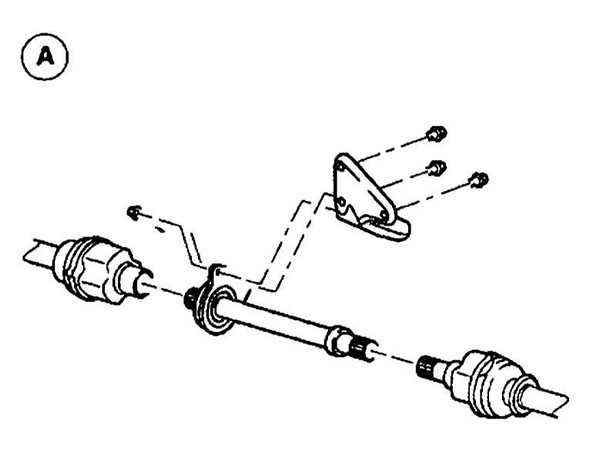
A - Duratec-VE (V6) with MTX-75 gearbox,
|
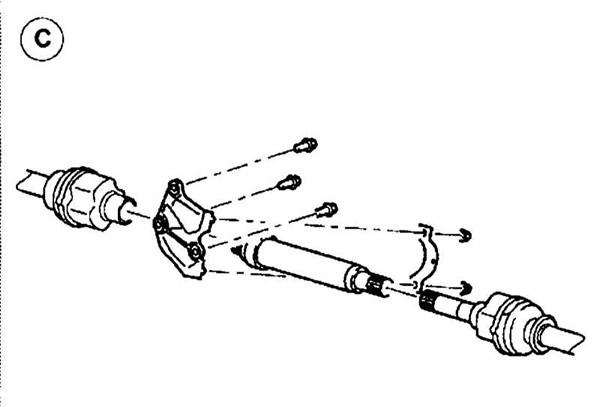
C — Duratec-HE with CD4E gearbox,
|
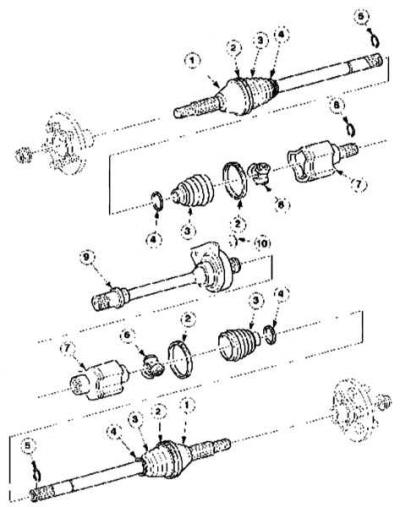
Overview: Duratec-VE Drive Shaft
 |
|
1 — Drive shaft with external constant velocity joint,
|
6 - Inner constant velocity joint,
|
The gearbox and final drive together with the differential are located in the housing. The power supplied from the engine to the gearbox is transmitted through the small and large pinion (the final drive pinion) to the final drive. The final drive pinion is connected to the differential housing. The drive shafts ultimately provide a connection with a force closure between the final drive and the wheel hub.
Main gear and drive shafts
Main gear: is located together with the differential and the manual or automatic transmission in one housing. The differential box contains four conical gears that mesh with each other, two of which are connected to the drive shafts.
Straight line movement: the front wheels rotate synchronously with the main gear. The differential rotates at the same speed, the bevel gears in the differential box "stand still".
Turning movement: the outer wheel in relation to the turn travels a greater distance backwards compared to the inner wheel (speed difference). If this difference were not compensated, the Mondeo would swerve strongly and the curve would be negotiated with the inner front wheel turning. The bevel gears prevent this effect; in the differential box, they take care of the necessary alignment: the bevel gear of the outer drive shaft, which rotates faster, exerts a braking effect via two intermediate bevel gears on the bevel gear of the drive shaft, which is related to the inner area of the curve. The necessary speed difference is neutralized by the difference in travel between the two front wheels.
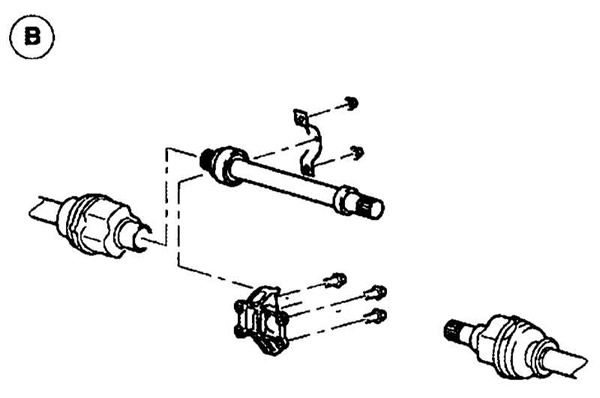
Power transmission to all wheels (from differential): depending on the engine-gearbox combination, Ford installs three different drive shafts on the left side and two on the right side in the Mondeo. They differ in their diameters and the flanges that connect to the gearbox. The outer joints cannot be replaced individually, but must be replaced as a set with the replacement drive shaft. Depending on the engine-gearbox combination, four different intermediate shafts with their own dimensions are used.
Constant velocity joint: such joints provide comfortable transmission of torque to the drive wheels. Since they, unlike the cardan joint, have fewer wearing parts, they are characterized by a long service life. On the gearbox side, the Mondeo drive shafts have a tripod joint (with a tripod star, running rollers and a tripod bell), on the wheel side, constant velocity joints are mounted (with a ball star, ball bearing separator and spherical shell). Constant velocity joints with difficulty transmit the actions of the drives to the steering wheel.
Drive shaft butts: rotate on the wheel side in two ball bearings in the steering gear pivot bearing. In contrast to the splined connection on the wheel hub side, the splined connection on the gearbox side has a slight twist, which reduces the clicking noise when starting off.
| PRACTICAL ADVICE | |
|
[For more information, please visit the specified website: Fordbook.ru]