Note: Check what replacement parts are available before performing any major repairs by referring to Section 1. Your Ford dealer, engine repair specialist, or parts supplier will be able to help you overcome any shortages of replacement parts.
1. Even if the main and connecting rod bearings are to be replaced with new ones during a major overhaul, the old bearings should be retained for careful inspection, which can provide valuable information on the condition of the engine (see Figure 18.1).
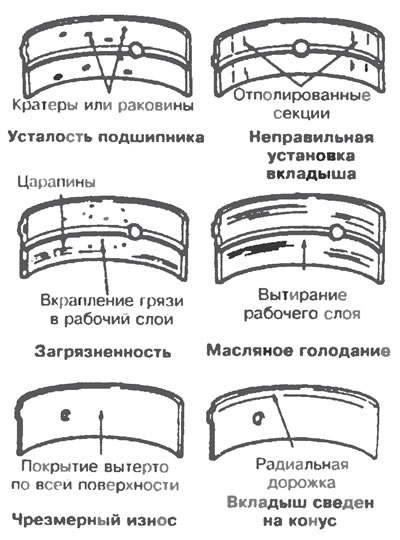
Figure 18.1. Inspect the main and connecting rod bearing shells, paying attention to the indicated defects.
2. Bearing defects can be caused by insufficient lubrication, dirt and other foreign particles, engine overloads, and corrosion. Regardless of the nature of the causes of defects, they must be eliminated before engine assembly to avoid recurrence of problems on the rebuilt engine.
3. For inspection, remove the bearings from the cylinder block, main bearing caps, connecting rods and connecting rod caps, and lay them out on a clean surface in the same positions in which they were installed on the engine. This will allow you to match the condition of the bearings to the corresponding crankshaft journals. Do not touch the working surface of the liner with your fingers when checking, as the thin surface can be easily scratched.
4. Dirt and other foreign particles can enter the engine in a variety of ways. They can be left in the engine during assembly, or enter it through filters or the ventilation system. Dirt can get into the oil and from there into the bearings. Metal shavings may also enter the engine, generated during mechanical processing during engine repair or as a result of engine wear during normal operation. Sometimes, after engine component remanufacturing procedures, abrasive material may remain in the engine, especially if the components were not cleaned using the recommended cleaning methods after processing. Regardless of how foreign particles enter the engine, they often end up embedded in the soft bearing material and are easily identified. Relatively large particles do not become lodged in the bearing, but leave scratches or nicks on the bearing or journal surface. The best way to eliminate the cause of this type of contamination is to thoroughly clean all parts and store them in a clean place during the engine assembly process. In addition, it is recommended to regularly change the engine oil and oil filter.
5. Insufficient lubrication (or cessation of lubrication) may also have various causes. Excessive heating (causing oil thinning), overloads (squeezing oil from the surface of bearings) and oil leakage or dispersion (in case of excessive clearances in bearings, wear of the oil pump or high engine speeds) cause lubrication problems. Blocked oil passages, usually caused by misalignment of the oil holes in the bearing shells, also cause oil starvation and bearing failure. If the bearing defect is caused by insufficient lubrication, the bearing's antifriction layer will be worn away or torn away from the steel bearing strip. In this case, as a result of friction, the liner tape can heat up to blue heat.
6. Your driving style also has a certain effect on the service life of bearings. Full throttle, low revs (engine jerking) lead to high loads on bearings and displacement of the oil film from their surface. Such loads lead to bending of bearings and the appearance of fine cracks on the bearing surface (fatigue deformation). Eventually, the bearing's working layer weakens and begins to separate from the steel bearing strip. Short-distance driving results in bearing corrosion due to the cold engine temperature not being sufficient to effectively remove water vapor and corrosive gases. When condensed, the gases penetrate into the motor oil, forming acid and sediment. Together with the oil, the acid is supplied to the bearings and corrodes their working layer.
7. Incorrect installation of bearings during engine assembly also leads to their damage. If the fit is too tight, the bearing clearance is insufficient, which leads to oil starvation. Getting dirt or foreign particles under the bearing shell also results in its damage. Do not touch the working surface of the liner with your fingers when checking, as the thin surface can be easily scratched.
(The original can be found on this resource: fordbook.ru)