Contents: Transmissions for traction forces ↳ "Separation" of the engine from the… ↳ Transmits engine torque -… ↳ The final drive before the drive… ↳
Mondeo selects gears using a cable.
In this chapter, you will learn how the Mondeo sends its engine power to the front wheels. The fuel transfer system, in particular, consists of the flywheel with clutch, gearbox and final drive. To ensure that all these components interact properly, they are connected by a precisely coordinated system of friction linings, shafts, bearings, gears and joints. How much power actually reaches the wheels depends primarily on the engine power of "your" accelerator. However, even the accelerator does little to help if the engine speed is not matched to the current speed – every internal combustion engine "obedient" only in a limited speed range. To theoretically help you "better understand your Mondeo", in the chapter Engines we have presented various power curves. If you want to move while saving fuel, then you need to accelerate quickly and quickly change to the next higher gear: try to constantly coordinate your speed with the gear at which the engine speed is close to maximum torque.
To ensure that torque and speed are as close as possible to each other, the Mondeo is assisted by a fully synchronized five-speed gearbox (MTX-75). In combination with the 2.0-liter V6 Duratec-HE engine, Ford offers an electronically controlled four-speed automatic transmission with accelerator and clutch for locking the torque converter (CD4E) as an alternative.
"Conductor's Baton": Gearbox Lever in Detail
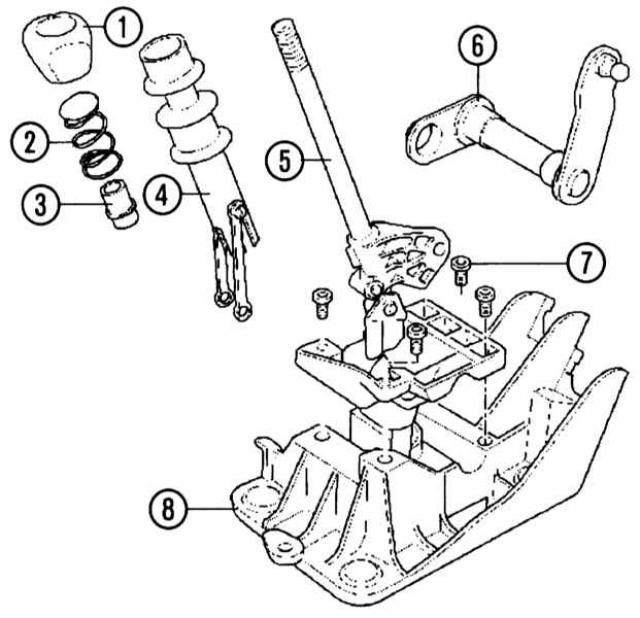 |
|
1 — Shift knob,
|
5 — Gear shift lever with the upper housing of the system of rods and gear shift levers,
|
Transmissions for traction forces
In order to accelerate smoothly from a "standstill", the drive wheels need as much torque as possible. If you have already looked at the power curves, then below 1500 rpm, at least for carburettor engines, the torque is not so good: with the help of the "quiet gear", first gear makes it easier for the engine to quickly jump to high revs and set the Mondeo in motion. When setting fourth - and even fifth - gear, unfortunately, everything is the other way around: in both gears, the "fast gear" comes into play. Compared to the speed of the drive wheels, the engine rotates leisurely high in these gears. In other words: the gearbox changes the engine speed closer to the desired speed of the drive wheels.
"Separation" of the engine from the gearbox - the clutch
During each start-up or gear shift, the power flow between the engine and the gearbox is briefly interrupted. In cars with a manual gearbox, the clutch is designed for this purpose. It ensures a "soft" start-up and smooth gear shifting by equalizing the different rotational speeds between the crankshaft and the gearbox drive shaft. The "play" between the planetary gears and the automatic gearbox is somewhat more wasteful. Each shifting process here occurs without interrupting the traction forces.
Transmits engine torque - hydraulically in the gearbox - torque converter
Instead of a conventional friction clutch, a hydraulic torque converter coordinates the process of starting off and "gear change". In the Mondeo, this is achieved by coordinating five electromagnetic valves, which, based on the common housing of the steering gear, form the "management" of the automatic transmission:
- pressure switching (by means of a pressure regulation mechanism in the pipeline),
- switching control (by means of a distribution valve with position control),
- modulated actuation of the torque converter - clutch override,
- control of the 3-2 switching process and...
- ... forced idle mode with engine braking function.
In this sector, the torque converter operates not only very comfortably, but also without mechanical wear – at least under normal loads.
Torque converter with clutch for locking up the hydraulic converter
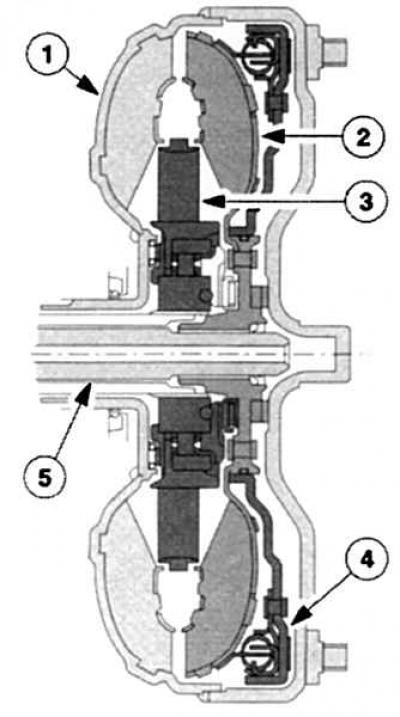 |
|
1 — Converter housing and pump wheel,
|
4 — Clutch for locking the hydraulic converter,
|
The final drive before the drive wheels is the final drive
The main gear is the last stage through which the torque generated by the engine passes on its way to the drive wheels. Its task is to convert the rotation speeds "coming" from the gearbox to "slow" ones, the torque as a result of which increases and is evenly distributed to the drive wheels.