Another sign of piston wear is piston knocking, similar to crankshaft noise, which must be distinguished from bearing knocking. It can be clearly heard at low engine speeds when there is no load (e.g., in idle mode), and is much less audible as engine speed increases. Piston wear usually occurs in the area of the skirt or lower end of the piston. It is also noticeable where the skirt thickness differs from normal.
Checking the piston ring gap using a feeler gauge
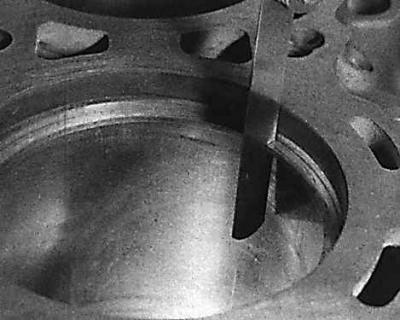
To check the wear of the piston rings, remove the rings from the piston, insert the rings into the cylinders from above, pushing them down approximately 40 mm using the piston (from which the rings were removed). Then measure the gap in the ring joints using a feeler gauge. If the gap exceeds the specified maximum, the rings need to be replaced.
Over time, the grooves in which the piston rings are located can also increase in size.
However, it is rare for a piston to be worn only in the ring grooves, and replacement is unlikely to be necessary for this reason alone. Whenever pistons are replaced, the weight of the four sets of pistons and connecting rods must be the same to maintain overall engine balance.
1. To remove the piston rings, carefully slide them towards the top of the piston so as not to scratch the aluminum alloy; never push them toward the piston skirt. Piston rings are easily damaged if removed carelessly, so this operation must be performed with extreme caution. Old feeler gauges can be used.
2. Lift one edge of the piston ring that needs to be removed from the groove and insert a feeler gauge under it.
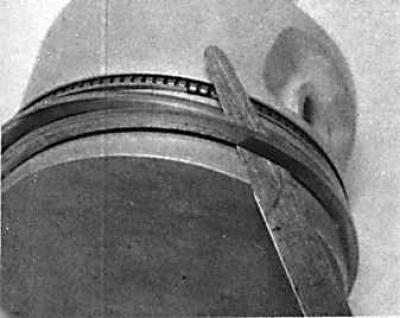
3. Slowly move the feeler gauge around the piston and when the ring comes out of its groove, remove it upwards, with the feeler gauge holding it from slipping into an empty groove, if there is one already.
4. Piston rings should always be removed through the top of the piston.
5. Check that the piston end grooves are clean.
6. The easiest way to install the rings is to use a feeler gauge and install the rings one at a time, starting with the bottom oil ring. The feeler gauge can then be moved down over the other piston ring grooves until the correct groove is reached. The piston ring is then slid off the feeler gauge into the correct groove.
7. Another method of inserting rings is to hold them between your thumb and forefinger. This method requires strong hands and great care, as the ring can be opened too much and broken.
[The text of the article was copied from the website: FordBook.ru]