You will need a ruler.
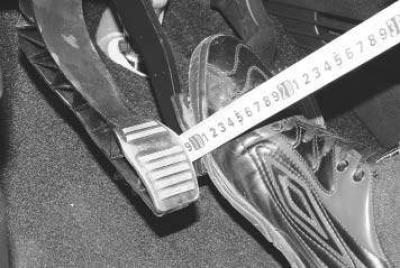
1. Press the brake pedal all the way down and measure the distance from the pedal pad to the floor.
Note: The ruler must be installed perpendicular to the floor plane.
2. Release the pedal and re-measure the distance from the pedal pad to the floor in a free state. This distance should be 140 mm. The difference in the dimensions obtained as a result of the two measurements is the full working stroke of the pedal, which should be 55 mm.
3. Check the free travel of the brake pedal by moving the pedal by hand until the pedal stops moving without resistance. Determine the free travel value using a ruler; it should be 3–8 mm. If the free travel does not match the specified value, it may be due to the following reasons:
- increased play in the connection between the vacuum booster pusher fork and the pedal. This may be due to wear on the fork pin;
- pistons seizing in the master brake cylinder;
- jammed plunger in the brake booster.
4. If the pedal travel is greater than the value given in paragraph 2, this indicates the presence of air in the brake hydraulic drive or the brake shoe linings, brake discs or drums are at their maximum wear. Remove air from the hydraulic drive (see ""Removal and installation the brake drum").
Warning! If the pedal is pressed all the way and held in this position and gradually moves to the floor, this indicates a fluid leak from the hydraulic drive or a malfunction of the master brake cylinder. These malfunctions are very dangerous, so immediately find the leak and fix it or replace the master brake cylinder!