If one of the circuits of the service brake system fails, the second circuit is used, ensuring that the vehicle stops with sufficient efficiency.
The hydraulic drive includes a vacuum booster. All vehicle configurations are equipped with an anti-lock braking system (ABS). Depending on the configuration, the vehicle is equipped with an emergency braking system (EBA) and a course stability system (ESP).
The parking brake system has a cable drive to the rear wheel brake mechanisms.
Front wheel brake mechanism disc, with automatic adjustment of the gap between the pads 2 (Fig. 9.1) and the disk 1, with a floating bracket. The movable bracket is formed by a support 3 with a single-piston working cylinder. The guide 4 of the pads is attached with bolts to the steering knuckle. The movable bracket is attached with guide pins screwed into the threaded holes of the pad guide. The guide pins are lubricated with consistent grease and protected by plastic bushings. A piston with a sealing ring is installed in the cavity of the working cylinder. Due to the elasticity of this ring, an optimal gap is maintained between the pads and the ventilated disk. When braking, the piston, under the influence of fluid pressure, presses the inner pad to the disk, under the influence of the reaction force, the caliper moves on the pins and the outer pad is also pressed to the disk, while the pressing force of the pads is the same. When releasing the brakes, the piston is moved away from the pad due to the elasticity of the sealing ring, resulting in a small gap being formed between the pads and the disc.
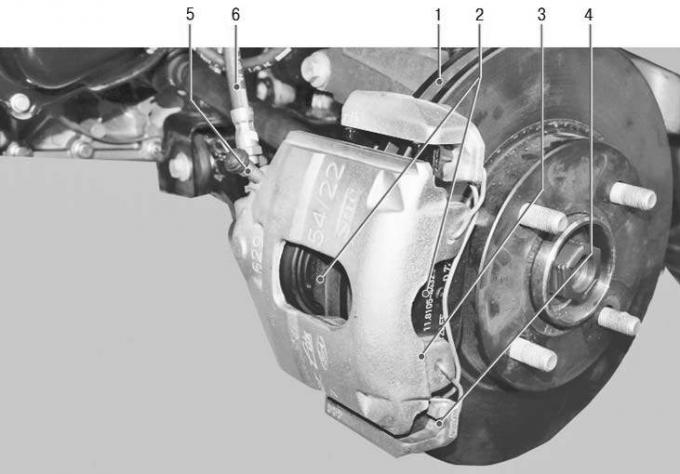
Fig. 9.1. Front wheel brake mechanism: 1 – brake disc; 2 – brake pads (the outer one is not visible, as it is covered by the caliper); 3 – brake mechanism support; 4 – shoe guide; 5 – air release valve; 6 – brake hose
Master brake cylinder 1 (Fig. 9.2) of the "tandem" type of hydraulic brake drive consists of two separate chambers connected to independent hydraulic circuits. The first chamber is connected to the right front and left rear brake mechanisms, the second - to the left front and right rear.
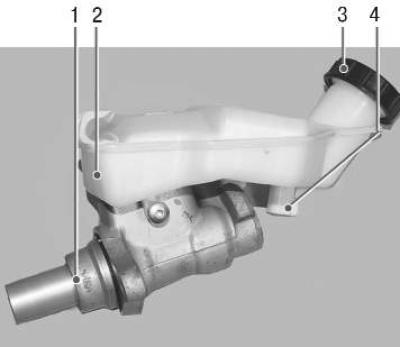
Fig. 9.2. Master brake cylinder: 1 – main brake cylinder; 2 – master brake cylinder reservoir; 3 – tank cap; 4 – brake fluid level sensor
A reservoir 2 is installed on the master cylinder via rubber connecting bushings, the internal cavity of which is divided by partitions into three sections. Each section supplies one of the chambers of the master brake cylinder and the master cylinder of the clutch release drive.
When you press the brake pedal, the pistons of the master brake cylinder begin to move, the working edges of the cuffs cover the compensation holes, the chambers and the reservoir are separated and the displacement of the brake fluid begins.
The brake fluid level sensor 4 is installed in the lower half of the tank body. When the fluid level drops below the permissible level, the brake system malfunction indicator light comes on in the instrument cluster.
Vacuum booster (Fig. 9.3), installed between the pedal mechanism and the main brake cylinder, during braking, due to the vacuum in the engine intake pipe through the rod and piston of the first chamber of the main cylinder, creates an additional force proportional to the force from the pedal.
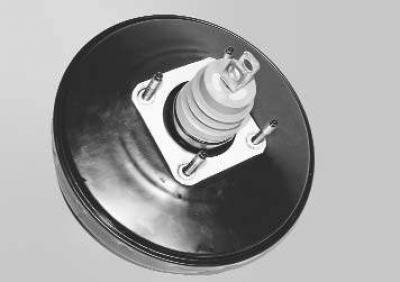
Fig. 9.3. Vacuum booster
A check valve is installed in the hose connecting the vacuum booster to the intake pipe. It maintains the vacuum in the booster when it drops in the intake pipe and prevents the fuel-air mixture from entering the vacuum booster.
Rear wheel brake mechanism drum, with automatic adjustment of the gap between the shoes and the drum. Brake shoes 1 and 11 (Fig. 9.4) are actuated by one hydraulic working cylinder 8 with two pistons. The optimum gap between the drum and the shoes is maintained by a mechanical regulator 9 mounted on a spacer bar 6. Some vehicles are equipped with disc brake mechanisms on the rear wheels, similar in design to the mechanisms on the front wheels, but smaller in size.
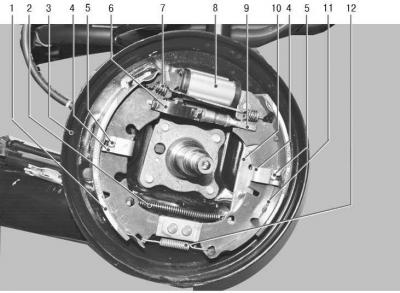
Fig. 9.4. Rear wheel brake mechanism: 1 – front brake shoe; 2 – parking brake drive cable; 3 – brake mechanism shield; 4 – brake shoe clamps; 5 – support posts; 6 – spacer bar; 7 – upper tension spring; 8 – working cylinder; 9 – clearance adjuster; 10 – parking brake drive lever; 11 – rear brake shoe; 12 – lower tension spring
Parking brake, which is driven mechanically, consists of a lever mounted on the base of the body between the front seats, a front cable with an adjusting device and equalizer, to which two rear cables are connected, and expansion levers 10 (see Fig. 9.4) installed in the drum brake mechanisms of the rear wheels. When moving, the expansion levers move the front brake shoe through the spacer bar until it stops in the brake drum and then, having received a rigid stop, press the rear shoe against the drum, blocking the drum. If the car is equipped with disc brake mechanisms of the rear wheels, they are provided with pivoting levers installed in the caliper. When the lever is turned, the piston of the brake cylinder moves and the shoes clamp the disk.
The parking brake does not require special maintenance. During routine maintenance, check the wear of the sector teeth and pawl. Replace excessively worn parts.
If the cable sheaths or wires are found to be broken, they must be replaced with new ones.
Anti-lock braking system (ABS) consists of wheel speed sensors, a brake light switch, a hydraulic unit, a hydroelectronic control unit and a warning lamp. In addition, the anti-lock braking system is equipped with a self-diagnosis system that detects component faults.
ABS is used to regulate the pressure in the brake mechanisms of all wheels when braking in difficult road conditions, which prevents the wheels from locking.
The ABS system provides the following benefits:
- avoiding obstacles with a higher degree of safety, including during emergency braking;
- reducing the braking distance during emergency braking while maintaining the vehicle's directional stability and controllability, including when turning.
In case of system failure, diagnostic functions and system failure support are provided.
The hydroelectronic control unit (HECU) receives information about the vehicle speed, direction of travel and road conditions from the wheel speed sensors. After the ignition is turned on, the ABS module supplies voltage to the sensors. The sensors use the Hall effect, they generate an output signal in the form of rectangular pulses. The signal changes proportionally to the rotation frequency of the pulse ring of the sensor, built into the front hub bearing seal and directly into the rear hub.
Based on this information, the ECU determines the optimal wheel braking mode.
The following operating modes of the anti-lock braking system are distinguished:
- normal braking mode. During normal braking, the electromagnetic valve is de-energized, the inlet valve is open, and the outlet valve is closed. When the brake pedal is pressed, the brake fluid under pressure is supplied to the working cylinder through the electromagnetic valve and activates the wheel brake mechanisms. When the brake pedal is released, the brake fluid returns to the main brake cylinder through the inlet and check valves;
- emergency braking mode. If the wheel starts to lock during emergency braking, the ECU issues a command to the electromagnetic valve to reduce the supply of brake fluid, then voltage is supplied to each electromagnetic valve. The inlet valve closes, and the supply of brake fluid from the master cylinder is cut off; the outlet valve opens and brake fluid flows from the slave cylinder to the master cylinder and then to the reservoir, causing a decrease in pressure;
- pressure maintenance mode. When the pressure in the working cylinder drops to the maximum, the ECU issues a command to the electromagnetic valve to maintain the brake fluid pressure, voltage is supplied to the input valve and is not supplied to the output valve. In this case, the input and output valves are closed and the brake fluid does not leave the working cylinder;
- pressure increase mode. If the ECU determines that the wheel is not locked, it de-energizes the electromagnetic valve. Voltage is not supplied to the electromagnetic valves, the brake fluid enters the working cylinder through the inlet valve, the pressure in which increases.
Special equipment and tooling are required to diagnose and repair the anti-lock braking system. Therefore, if it fails, contact a specialized service station.
Hydraulic brake system is united into a single whole by metal tubes and hoses. The system is filled with a special brake fluid of class not lower than DOT-4, which must be replaced periodically. The procedure for replacing the brake fluid is described in Section 4 "Replacing brake fluid in hydraulic brake and clutch release systems").
Checking the brake system is described in section. ""Maintenance".
Note. Some drivers, trying to wear out the parking brake cables less, try to use them less often. Such "savings" lead to the opposite result: the cable, rarely moving in the sheath, gradually loses mobility, it jams, and as a result the cable breaks. Therefore, use the parking brake in all cases when it is necessary.
Note. The free travel of the brake pedal with the engine off should be approximately 3–8 mm. Too little free travel indicates incorrect initial installation of the brake pedal or jamming of the working cylinder, causes increased fuel consumption and accelerated wear of the brake pads. Too much free travel is a sign of excessive clearances in the pedal mechanism or a leak in the hydraulic drive of the brake system. If the free travel decreases with repeated pressing of the pedal, i.e. it becomes "harder", there is air in the system. If the full pedal travel begins to increase, the system is leaky.
Note. If the brake pedal always starts to vibrate when braking, the brake discs are most likely warped. Unfortunately, in this situation, they only need to be replaced, and both at once. Periodically appearing and disappearing vibration of the pedal during sharp braking of a car equipped with an anti-lock braking system accompanies the operation of this system and is not a sign of a malfunction.
Note: If the car starts to pull to one side when braking, check the wheel cylinders: they may need to be replaced.
Note: If a knocking noise appears in the front suspension that disappears when braking, check the tightness of the caliper mounting bolts.
Note: After replacing the brake pads, be sure to press the brake pedal several times before starting to move - the pistons in the working cylinders should fall into place.